
Stelidota octomaculata
(Say, 1825)
Stelidota octomaculata is a small sap-feeding beetle in the Nitidulidae, to North America. overwinter in forest litter and feed primarily on acorns, particularly damaged or germinating ones, beginning in March. occurs in spring and early summer inside acorns both above and below ground. The has been described as a chemical '' but behavioral '' compared to its S. geminata, showing reduced locomotion rates and different -finding strategies. Laboratory studies indicate a of approximately 34 days at 22-26°C, with females producing up to 933 offspring.
Pronunciation
How to pronounce Stelidota octomaculata: /ˌstɛlɪˈdoʊtə ˌɒktoʊˌmækjʊˈleɪtə/
These audio files are automatically generated. While they are not always 100% accurate, they are a good starting point.
Identification
Distinguished from the congeneric and broadly sympatric Stelidota geminata by behavioral differences: S. octomaculata never exhibits phototactic and does not respond to food odors by flying to the source, whereas S. geminata readily displays both phototactic and -orienting flights. S. octomaculata also walks to odor sources at a significantly slower rate (0.16 cm/s versus 0.54 cm/s in S. geminata) and shows different turning frequency during upwind .
Images
Appearance
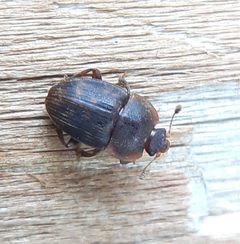
Small in Nitidulidae. Specific morphological details not provided in available sources. As implied by the epithet 'octomaculata' (eight-spotted), likely possesses eight distinct spots or markings, though this interpretation is not explicitly confirmed in provided sources.
Habitat
Forest with oak presence. overwinter in forest litter. Reproductive includes acorns both above ground on trees and below ground. Associated with environments where acorns are available for feeding and oviposition.
Distribution
to North America. Documented from Ohio and Pennsylvania in studies, with additional records from New Brunswick, Nova Scotia, and Ontario in Canada. GBIF records indicate presence across North America broadly.
Seasonality
active from March through early December, with peak reproductive activity in spring and early summer. ceases in late July to early August, though adult feeding activity may continue until early December.
Diet
Primary diet consists of acorns, particularly damaged acorns and undamaged germinating acorns. Laboratory studies demonstrated larvae can develop on acorns of all tested oak (Quercus) and seeds of 28 other plant species, indicating broad potential range under artificial conditions.
Host Associations
- Quercus - primary Acorns are the primary food source and reproductive substrate; both damaged and germinating acorns are utilized
Life Cycle
Complete . overwinter in forest litter. Feeding on acorns begins in March. occurs in spring and early summer inside acorns above and below ground. Laboratory rearing at 22-26°C showed completion in approximately 34 days. Maximum recorded female lifespan 238 days at room temperature.
Behavior
Exhibits distinctive -finding compared to : acts as chemical '' (responding broadly to fermentation cues) but behavioral '' with reduced locomotion rate and altered post-landing behavior. Never exhibits phototactic ; does not fly to food odor sources. Upwind to odor sources occurs at reduced rate with different turning frequency than related .
Ecological Role
Pest of acorns affecting oak and seedling establishment. Acorn damage caused by feeding may result in seedling failure. Role in broader forest as decomposer of damaged plant material and as prey for other organisms not documented in available sources.
Human Relevance
Considered a pest of acorns with negative impact on oak seedling establishment and forest . No other documented human interactions found in available sources.
Similar Taxa
- Stelidota geminataCongeneric with overlapping distribution; distinguished by behavioral differences including phototactic , -orienting flight , and faster upwind rate (0.54 cm/s versus 0.16 cm/s)
More Details
Laboratory rearing data
Maximum of 933 offspring per female recorded in laboratory conditions. completed in approximately 34 days at 22-26°C. Maximum lifespan 238 days at room temperature.
Chemical ecology
Both Stelidota octomaculata and S. geminata respond to all food substrates offered in no-choice assays without significant preference, indicating both function as 'olfactory ' at the chemical level. range restriction in S. octomaculata is mediated by behavioral and ecological factors rather than differential response to host odors.
Sources and further reading
- BugGuide
- Wikipedia
- GBIF taxonomy match
- iNaturalist taxon
- NCBI Taxonomy
- Sphingidae | Beetles In The Bush | Page 2
- The Moth and Me | Beetles In The Bush
- Saturniidae | Beetles In The Bush | Page 2
- Noctuidae | Beetles In The Bush | Page 3
- blog carnivals | Beetles In The Bush
- Bug Eric: June 2012
- Life history and notes on the biology of Stelidota octomaculata (Coleoptera:Nitidulidae)
- Chemical ‘generalists' and behavioral ‘specialists‘: a comparison of host finding by Stelidota geminata and Stelidota octomaculata