
Stelidota
Erichson, 1843
strawberry sap beetles
Species Guides
4- Stelidota adsuffusa
- Stelidota coenosa
- Stelidota geminata(strawberry sap beetle)
- Stelidota octomaculata
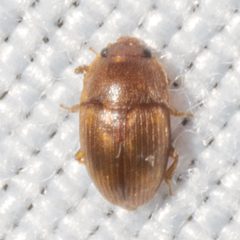
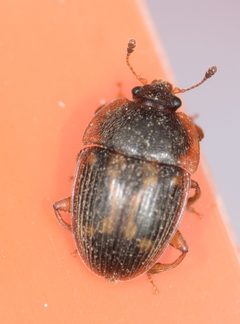
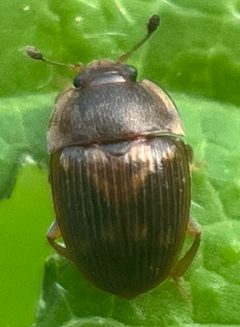
Stelidota is a of sap-feeding beetles in the Nitidulidae comprising approximately 15 described . Species in this genus are associated with fermenting plant materials and are known primarily from studies of Stelidota geminata and S. octomaculata, which differ markedly in -finding despite both being olfactory . The genus includes economically significant pests of strawberries and other crops.
Pronunciation
How to pronounce Stelidota: /stɛlɪˈdoʊtə/
These audio files are automatically generated. While they are not always 100% accurate, they are a good starting point.
Identification
Members of Stelidota are small nitidulid beetles. Specific diagnostic features for -level identification are not documented in available sources. -level identification requires examination of morphological characters not detailed in the provided literature.
Images
Habitat
Associated with fermenting plant materials; specific requirements vary by . Stelidota geminata has been observed in agricultural settings including strawberry plantings.
Distribution
The occurs in North America, Central America, South America, Europe, and Asia. Stelidota geminata specifically has been recorded from: North America (Canada: Ontario; USA: Arkansas, California, Delaware, Florida, Georgia, Hawaii, Illinois, Indiana, Iowa, Kansas, Maryland, Massachusetts, Michigan, New Hampshire, New Mexico, New York, Ohio, Pennsylvania, Tennessee, Texas, Virginia, Wisconsin; Mexico), Central America and Caribbean (Bahamas, Cuba, Puerto Rico), South America (Brazil: Paraiba, São Paulo; Colombia; Peru), Europe (Austria, Belgium, France, Germany, Gibraltar, Hungary, Italy, Portugal, Serbia, Slovenia, Spain, Canary Islands, Switzerland), and Asia (Turkey).
Diet
Sap-feeding on fermenting plant materials. Stelidota geminata feeds on diverse fermenting substrates including strawberry (Fragaria spp.). Stelidota octomaculata feeds primarily on acorns.
Host Associations
- Fragaria spp. - feeds onstrawberry of S. geminata
- Quercus spp. - feeds onacorn of S. octomaculata
Behavior
-finding varies between . Stelidota geminata exhibits phototactic and host-orienting flights, with rapid upwind (0.54 ± 0.02 cm/s) toward food sources. Stelidota octomaculata lacks phototactic flight, does not fly to food odors, and walks more slowly toward sources (0.16 ± 0.01 cm/s) with different turning frequency patterns. Both species respond to diverse food substrates in no-choice assays, indicating olfactory generalization.
Ecological Role
Decomposer of fermenting plant materials. Serves as for Microctonus nitidulidis.
Human Relevance
Stelidota geminata is an agricultural pest of strawberry crops. The has been introduced to Europe from North America, expanding its economic impact.
Similar Taxa
- other Nitidulidae generaStelidota can be distinguished from related sap beetles by -specific morphological characters; specific diagnostic features require taxonomic expertise.
Sources and further reading
- BugGuide
- Wikipedia
- GBIF taxonomy match
- iNaturalist taxon
- NCBI Taxonomy
- Stelidota geminata . [Distribution map].
- Chemical ‘generalists' and behavioral ‘specialists‘: a comparison of host finding by Stelidota geminata and Stelidota octomaculata
- Stelidota geminata (Say): Studies of Its Biology (Coleoptera: Nitidulidae1)
- Notes on the biology and hosts of Stelidota ferruginea (Coleoptera:Nitidulidae)
- Some Host-Parasite Relationships of Microctonus nitidulidis1 and Stelidota geminata23
- Life history and notes on the biology of Stelidota octomaculata (Coleoptera:Nitidulidae)
- Electrophysiological and behavioral identification of a volatile blend involved in host location of female strawberry sap beetle, Stelidota geminata