
Carpophilus hemipterus
(Linnaeus, 1758)
dried-fruit beetle
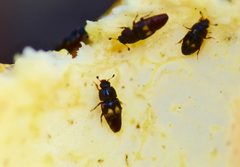
Carpophilus hemipterus is a sap-feeding beetle in the Nitidulidae known as the dried-fruit . It is a pest of ripening and dried fruits, with documented on dates, litchi, mango, guava, papaya, and stone fruits. The exhibits strong mediated by and shows phototactic responses that transition readily to vegetative orientation upon encountering food odors. It completes multiple per season in warm climates, with peaks correlating with temperature and humidity optima. Both and larvae cause direct damage to fruits and can microorganisms associated with fermentation and aflatoxin production.
Pronunciation
How to pronounce Carpophilus hemipterus: /kɑrˈpɒfɪləs hɛmˈɪptərəs/
These audio files are automatically generated. While they are not always 100% accurate, they are a good starting point.
Identification
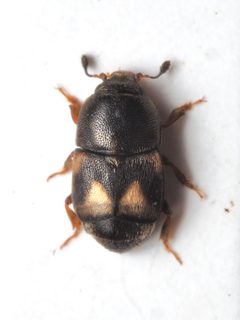
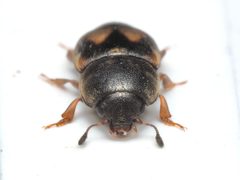
Small nitidulid ; are active fliers with documented phototactic responses to high-pressure sodium lighting. Distinguished from Carpophilus lugubris by : C. hemipterus initiates flight to food odors beginning on day 4 of adult life, while C. lugubris rarely flies regardless of age. Can be separated from Carpophilus truncatus by differences in damage patterns and geographic origin; C. truncatus is a more recent with confirmed damage to almond and pistachio kernels, whereas C. hemipterus is primarily associated with fleshy and dried fruits.
Images
Habitat
Ripening and fermenting fruits in field and storage conditions; warm agricultural areas with date palm ; post-harvest storage facilities. Associated with fallen, rotting, or damaged fruits on soil surface. Laboratory rearing successful on sliced bananas with sand substrate for .
Distribution
North America, Oceania, Europe, and worldwide in date-producing regions; present in India (Bihar and other fruit-growing regions), Australia, and the Azores (Faial, Graciosa, São Jorge, São Miguel, Santa Maria).
Seasonality
peaks during warmer months correlating with optimal temperature and humidity conditions; bimodal activity pattern during photophase with peaks 14–10 hours prior to scotophase and a large 4-hour peak from 3 hours prior to scotophase through 1 hour after. Phototactic flight propensity highest in beetles 3–7 days old.
Diet
Sap and pulp of ripening, dried, and fermenting fruits; documented include dates (Phoenix dactylifera), litchi, mango, guava, papaya, custard apple, stone fruits, figs, and various rotten fruits. Laboratory studies confirm survival and on groundnut, cocoa, cowpea, and rice, though with variable success. and larvae both feed on host material.
Host Associations
- Phoenix dactylifera - pestKey pest of dates in field and storage; and larvae feed on fruit pulp
- Litchi chinensis - pestSignificant pest in Bihar, India; highest susceptibility during peak harvests
- Mangifera indica - pestHigh susceptibility with significant losses during peak harvests in India
- Psidium guajava - pestModerate impact, particularly during storage
- Carica papaya - pestModerate impact, particularly during storage
- Annona squamosa - pestLocalized impact in areas with inadequate pest management
- Ficus carica - foodAttraction demonstrated to fungal-inoculated figs in wind tunnel studies
- Stone fruits (Prunus spp.) - pestKey pest in Australia
- Groundnut (Arachis hypogaea) - foodSupports survival and in laboratory conditions
- Theobroma cacao - foodSupports survival; significantly higher larval damage but lowest survival
- Vigna unguiculata (cowpea) - foodHighest survival in laboratory studies
- Oryza sativa (rice) - foodFewest deposited; supports development but less preferred
Life Cycle
, larva, pupa, and stages. Multiple completed within a single season in warm climates. Average development time under laboratory conditions (25±3°C, 45±10% RH): 3.2 days from oviposition to hatching; 7.54 days from egg to wandering larva; 11.08 days from wandering larva to adult. Adult longevity averages 94.33 days. occurs in moist substrate such as sand.
Behavior
Strong mediated by powerful aggregation causing beetles to gather on few fruits. Phototactic induced by high-pressure sodium lighting, with flight propensity peaking at 3–7 days of age. Flight characterized as extended foraging rather than true migratory flight: phototactic flight is readily interrupted by food odors, causing immediate landing and loss of altitude. When food odor is removed, beetles resume phototactic flight with no cumulative inhibitory effect. upwind to food odors begins on day 3 of life; flight to odor sources begins on day 4. Maximum response to food odors occurs at 6–9 days after . Bimodal daily activity pattern with peaks during photophase. Water-maintained adults show higher flight activity than diet-maintained adults. Three hours of locomotory activity under sodium lighting does not enhance upwind orientation. behavior from heated fruits observed under radio frequency treatment (2500 V for 8–10 minutes induces nearly 100% escape).
Ecological Role
Pest of agricultural crops causing direct qualitative and quantitative losses through feeding damage. for microorganisms associated with fermentation processes, including fungi that produce harmful aflatoxins. Contributes to post-harvest spoilage of fruits and stored products.
Human Relevance
Major economic pest of fruit crops and stored products, particularly affecting small- farmers through reduced market value and export viability. Target of strategies combining cultural, biological, and chemical controls. Subject of research on -based monitoring and trapping. Radio frequency treatment investigated as non-chemical disinfestation method for dates. Laboratory rearing protocols established using bananas and sand for research purposes.
Similar Taxa
- Carpophilus truncatusSimilar and appearance; distinguished by preferences (almond and pistachio kernels versus fleshy/dried fruits), geographic origin (Europe versus ), and more recent status in California
- Carpophilus lugubrisSimilar and range; distinguished by —C. lugubris rarely flies regardless of age and primarily walks upwind to food sources, whereas C. hemipterus readily initiates flight on day 4 of life
Sources and further reading
- BugGuide
- Wikipedia
- GBIF taxonomy match
- iNaturalist taxon
- NCBI Taxonomy
- Why Bananas and Sand Will Improve Response to an Invasive Beetle
- Emigration Effects Induced by Radio Frequency Treatment to Dates Infested by Carpophilus hemipterus
- Fecundity and survival of Carpophilus hemipterus (Linnaeus, 1758) (Coleoptera: Nitidulidae) on alternative hosts
- Effect of physiological state and fungal inoculation on chemically modulated host‐plant finding by Carpophilus hemipterus and Carpophilus lugubris
- Comparative analysis of the impact of the dried fruit beetle (carpophilus hemipterus) on selected host plant in india
- Responses of Carpophilus hemipterus (Coleoptera: Nitidulidae) and Other Sap Beetles to the Pheromone of C. hemipterus and Host-Related Coattractants in California Field Tests
- Impact of the Dried-Fruit Beetle (Carpophilus hemipterus) on Litchi Production in Bihar: A Study on Life Cycle and Seasonal Population Patterns
- Behavior of Carpophilus hemipterus in a vertical flight chamber: transition from phototactic to vegetative orientation