
Carpophilus
Stephens, 1829
sap beetles
Species Guides
14- Carpophilus antiquus
- Carpophilus brachypterus
- Carpophilus corticinus
- Carpophilus dimidiatus(cornsap beetle)
- Carpophilus discoideus(Disk-shaped Sap Beetle)
- Carpophilus hemipterus(dried-fruit beetle)
- Carpophilus ligneus
- Carpophilus marginatus
- Carpophilus marginellus
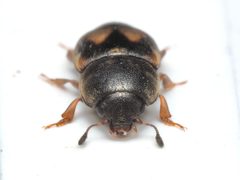
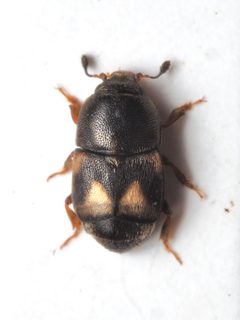
Carpophilus is a of sap beetles (Nitidulidae) containing numerous worldwide. are small (approximately 3 mm), oblong beetles with short that expose the last two abdominal tergites. Several species are significant agricultural pests of fruits, nuts, and stored products. The genus exhibits diverse ecological roles, with some species acting as while others serve as of plant .
Pronunciation
How to pronounce Carpophilus: //ˌkɑr.pəˈfaɪ.ləs//
These audio files are automatically generated. While they are not always 100% accurate, they are a good starting point.
Identification
Distinguished from similar nitidulid by the combination of short exposing two abdominal tergites and clubbed . Urophorus humeralis, formerly placed in Carpophilus, can be differentiated by having three exposed abdominal tergites rather than two. -level identification often requires examination of male genitalia or , as many species are morphologically similar.
Images
Habitat
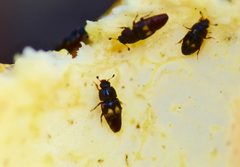
Associated with decaying or ripening plant material including fruits, nuts, and stored products. Found in agricultural settings, orchards, and food storage facilities. sites include fruit, stored products, soil, and cracks or under bark of trees.
Distribution
Worldwide distribution with records from Europe, Australia, North America (including California and Vermont), South America, and south-eastern Asia. Individual show varying ranges; C. truncatus is particularly widespread and .
Seasonality
are active in spring and summer. Multiple occur per year. Development from to adult takes approximately one month in summer, with temperature-dependent variation from 12 days at 32.2°C to 42 days at 18.3°C.
Diet
Feeds on ripening and decaying fruits, nuts, grains, and other plant materials. Specific items include stone fruit, citrus, apples, figs, persimmons, almonds, pistachios, corn, wheat, oats, rice, beans, peanuts, nuts, cottonseed, copra, spices, and honey.
Host Associations
- stone fruit - pestfemales lay in fruit on tree
- citrus - pestfemales lay in fallen fruit on ground
- apple - pestfemales lay in fallen fruit on ground
- fig - pestfemales lay in fallen fruit on ground
- persimmon - pestpest status documented
- almond - pestC. truncatus causes 2-40% damage in Australian crops
- pistachio - pestC. truncatus detected in California orchards 2023
- cotton - C. aterrimus contributes to cotton pollination
Life Cycle
Females lay in fruit on trees (stone fruit) or in fallen fruit on the ground (citrus, apples, figs), and in stored products. Larvae feed and grow within the fruit or stored material. Mature larvae leave fruit to pupate in soil; larvae in stored products pupate within the substrate. can occur as mature larva, pupa, or . Development is temperature- and humidity-dependent.
Behavior
can fly several kilometers in search of fruit. Both sexes respond to food odors, with attraction increasing after starvation. Some (C. hemipterus) take readily, while others (C. lugubris) primarily walk upwind to odor sources. Males produce that attract both sexes. Response to host volatiles is enhanced by fungal inoculation in some species.
Ecological Role
Agricultural pest causing direct feeding damage and indirect damage by spreading such as brown rot. Carpophilus sayi is a documented of the fungus Ceratocystis fagacearum. Some (e.g., C. aterrimus) contribute to pollination. Symbiotic relationships with yeasts (Saccharomyces cerevisiae, Candida krusei) influence -finding .
Human Relevance
Major economic pest of fruits, nuts, and stored products worldwide. Carpophilus truncatus has rapidly expanded as an pest in Australia, Latin America, and California since 2013, causing significant damage to almond and pistachio crops. Management is difficult due to the 's protected life stage within hulls and shells. Synthetic combined with food baits are used for monitoring and potential control. Laboratory rearing for research purposes can be accomplished using bananas and sand.
Similar Taxa
- Urophorus humeralisFormerly placed in Carpophilus; distinguished by three exposed abdominal tergites versus two in Carpophilus
- GlischrochilusSimilar sap beetles with different antennal club structure and elytral patterns
More Details
Pheromone biology
Male-produced have been identified in multiple . C. sayi and C. lugubris share major pheromone components: (2E,4E,6E,8E)-3,5-dimethyl-7-ethyl-2,4,6,8-undecatetraene and (2E,4E,6E,8E)-3,5,7-trimethyl-2,4,6,8-undecatetraene. These pheromones are synergized by fermenting food baits such as whole wheat bread dough.
Invasive spread
C. truncatus originated in Europe where it was considered harmless. Since 2013, it has become a destructive pest in Australia, Latin America, and California. The rapid expansion has been attributed to facilitation by other insect pests, changes in pest management practices, or introduction of more virulent strains through trade.
Taxonomic complexity
has revealed cryptic diversity within the . Reference sequences previously identified as C. dimidiatus comprise three genetically divergent lineages representing three : C. dimidiatus, C. truncatus, and the newly described C. imitatus from south-eastern Asia and Australia.
Sources and further reading
- BugGuide
- Wikipedia
- GBIF taxonomy match
- iNaturalist taxon
- NCBI Taxonomy
- Catalogue of Life
- Why Bananas and Sand Will Improve Response to an Invasive Beetle
- Chemical ecology of Carpophilus beetles and their yeast symbionts
- The pest sap beetle Carpophilus (Myothorax) truncatus Murray, 1864 (Coleoptera: Nitidulidae)—a new synonymy and a related new species of Carpophilus
- Effect of physiological state and fungal inoculation on chemically modulated host‐plant finding by Carpophilus hemipterus and Carpophilus lugubris
- Male‐produced aggregation pheromone of Carpophilus sayi , a nitidulid vector of oak wilt disease, and pheromonal comparison with Carpophilus lugubris
- Phasic Behaviour Shown by Two Carpophilus Species (Coleoptera, Nitidulidae) in Various Humidity Gradients and Its Ecological Significance
- Hosts of Carpophilus dimidiatus12
- Role of pollen beetles (Carpophilus aterrimus: Nitidulidae) in cotton pollination and their interaction with honeybees (Apis mellifera: Apidae).