
Urophorus humeralis
(Fabricius, 1798)
pineapple beetle, yellow-shouldered souring beetle
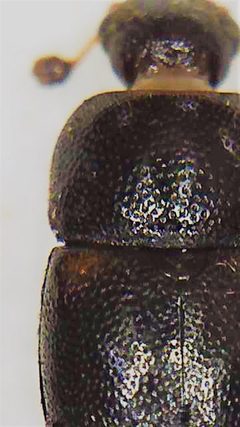
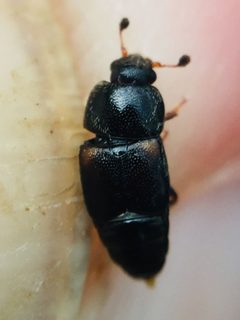
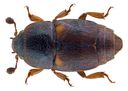
Urophorus humeralis is a sap-feeding beetle in the Nitidulidae, commonly known as the pineapple or yellow-shouldered souring beetle. The has a remarkably broad distribution spanning Africa, North America, Oceania, Southern Asia, Europe, and temperate Asia. It is an agricultural pest with documented associations to multiple crop plants, including a first reported of pear fruits in China. The species has been identified as a of the plant Ceratocystis paradoxa in sugarcane in Hawaii, with preferentially attracted to diseased over healthy plant material.
Pronunciation
How to pronounce Urophorus humeralis: /ˌjʊərəˈfɔːrəs ˌhjuːməˈreɪlɪs/
These audio files are automatically generated. While they are not always 100% accurate, they are a good starting point.
Images
Habitat
Agricultural and orchard environments; pear orchards in China where it was first documented as a fruit pest. Laboratory rearing successful at 25±1°C, 75±5% relative humidity, with 16:8 hour light-dark .
Distribution
Africa; North America; Oceania; Southern Asia; Europe; temperate Asia; Galápagos Islands; Montenegro; Serbia; Wuyang County, Luohe City, Henan Province, China (confirmed collection site for pear study).
Diet
Sap-feeding; larvae feed on fresh pear fruits in laboratory conditions. attracted to diseased sugarcane in Hawaii, with Ceratocystis paradoxa-infected tissue providing more nutritious substrate for larval development than healthy tissue.
Host Associations
- Pyrus spp. - First report of pear fruit ; laboratory study used fresh pear fruits as food and oviposition substrate
- Saccharum officinarum (sugarcane) - Documented of Ceratocystis paradoxa in Hawaii; prefer diseased sugarcane
Life Cycle
Three distinct larval instars confirmed through morphometric analysis; capsule width most reliable character for instar discrimination. hatching followed by larval development through three instars until ; emerge from pupation. Overlapping contribute to successful in orchard environments.
Behavior
demonstrate preferential attraction to diseased plant material over healthy tissue. Early larval instars possess softer and lower compared to later instars.
Ecological Role
Agricultural pest causing crop damage in pear orchards; classified as important agricultural pest. of plant Ceratocystis paradoxa in sugarcane, potentially facilitating transmission in crop systems.
Human Relevance
Economic pest of agricultural crops; documented damage to pear fruits and sugarcane. status for Ceratocystis paradoxa increases its significance in programs. identity can be confirmed through integrated morphological examination and molecular COI barcoding analysis.
More Details
Taxonomic verification
identity confirmed through integrated morphological examination (pronotum shape, elytral pattern, genitalia) and molecular COI barcoding (0.00 intraspecific , well-supported clade in phylogenetic analyses).
Morphometric research significance
First study to establish detailed morphometric criteria for larval staging in this , providing baseline data for Nitidulidae and scientific basis for stage-specific pest management strategies.
Sources and further reading
- BugGuide
- Wikipedia
- GBIF taxonomy match
- iNaturalist taxon
- NCBI Taxonomy
- Meloidae Holdings | Entomology Research Museum
- A Silver Anniversary | Beetles In The Bush
- North America’s largest stag beetle | Beetles In The Bush
- Determination of the Morphometric Characteristics of Larval Instars in the Sap Beetle Urophorus humeralis (Coleoptera: Nitidulidae)