
Carpophilinae
Erichson, 1842
Genus Guides
4- Caplothorax(sap beetles)
- Carpophilus(sap beetles)
- Nitops
- Urophorus
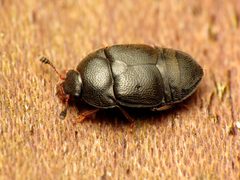
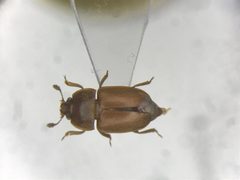
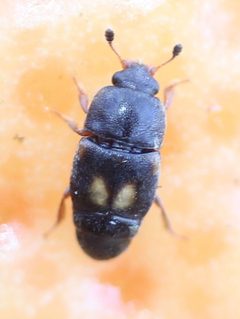
Carpophilinae is a of sap beetles (Nitidulidae) comprising at least 70 described across six : Amphicrossus, Aphenolia, Carpophilus, Caplothorax, Epuraea, Nitops, and Urophorus. Recent phylogenetic studies have reclassified the group, elevating Caplothorax to generic rank and confirming the monophyly of Nitops, Urophorus, and Caplothorax. The subfamily exhibits multiple independent origins of anthophily (flower-visiting ), a trait that has evolved convergently across lineages.
Pronunciation
How to pronounce Carpophilinae: //ˌkɑrpoʊfaɪˈlaɪniː//
These audio files are automatically generated. While they are not always 100% accurate, they are a good starting point.
Identification
Members of Carpophilinae can be distinguished from other Nitidulidae by phylogenetic placement, with Caplothorax, Nitops, and Urophorus forming well-supported . The Caplothorax was historically treated at subgeneric rank but is now recognized as distinct based on molecular and morphological data. -level identification requires examination of specific morphological characters detailed in generic redescriptions.
Images
Distribution
Global distribution corresponding to the range of the Nitidulidae; specific range limits for the as a whole are not documented in available sources.
Behavior
Anthophily (flower-visiting ) has been documented across multiple lineages within Carpophilinae, with ancestral state reconstruction indicating independent evolutionary origins rather than a single ancestral acquisition of this trait.
Human Relevance
Some within Nitidulidae, including members of Carpophilinae, are economically significant as pests of stored products and ripening fruits, while others perform beneficial functions; specific pest or beneficial status varies by species and is not generalized to the level.
Similar Taxa
- Other Nitidulidae subfamiliesCarpophilinae is distinguished from other Nitidulidae by its phylogenetic placement and the monophyly of its constituent ; morphological distinctions are detailed in taxonomic redescriptions of the group.
More Details
Taxonomic Reclassification
Caplothorax was elevated from subgeneric to generic rank based on phylogenetic analysis of six genetic loci (16S, 18S, 28S, COI, H3, and ITS2) using a novel 'wide-seq' method combining next- sequencing with traditional Sanger sequence overlap.
Phylogenetic Support
Carpophilinae recovers as a well-supported clade with respect to outgroup , with high support for the monophyly of Nitops, Urophorus, and Caplothorax.