
Clypastraea lugubris
(LeConte, 1852)
minute hooded beetle
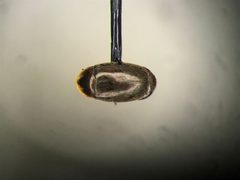
Clypastraea lugubris is a of minute hooded beetle in the Corylophidae. It is one of the smallest beetles in North America, measuring approximately 2 millimeters in length. The species is found across much of North America, with records from Canada (Alberta, British Columbia, Manitoba) and the United States. It belongs to a family commonly known as minute hooded beetles or minute fungus beetles, characterized by a distinctive shelf-like projection of the pronotum that conceals the .
Pronunciation
How to pronounce Clypastraea lugubris: //klɪˈpæstriə luˈɡuːbrɪs//
These audio files are automatically generated. While they are not always 100% accurate, they are a good starting point.
Identification
Distinguishable from other North American beetles by its minute size (~2 mm) and the hooded appearance created by the pronotal projection covering the . Within Corylophidae, identification to level requires examination of microscopic morphological features; the Clypastraea is distinguished from other corylophid genera by specific characters of the , , and genitalia. Separation from requires knowledge of the .
Images
Appearance
Extremely small , approximately 2 mm in length. The is concealed beneath a shelf-like projection of the pronotum, a defining feature of the Corylophidae. The overall body form is compact and minute, consistent with other members of this family of microbeetles.
Habitat
Associated with fungi and mold in rotting wood and under bark on dead trees. Has been observed on artificial substrates near trees, including the base of utility boxes beneath large cottonwoods in residential areas. The microhabitat appears to involve decaying organic matter where fungal growth occurs.
Distribution
North America, with confirmed records from Canada (Alberta, British Columbia, Manitoba) and the United States. The has a transcontinental distribution across northern North America.
Diet
Feeds on fungal spores as both larvae and . This diet is characteristic of the Corylophidae and is well-documented for the Clypastraea.
Life Cycle
Complete with , larval, pupal, and stages. Larvae develop in association with fungal substrates, feeding on spores alongside adults.
Behavior
are active and capable of crawling on various substrates. One observed individual was found crawling on the base of a plastic-covered utility box, suggesting some mobility in seeking fungal resources. No has been specifically documented for this , though many minute beetles are capable of flight.
Ecological Role
Fungivore that contributes to nutrient cycling in decaying wood . By consuming fungal spores, it may influence fungal dynamics in dead wood microhabitats.
Human Relevance
No direct economic importance. Occasionally encountered by entomologists and naturalists investigating of decaying wood. Not known to be a pest or beneficial in human contexts.
Similar Taxa
- Other Corylophidae generaMinute hooded beetles in such as Arthrolips and Orthoperus share the hooded pronotal structure and similar size, requiring microscopic examination for separation.
- Other Clypastraea speciesCongeneric in North America require detailed morphological comparison of , , and male genitalia for accurate identification.
More Details
Discovery and documentation
The was first described by LeConte in 1852 under the name Sacium lugubre before being transferred to Clypastraea. It remains poorly known due to its minute size and cryptic habits.
Taxonomic history
Originally described in the Sacium, later moved to Clypastraea. The genus Clypastraea currently contains multiple North American , though the exact number and their distributions remain incompletely documented.
Sources and further reading
- BugGuide
- Wikipedia
- GBIF taxonomy match
- iNaturalist taxon
- NCBI Taxonomy
- Bug Eric: October 2014
- Study Describes Three New Species of Fruit Flies and Revises Their Genus
- June | 2010 | Beetles In The Bush
- Carabidae | Beetles In The Bush | Page 2
- Research Confirms: (Insect) Moms Are the Best
- Beetle Collecting 101: Fermenting bait traps for collecting longhorned beetles | Beetles In The Bush