
Corylophidae
LeConte, 1852
minute hooded beetles, minute fungus beetles
Genus Guides
7- Aenigmaticum
- Holopsis
- Microstagetus
- Orthoperus(minute hooded beetles)
- Parmulini(minute hooded beetles)
- Rypobiini
- Sericoderus
is a of minute beetles in the superfamily Coccinelloidea, comprising approximately 18 and at least 120 described . Members are among the smallest free-living insects, with body lengths typically around 2 mm. The family exhibits distinctive anatomical modifications associated with extreme miniaturization, including elevated rates of substitution in nuclear rRNA genes in the most diminutive species. Formerly known as Orthoperidae in older literature.

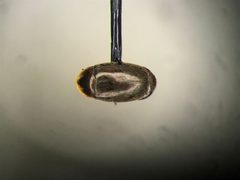
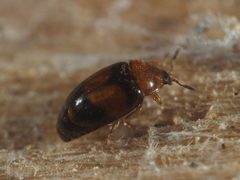
Pronunciation
How to pronounce Corylophidae: /kɔrɪˈlɒfɪdiː/
These audio files are automatically generated. While they are not always 100% accurate, they are a good starting point.
Identification
Distinguished from other minute beetles by the hooded appearance created by the pronotum concealing the . The combination of extremely small size (approximately 2 mm) and the shelf-like pronotal projection is diagnostic. Molecular places the in Coccinelloidea, with Anamorphinae (Endomychidae) or Coccinellidae as sister groups depending on analysis type.
Images
Habitat
Found in diverse microhabitats including bark crevices, leaf litter, decaying vegetation, rotting wood, and surfaces of leaves and flowers. Some occur in bird nests. Clypastraea is most often found in fungi and mold in rotting wood and under bark on dead trees.
Distribution
distribution. Approximately 61 in ten occur north of Mexico. Documented from Australia, South Korea, Myanmar (fossil), Denmark, Norway, Sweden, Vermont (USA), and other regions. The comprises approximately 300 species globally across 28 genera.
Diet
Larvae and feed on fungal spores and microfungi such as molds.
Life Cycle
Complete with larval and stages both feeding on fungal spores.
Ecological Role
Consumers of microfungi and molds in decaying organic matter, contributing to nutrient cycling in forest floor and woody debris .
Human Relevance
Occasionally encountered by entomologists and naturalists; one specimen was found on a utility box in a residential neighborhood, indicating potential for incidental human contact. No known economic importance or pest status.
Similar Taxa
- EndomychidaeSister group relationship in molecular analyses; both are small cucujiform beetles with fungal associations
- CoccinellidaeRecovered as sister group in combined morphological and molecular analyses; both in superfamily Coccinelloidea
More Details
Taxonomic history
Formerly known as Orthoperidae in older literature. The was established by LeConte in 1852.
Phylogenetic relationships
Molecular data strongly support Anamorphinae (Endomychidae) as sister group; combined data analyses recover Coccinellidae as sister group. and Corylophinae are monophyletic in all analyses.
Miniaturization
Key phenotypic modifications and elevated rates of substitution in nuclear rRNA genes are evident in a subgroup of Corylophinae that includes the most diminutive .
Sources and further reading
- BugGuide
- Wikipedia
- GBIF taxonomy match
- iNaturalist taxon
- NCBI Taxonomy
- Catalogue of Life
- Bug Eric: It's a Corylo-what?
- Bug Eric: October 2014
- PRIAMIMA, A NEW GENUS OF CORYLOPHIDAE (COLEOPTERA) FROM AUSTRALIA
- New species and a new record of Corylophidae (Coleoptera: Coccinelloidea) from South Korea
- Molecules, morphology and minute hooded beetles: a phylogenetic study with implications for the evolution and classification of Corylophidae (Coleoptera: Cucujoidea)