
Scymnus coniferarum
Crotch, 1874
conifer lady beetle
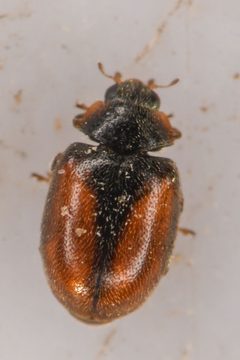
Scymnus coniferarum is a small predatory lady beetle native to western North America. It has been studied as a potential agent for the hemlock woolly adelgid (Adelges tsugae), an pest of eastern hemlock in eastern North America. Field studies in Washington State indicate it feeds on multiple adelgid across different conifer , with higher abundance observed on pine adelgids than on hemlock woolly adelgid.
Pronunciation
How to pronounce Scymnus coniferarum: /ˈsɪmnəs ˌkɒnɪˈfɛrərəm/
These audio files are automatically generated. While they are not always 100% accurate, they are a good starting point.
Images
Habitat
Coniferous forests; found on trees including Pinus contorta, Pinus monticola, and Tsuga heterophylla. have been observed on all sampled conifer except Pseudotsuga menziesii.
Distribution
Western North America; documented in Washington State (Puget Sound region, Tacoma), British Columbia (Canada), and broader North American range per GBIF records.
Seasonality
active year-round with seasonal abundance patterns studied through twice-monthly sampling; synchronized with multiple adelgid prey .
Diet
Adelgids (Hemiptera: Adelgidae); documented prey include Adelges tsugae (hemlock woolly adelgid) and multiple pine adelgid . Field observations indicate greater association with pine adelgids than with hemlock woolly adelgid.
Host Associations
- Adelges tsugae - preyhemlock woolly adelgid
- Pinus contorta - lodgepole pine, to pine adelgids
- Pinus monticola - western white pine, to pine adelgids
- Tsuga heterophylla - western hemlock, to A. tsugae
Behavior
Exhibits phenological synchrony with adelgid prey . Field-cage studies have evaluated feeding and survival on hemlock woolly adelgid.
Ecological Role
of adelgids; evaluated as agent for forest pests. levels appear more strongly tied to pine adelgid systems than to hemlock adelgid systems in native range.
Human Relevance
Evaluated for potential use in of hemlock woolly adelgid threatening eastern hemlock forests in eastern North America. Suitability remains uncertain due to taxonomic questions ( indicates 6% divergence between two distinct clusters) and stronger ecological association with pine adelgids than with the target pest.
Similar Taxa
- Other Scymnus speciesSmall dusky lady beetles require careful examination; S. coniferarum specifically associated with coniferous and adelgid prey
- Other Coccinellidae in conifer systemsAdelgid-feeding lady beetles in western North America include multiple Scymnus and related ; identification to level requires examination
More Details
Taxonomic uncertainty
has identified two distinct clusters within S. coniferarum differing by 6% sequence divergence. Beetles from both clusters co-occur on the same conifer and cannot be distinguished morphologically. The taxonomic significance of this divergence requires further study.
Biological control considerations
Despite initial collection from hemlock woolly adelgid in the western United States, field studies found S. coniferarum more frequently associated with pine adelgids. Combined with unresolved taxonomic status, this suggests limited suitability for HWA programs.
Sources and further reading
- BugGuide
- Wikipedia
- GBIF taxonomy match
- iNaturalist taxon
- Phenology and Synchrony of Scymnus coniferarum (Coleoptera: Coccinellidae) with Multiple Adelgid Species in the Puget Sound, WA, USA
- Phenology and synchrony ofScymnus coniferarum(Coleoptera: Coccinellidae) and its host hemlock woolly adelgid (Hemiptera: Adelgidae) in Tacoma, Washington
- Field-Cage Evaluation of Survival, Reproduction, and Feeding Behavior of AdultScymnus coniferarum(Coleoptera: Coccinellidae), a Predator ofAdelges tsugae(Hemiptera: Adelgidae)