
Calvia quatuordecimguttata
(Linnaeus, 1758)
cream-spot ladybird, cream-spotted ladybird, polkadot ladybird, eighteen spot ladybird
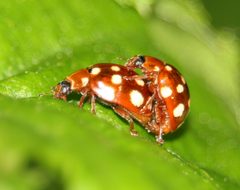
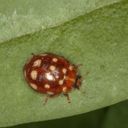
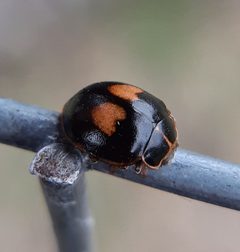
A small Holarctic ladybird measuring 4–5.5 mm, highly variable in coloration across its range. In Europe it appears maroon-brown with fourteen cream spots; in North America and eastern Asia, color forms range from black with white spots to yellow or pink with eighteen large blotches. It inhabits deciduous woodlands, hedgerows, and areas, in bark crevices and leaf litter.
Pronunciation
How to pronounce Calvia quatuordecimguttata: /ˈkal.vi.a ˌkwat.wɔr.de.kimˈɡʊt.ta.ta/
These audio files are automatically generated. While they are not always 100% accurate, they are a good starting point.
Identification
Distinguished from Myrrha octodecimguttata (also called 'eighteen-spot ladybird') by and : C. quatuordecimguttata occurs on deciduous trees and hedgerows, is larger, darker maroon-brown in Europe, and lacks the characteristic M-shaped white mark on the pronotum that M. octodecimguttata bears. M. octodecimguttata is smaller, paler brown, and found on pine trees.
Images
Habitat
Deciduous and mixed forests, particularly Western European broadleaf forests; hedgerows; areas; parks; gardens; meadows. Found on grasses, bushes, and trees. Also occurs in forest litter, brushwood, moss, coarse woody debris, and compost.
Distribution
Holarctic. North America: Alaska and Labrador south to California and New Jersey (introduced in New Jersey). Palearctic: Europe, North Africa, Cyprus, European Russia, Caucasus, Siberia, Russian Far East, Belarus, Ukraine, Moldova, Transcaucasia, Kazakhstan, western Asia, Pakistan, Mongolia, China, and Japan. Britain and Ireland: present throughout, more common in England than west and north.
Seasonality
overwinter in leaf litter, bark crevices, and similar protective locations. Activity resumes after winter dormancy; specific seasonal activity peaks not documented.
Diet
Entomophagous. Preys on aphids (Chaitophorus tremulae, Cavariella konoi, Aphis farinosa, Eucallipterus tiliae, Euceraphis betulae, Macrosiphoniella artemisiae), Aleyrodidae (whiteflies), coccids and other Coccoidea, and larvae and of some beetles and butterflies.
Life Cycle
Complete with , larval, pupal, and stages. Larvae described but specific duration of stages and voltinism not documented. Adults overwinter.
Behavior
Overwinters in in protective microhabitats including leaf litter and bark crevices.
Ecological Role
of sap-feeding insects (aphids, scale insects, whiteflies) and occasional predator of other insect and larvae. Contributes to of pest in woodland and .
Human Relevance
Contributes to natural pest suppression in gardens, parks, and managed landscapes. No documented negative impacts.
Similar Taxa
- Myrrha octodecimguttataAlso called 'eighteen-spot ladybird'; distinguished by occurrence on pine trees, smaller size, paler brown coloration, and M-shaped white mark on pronotum.
- Cycloneda speciesLarvae similar but with longer legs; differ in spot pattern and coloration.