
Azya
Mulsant, 1850
Species Guides
1- Azya orbigera(globe-marked lady beetle)
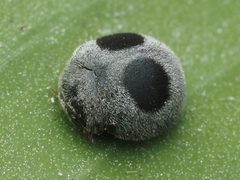
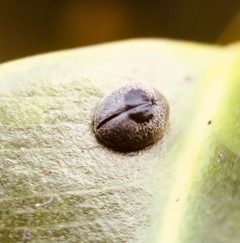
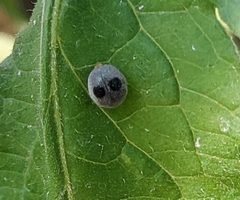
Azya is a of lady beetles ( Coccinellidae) comprising approximately 12 described . The genus is notable for its unusual coloration—many species display cobalt blue rather than the typical red-orange-and-black pattern of most coccinellids. Azya species are of scale insects, particularly in agricultural settings. The genus was established by Mulsant in 1850 and occurs primarily in the Neotropics.
Pronunciation
How to pronounce Azya: /ˈeɪzjə/
These audio files are automatically generated. While they are not always 100% accurate, they are a good starting point.
Identification
Distinguished from other coccinellid by the presence of dense on the and pronotum combined with blue or bluish coloration. Most other coccinellids are glabrous (smooth) and exhibit red, orange, or yellow patterns with black spots or markings. The small size (under 5 mm) and rounded, convex body shape are typical of the but the coloration and pubescence are diagnostic for the genus. Azya orbigera specifically has been noted as a model for mimicry by beetles in the genus Hylaeogena (family Buprestidae).
Images
Habitat
Associated with vegetation infested with scale insects, particularly in agricultural and horticultural settings. Found on coffee plants, citrus, and other woody plants supporting Coccidae and related insect . In natural settings, occurs in tropical and subtropical forests and shrublands where scales are present.
Distribution
Neotropical distribution, primarily in Central and South America. Documented from Brazil (São Paulo State), with collection records from coffee and citrus plantings. The likely ranges more broadly through tropical and subtropical regions of the Americas where suitable insect occur.
Diet
Specialized of scale insects ( Coccidae), particularly soft scales. Documented prey includes Coccus viridis (green scale) on coffee. may supplement diet with honeydew or sugar sources.
Host Associations
- Coccus viridis - preygreen scale, major pest of coffee
- Coffea arabica - coffee plants supporting
- Citrus sinensis - sweet orange, alternative plant
Life Cycle
Complete with , four larval instars, , pupa, and stages. In A. luteipes at 28°C: eggs incubate 8.3 days; larval instars last 2.0, 3.2, 3.6, and 4.6 days respectively; prepupal stage 2.0 days; pupal stage 10.9 days; total egg-to-adult development 34.3 days. Larvae are campodeiform (elongate and active) with yellowish coloration and white waxy filaments for protection. High viability through development (approximately 79% total survival from egg to adult).
Behavior
exhibit (death-feigning) when disturbed. Larvae produce defensive yellowish droplets from thoracic joints when threatened. Females oviposit specifically under the bodies of adult scale insects, depositing 2–4 per (up to 7), with 8–10 eggs per day. This protects eggs from desiccation and . Larvae cover themselves with white waxy filaments for protection. occurs only under low prey conditions; larvae do not cannibalize each other even without food for up to 4 individuals together.
Ecological Role
agent of scale insects in agroecosystems, particularly coffee plantations. As a specialized of Coccus viridis and related soft scales, Azya help regulate pest in coffee nursery seedlings and established plantings. The represents part of the diverse coccinellid fauna contributing to natural pest suppression in tropical agriculture.
Human Relevance
Used or potentially useful as agents against insect pests in coffee and citrus production. The specific association with Coccus viridis, a major pest of coffee, highlights agricultural importance. No documented negative impacts; the unusual blue coloration may also provide aesthetic value in educational contexts.
Similar Taxa
- Hylaeogena (Buprestidae)Mimics Azya orbigera in coloration and ; both are cobalt blue with dense hair-like covering. Distinguished by -level characters: buprestids have elongate bodies, serrate , and different wing venation.
- Steely Blue Ladybird (undetermined Australian species)Similar blue coloration but smooth, glabrous surface unlike the pubescent Azya; different geographic distribution (Australia vs. Neotropics).
- Other Coccinellidae (e.g., Harmonia, Coccinella)Typical lady beetles are larger, glabrous, and exhibit red-orange-yellow with black spot patterns rather than blue pubescent appearance.
More Details
Sexual dimorphism
In Azya luteipes, sexes can be distinguished by color: females have gray heads, males have yellow heads. This may facilitate field identification of living specimens.
Mimicry relationships
Azya orbigera serves as a model for mimicry by Hylaeogena (Buprestidae), which converge in the unusual blue pubescent appearance. This represents one of the few documented cases of -beetle mimicry involving lady beetles.
Taxonomic history
The was established by Étienne Mulsant in 1850. counts vary between sources: Wikipedia cites approximately 12 described species, while iNaturalist notes at least four described species. This discrepancy may reflect taxonomic revisions or differing criteria for species recognition.
Sources and further reading
- BugGuide
- Wikipedia
- GBIF taxonomy match
- iNaturalist taxon
- NCBI Taxonomy
- Catalogue of Life
- Brazil Bugs #2 | Beetles In The Bush
- Coccinelidae | Beetles In The Bush
- Sarcophagidae | Beetles In The Bush
- Brazil Bugs | Beetles In The Bush | Page 2
- Hymenoptera | Beetles In The Bush | Page 8
- Lepidoptera | Beetles In The Bush | Page 8
- Morphological, behavioral and biological aspects of Azya luteipes Mulsant fed on Coccus viridis (Green)