
Dasytinae
Laporte, 1840
soft-wing flower beetles
Tribe Guides
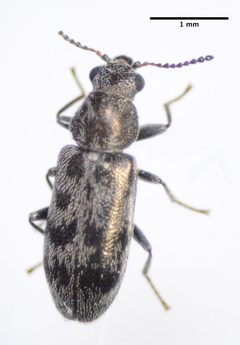
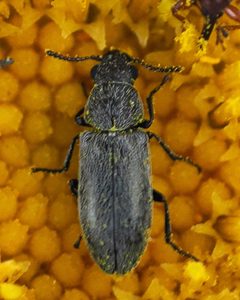
2Dasytinae is a of soft-wing flower beetles within the Melyridae, historically treated as the separate family Dasytidae. Members are typically small (<8 mm), parallel-sided beetles with brownish to blackish , rarely metallic, and may bear short . The subfamily is most diverse and abundant in xeric regions of North America and Central Asia, with such as Trichochrous and Listrus particularly well-represented in North American arid zones. Dasytinae are commonly found on flowers, where they feed on pollen.

Pronunciation
How to pronounce Dasytinae: //ˌdaɪ.sɪˈtiː.naɪ//
These audio files are automatically generated. While they are not always 100% accurate, they are a good starting point.
Identification
Small, parallel-sided beetles with soft bodies and typically dull brown to black coloration. Distinguished from other Melyridae by combination of small size, parallel-sided form, and non-metallic or weakly metallic . North American Trichochrous and Listrus are characteristic of the subfamily in xeric regions. Separation from Malachiinae (the other major Melyridae subfamily) often requires examination of genitalic characters; Dasytinae lack the expanded hind and associated defensive glands found in many Malachiinae.
Images
Habitat
Xeric and arid regions; found in shortgrass prairie, gypsum clay formations, pinyon-juniper woodland, and other dry . frequently encountered on flowers of Asteraceae and other blooming plants in these environments.
Distribution
Most common and diverse in xeric regions of North America (especially southwestern U.S. and Great Plains) and Central Asia. Present across the Palaearctic region including Europe; recorded from Cyprus, Italy, and broader Mediterranean. Distribution extends to northern Europe (records from Denmark, Norway, Sweden).
Seasonality
active during spring through fall depending on region; in North American Great Plains and southwestern deserts, active during summer months when plants are in bloom. Some may show fall activity periods.
Diet
feed on pollen from flowers; observed on Heterotheca, Gutierrezia, and other Asteraceae. Larval diet poorly documented but presumed or scavenging based on related Melyridae.
Host Associations
- Heterotheca stenophylla - feeding on flowersListrus senilis observed feeding on pollen
- Gutierrezia sarothrae - feeding on flowersEpicauta and other beetles present; Dasytinae also frequent these blooms
- Asteraceae - feeding on flowersgeneral association with yellow-flowered composites in Great Plains
Life Cycle
Complete with , larva, pupa, and stages. Larval poorly known; development likely occurs in soil or decaying organic matter. Adults are the most commonly encountered life stage, frequently found on flowers.
Behavior
are flower visitors, actively feeding on pollen during daylight hours. Small size and soft bodies make them vulnerable to desiccation; activity patterns likely tied to humidity and temperature conditions in arid .
Ecological Role
Pollen feeders on diverse flowering plants; may contribute to pollination though effectiveness undocumented. Likely serve as prey for larger insects, spiders, and other in prairie and desert .
Human Relevance
No significant economic importance; occasionally encountered by entomologists and naturalists during flower-visiting insect surveys. Some (e.g., Listrus senilis) are common enough to be useful indicators of prairie health.
Similar Taxa
- MalachiinaeOther major of Melyridae; distinguished by often brighter coloration, expanded hind with defensive glands, and different genitalic structure
- CantharidaeSoldier beetles share soft bodies and flower-visiting habits, but have that completely cover and different antennal structure
- MordellidaeTumbling flower beetles are small and found on flowers, but have characteristic wedge-shaped body form and tumbling escape
Misconceptions
Historical treatment as Dasytidae rather than of Melyridae; modern classification places Dasytinae within Melyridae based on shared derived characters, though some regional treatments may still use the older family-level designation.
More Details
Taxonomic History
Dasytinae was historically treated as the separate Dasytidae, but is now universally classified as a of Melyridae based on phylogenetic studies. The subfamily contains approximately 25 worldwide, with greatest diversity in arid regions.
Research Needs
Larval and development remain poorly documented for most Dasytinae . plant associations are known primarily from flower visitation records; actual pollen preferences and nutritional requirements require study.
Sources and further reading
- BugGuide
- Wikipedia
- GBIF taxonomy match
- iNaturalist taxon
- NCBI Taxonomy
- Catalogue of Life
- Meloidae | Beetles In The Bush | Page 3
- Eumastacidae | Beetles In The Bush
- A contribution to the knowledge of Melyridae Dasytinae and Rhadalidae of Cyprus (Coleoptera, Cleroidea)
- Note on <em>Dolichosoma</em> (<em>Dolichomorphus</em>) femorale Morawitz, 1861 (Coleoptera, Melyridae, Dasytinae): taxonomy, anatomy, distribution and presence in Italy