
Listrus senilis
(LeConte, 1852)
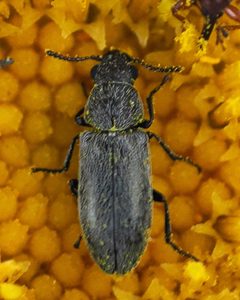
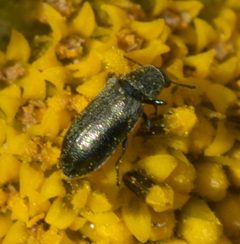
Listrus senilis is a small soft-winged flower beetle ( Melyridae, Dasytinae) distributed across the Great Plains of North America. are typically found feeding on pollen of yellow-flowered asteraceous plants, particularly Heterotheca . The species was redescribed by Mawdsley (1999) who provided notes on its .
Pronunciation
How to pronounce Listrus senilis: /ˈlɪstrəs səˈnaɪlɪs/
These audio files are automatically generated. While they are not always 100% accurate, they are a good starting point.
Identification
The can be identified by its small size (<5 mm), gray coloration, and consistent association with yellow asteraceous flowers. Mawdsley (1999) provides a formal redescription with diagnostic characters distinguishing it from related . It resembles other small dasytine melyrids but can be confirmed by reference to the MCZ .
Images
Appearance
measure less than 5 mm in length. The body is small and gray in coloration. Detailed morphological descriptions are provided in Mawdsley (1999), including redescriptions of diagnostic features.
Habitat
Open prairie and grassland with exposed gypsum or clay soils. Associated with flowering vegetation in sunny conditions.
Distribution
Great Plains of North America, from Alberta, Canada south to Texas, USA. Documented from Oklahoma (Glass Mountains, Alabaster Caverns State Park), and inferred to occur throughout the central plains based on Mawdsley (1999).
Seasonality
active in fall (October documented). Activity period coincides with blooming of yellow-flowered asteraceous plants.
Diet
feed on pollen of yellow-flowered asteraceous plants, particularly Heterotheca stenophylla (stiffleaf false goldenaster) and Heterotheca subaxillaris.
Host Associations
- Heterotheca stenophylla - pollen sourcestiffleaf false goldenaster
- Heterotheca subaxillaris - pollen sourcestiffleaf false goldenaster
Behavior
are pollen feeders, frequently observed singly or in small (up to 4-5 individuals) on individual flowers. They are and associated with sunny conditions.
Ecological Role
Pollen consumer on native asteraceous plants; likely contributes to pollination through incidental pollen transfer.
Similar Taxa
- Epicauta species (Meloidae)Similar gray coloration and flower-visiting , but Epicauta are blister beetles ( Meloidae), typically larger, with different body shape and elytral texture. Listrus senilis is distinguished by smaller size (<5 mm vs. 10+ mm) and family-level characters of Melyridae.
- Other DasytinaeSmall gray dasytines share general appearance; precise identification requires reference to Mawdsley (1999) redescription and comparison with type material.
More Details
Taxonomic note
Originally described as Amecocerus senilis LeConte, 1852; transferred to Listrus. Mawdsley (1999) provided redescription and biological notes in Journal of the New York Entomological Society 107(1):68-72.
Field observation
MacRae (2012) observed abundant in Oklahoma, with individuals frequently encountered on Heterotheca flowers in gypsum prairie .