
Listrus
Motschulsky, 1860
Species Guides
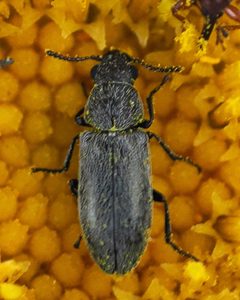
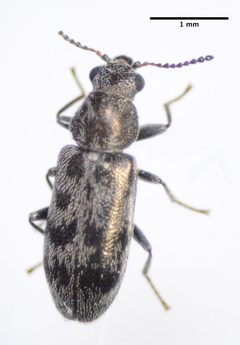
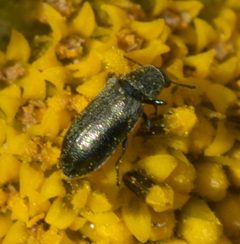
2Listrus is a of soft-winged flower beetles in the tribe Listrini. are small, cylindrical beetles approximately 3 mm in length, often gray in color with variable spot patterns on the . They are frequently observed on flowers, where they feed on pollen.
Pronunciation
How to pronounce Listrus: /ˈlɪstɹʊs/
These audio files are automatically generated. While they are not always 100% accurate, they are a good starting point.
Identification
The combination of very small size (~3 mm), cylindrical body shape, gray coloration, and presence on flowers distinguishes Listrus from many other . Within the Melyridae, identification to genus requires examination of specific morphological characters; the genus Listrus is placed in tribe Listrini based on established classification.
Images
Appearance
are small, cylindrical beetles approximately 3 mm in body length. Coloration is typically gray, with some exhibiting a pattern of spots on the . The overall body form is compact and streamlined.
Habitat
Associated with flowering vegetation in open . Observations indicate strong fidelity to specific flowers, including of Heterotheca (Asteraceae).
Distribution
of this occur in North America, with documented records from the Great Plains region of the United States (Oklahoma, Texas) extending south to Durango, Mexico. The genus appears to be broadly distributed across the central and southwestern United States and northern Mexico.
Seasonality
are active during spring and summer months. One , Listrus senilis, has been observed in October in Oklahoma, suggesting possible extended activity periods into early autumn in some regions.
Diet
Pollen feeders. have been observed feeding on pollen of Asteraceae flowers, specifically Heterotheca stenophylla and Heterotheca subaxillaris.
Host Associations
- Heterotheca stenophylla - food source feed on pollen; abundant observed
- Heterotheca subaxillaris - food source feed on pollen
Behavior
are frequently found on flowers, often in groups. Multiple individuals may occupy a single flower, with observations of up to four or five beetles per flower. They are active , moving among flowers to feed on pollen.
Ecological Role
. The frequent presence of on flowers and their pollen-feeding indicates a role in pollen transfer among flowering plants, particularly Asteraceae .
Similar Taxa
- Other Melyridae generaSimilar small size and flower-associated ; -level identification requires detailed morphological examination
- Epicauta (Meloidae)Similar gray coloration and flower-visiting , but blister beetles are generally larger with different body proportions and chemical defenses
More Details
Taxonomic note
The Listrus was established by Motschulsky in 1860. It contains approximately 20 described , including Listrus senilis (LeConte, 1852), which serves as a representative species for biological observations.
Research note
Mawdsley (1999) provided redescription and biological notes on Listrus senilis, documenting its abundance throughout the Great Plains region.