
Diabrotica
Chevrolat in Dejean, 1836
cucumber beetles, corn rootworms
Species Guides
9- Diabrotica adelpha(Festive Diabrotica)
- Diabrotica balteata(banded cucumber beetle)
- Diabrotica barberi(northern corn rootworm)
- Diabrotica cristata(Black Diabrotica)
- Diabrotica lemniscata
- Diabrotica litterata(Milkvine Diabrotica)
- Diabrotica longicornis(northern corn rootworm)
- Diabrotica undecimpunctata(spotted cucumber beetle)
- Diabrotica virgifera(Western corn rootworm)
Diabrotica is a large, widespread of leaf beetles (Chrysomelidae) comprising approximately 400 native to the Americas. The genus includes several economically significant agricultural pests, particularly species affecting corn, cucurbits, and other crops. Three informal species groups are recognized—fucata (354 species, multivoltine), virgifera (24 species, ), and signifera (11 species, univoltine)—based on traits rather than molecular . The genus exhibits a unique evolutionary relationship with cucurbitacin-producing plants, with beetles attracted to these bitter, toxic compounds for chemical defense.
Pronunciation
How to pronounce Diabrotica: //ˌdaɪ.əˈbɹoʊ.tɪ.kə//
These audio files are automatically generated. While they are not always 100% accurate, they are a good starting point.
Identification
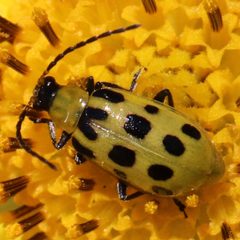
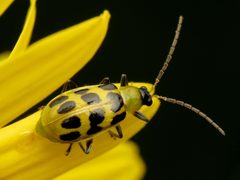
Identification to level requires examination of elytral color pattern, body proportions, and male genitalia. The three species groups (fucata, virgifera, signifera) can be distinguished by traits: fucata species are multivoltine with two or more per year, while virgifera and signifera species are with one generation per year. Within the virgifera group, D. virgifera and D. longicornis barberi differ in feeding : D. virgifera feeds on corn leaves after pollen/silk depletion and remains in corn fields, whereas D. longicornis barberi does not feed on leaves and disperses from corn when reproductive structures are unavailable. D. undecimpunctata has three pairs of dark spots on each (six total), distinguishing it from similar beetles with different spot arrangements.
Images
Appearance
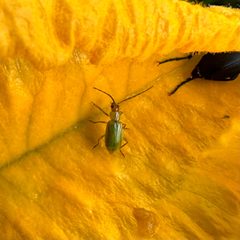
are small to medium-sized leaf beetles, typically 5–10 mm in length. Body shape is generally oval to elongate-oval. Coloration is highly variable among , ranging from yellow, green, or orange to black, often with contrasting spots, stripes, or bands on the . are thread-like and moderately long. The is partially concealed from above by the pronotum. Larvae are elongate, cylindrical, and cream-colored with a brown head capsule and three pairs of thoracic legs.
Habitat
occupy diverse including agricultural fields, grasslands, and areas with flowering vegetation. Movement patterns are driven by food availability. in the virgifera group that feed on corn inhabit large maize . Larval habitat is strictly subterranean, with development occurring in soil adjacent to plant roots. The fucata group is restricted to tropical and subtropical regions due to inability to overwinter; virgifera group species extend into temperate regions where they overwinter as .
Distribution
Native to the Americas with highest in Central America, Mexico, and Brazil. The is primarily neotropical in origin. In the United States, 7 native occur, of which 4 are agricultural pests. The western corn rootworm (D. virgifera) has been introduced to Europe, where it was accidentally brought to Serbia and subsequently spread to Germany, Hungary, and other Central and Eastern European countries; it has been extirpated from Belgium, Netherlands, and United Kingdom.
Seasonality
Activity patterns vary by group. Fucata group species are multivoltine, completing -to- development in approximately 30 days and producing two or more annually; adults overwinter in in mild climates. Virgifera and signifera group species are , with eggs in soil, hatching in late spring, and adults present from midsummer until frost. In northern portions of the range, D. undecimpunctata produces one per year; in warmer regions, up to three generations occur.
Diet
feed primarily on pollen, floral structures, and foliage of plants. Larvae feed on roots and, in some cases, stem bases and fruit rinds in contact with soil. Fucata group are , feeding on numerous plant species across diverse . Virgifera and signifera group species are oligophagous, feeding on few host plants. Several species show strong attraction to and compulsive feeding on cucurbitacin-containing plants (Cucurbitaceae), even when alternative nutritious hosts are available. Corn-feeding species consume silks, pollen, young kernels, and (in D. virgifera) leaves.
Host Associations
- Zea mays - larval and food sourceprimary for virgifera group pests including western, northern, and Mexican corn rootworms
- Cucurbitaceae - food source and chemical defense acquisitionstrong attraction to cucurbitacin compounds; includes squash, melon, cucumber, pumpkin
- Glycine max - food sourceminor feeding damage
- Arachis hypogaea - larval food sourcebelow-ground feeding on roots and pods
- Ipomoea batatas - larval food sourcedirect damage to marketable tubers
- Phaseolus vulgaris - food sourcepod damage in snap beans
- Miscanthus - larval food sourcedocumented for European D. virgifera
Life Cycle
Females deposit 300–400 in soil at depths up to 15 cm, typically near plant roots. Eggs hatch into larvae that undergo three instars, feeding on roots throughout development. Following the third instar, larvae pupate in soil. emerge and disperse by to feeding and mating sites. (virgifera and signifera groups) overwinter as eggs; multivoltine species (fucata group) complete multiple annually with adults in reproductive . The subterranean larval stage is frequently the most economically damaging.
Behavior
are strong fliers and readily disperse between fields. Movement is driven by plant availability rather than fixed associations. Females release and assume a characteristic calling posture with abdominal exposed to signal receptivity. Males engage in tactile stimulation of the female prior to and during copulation, which lasts 10–60 minutes within mating events of 1–6 hours duration; mating peaks at dusk. Males transfer detoxified cucurbitacins to females during copulation, reducing metabolic costs of chemical defense for females. formation occurs at cucurbitacin-rich food sources. Larvae tunnel toward host roots after hatching, with damage severity proportional to near the host plant.
Ecological Role
Agricultural pests causing significant crop damage, particularly through larval root feeding. The subterranean habit of larvae makes damage frequently unrecognized in regions with less developed agriculture. Chemical defense from cucurbitacins creates a pharmacophagous relationship with Cucurbitaceae, potentially influencing plant secondary compound evolution. As herbivores, Diabrotica influence plant composition and crop productivity. Some species plant : D. undecimpunctata transmits Erwinia tracheiphila, the causal agent of bacterial wilt in cucurbits.
Human Relevance
Major agricultural pests causing billions of dollars in crop losses annually. Western corn rootworm (D. virgifera) is the most damaging corn pest in the United States. Management relies on crop , application (, phenyl pyrazoles, neonicotinoids), genetically modified crops, and using (Steinernema carpocapsae). Attract-and-kill strategies exploit cucurbitacin preference. Resistance to control methods has evolved in some . Spotted cucumber beetle (D. undecimpunctata) bacterial wilt , compounding direct feeding damage.
Similar Taxa
- Acalymmastriped cucumber beetles; similar size, coloration, and associations; distinguished by elytral pattern (stripes vs. spots in most Diabrotica) and lack of cucurbitacin compulsive feeding in most
- Cerotomabean leaf beetles; similar agricultural pest status on legumes; distinguished by different elytral color patterns and preferences
- Epicautablister beetles; similar warning coloration in some ; distinguished by soft, flexible , broader , and different larval ( vs. herbivorous)
More Details
Evolutionary history
The arose in the Cretaceous period and diversified 60–30 million years ago, predating corn . Gene sequencing indicates monophagy is ancestral, with subsequent evolution of polyphagy in some lineages and reversals to restricted ranges in others.
Species groups
The three informal groups (fucata, virgifera, signifera) are 'groups of convenience' based on ecological traits rather than phylogenetic relationships. Molecular data do not support these groupings as monophyletic.
Cucurbitacin reception
Diabrotica mouthparts possess receptors that bind cucurbitacins, stimulating compulsive feeding. This pharmacophagous persists even in that have evolved away from cucurbit-dependent diets.
Sources and further reading
- BugGuide
- Wikipedia
- GBIF taxonomy match
- iNaturalist taxon
- NCBI Taxonomy
- Catalogue of Life
- Jasmin Ramirez Bonilla: Targeting Cucumber Beetles on Melons | Bug Squad
- UC Davis Entomology/Nematology Fall Seminars Begin Wednesday, Sept. 21 | Bug Squad
- Soybean Insects: Early-to-Late Season Pests (Emergence to R7) - AgriLife Extension Entomology
- Hanna Kahl's Exit Seminar: European Earwigs! | Bug Squad
- Spotted Cucumber Beetle: New Guide Profiles Crop Damage, Management for Polyphagous North American Pest
- ID Challenge #8 | Beetles In The Bush
- Introduction: Biology, Distribution, and Identification of Pest Diabrotica
- Miscanthus, a host for larvae of a European population of Diabrotica v. virgifera