
Diabrotica virgifera
LeConte, 1868
Western corn rootworm, Mexican corn rootworm
Species Guides
1- Diabrotica virgifera zeae(Mexican corn rootworm)
Diabrotica virgifera is a of leaf beetle in the Chrysomelidae, comprising two : D. v. virgifera () and D. v. zeae (Mexican corn rootworm). Both subspecies are significant agricultural pests of maize (Zea mays), with larvae feeding on corn roots and feeding on silks, pollen, and leaves. The species has been responsible for substantial economic damage to corn production, with estimates of $1 billion annually in yield losses and control costs in North America. The western corn rootworm has shown remarkable adaptive capacity, having evolved resistance to multiple management strategies including crop and Bt toxins.
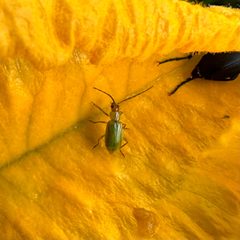
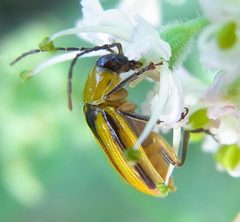
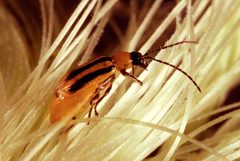
Pronunciation
How to pronounce Diabrotica virgifera: //daɪəˈbrɒtɪkə vɜːrdʒɪˈfɪərə//
These audio files are automatically generated. While they are not always 100% accurate, they are a good starting point.
Identification
are distinguished from similar Diabrotica by the specific pattern of black markings on yellow-green . The (D. v. virgifera) has three black stripes on each wing cover, while the Mexican corn rootworm (D. v. zeae) typically has reduced or irregular striping. Larvae are identified by their slender, -like form, brown capsule, and dark terminal abdominal plate. Adults may be confused with D. barberi (), which has similar size and coloration but differs in geographic range and elytral pattern. Accurate identification requires examination of elytral markings and geographic origin.
Images
Habitat
Agricultural , specifically continuous corn production systems. Larvae develop in soil associated with corn root systems. inhabit corn fields and adjacent vegetation, particularly during the reproductive stage of corn when silks are available. The thrives in regions with intensive, continuous corn .
Distribution
Native to North America, with the distributed from the Great Plains eastward through the Corn Belt to the Atlantic coast, and the Mexican corn rootworm occurring in Mexico and the southwestern United States. Introduced to Europe, first detected in Serbia in 1992, and subsequently spread to multiple European countries including Hungary, Croatia, Italy, and others. Also present in Central America.
Seasonality
One per year in most regions. overwinter in soil and hatch in spring, with timing varying by latitude: mid-April in southern regions, mid-May in northern areas. Larval feeding peaks in June. emerge in late June to July, with peak abundance in late July. Adults remain active until first frosts. In the southern United States, the related southern corn rootworm (D. undecimpunctata howardi) can have multiple generations.
Diet
Larvae feed exclusively on corn roots, including root hairs, smaller roots, and primary brace roots. feed on corn silks, pollen, tassels, and leaves, with a strong preference for green silks during the reproductive stage.
Host Associations
- Zea mays - primary Obligate for larval development; feed on reproductive tissues
Life Cycle
(one per year). are laid in soil during summer and fall, primarily within corn fields in the upper 2-8 inches of soil. Eggs enter and overwinter. Hatching occurs in spring when soil temperatures reach appropriate thresholds. Larvae progress through three instars, feeding on corn roots for approximately 3-4 weeks. occurs in soil. emerge in mid-summer, feed, mate, and oviposit in corn fields. Egg-laying begins shortly after silking and continues through late summer.
Behavior
exhibit bimodal patterns with short trivial flights and occasional sustained flights. Flight activity peaks during early morning and early evening. Adults are relatively sedentary within fields where they developed as larvae, contributing to localized buildup. Some populations have evolved - , with females laying in soybean fields or other non-corn crops, enabling survival through crop rotation cycles. Larvae are subterranean and feed on roots from within the soil profile.
Ecological Role
Major agricultural pest with significant economic impact. In natural or non-agricultural , the has minimal ecological role due to its specialized association with cultivated maize. are driven by agricultural practices, with continuous corn supporting high densities. Serves as a model organism for studying insect resistance evolution to transgenic crops and strategies.
Human Relevance
One of the most economically damaging pests of corn in North America and Europe. Larval root feeding reduces yield through impaired water and nutrient uptake, causes plant lodging, and increases harvest difficulty. silk feeding can interfere with pollination. Management costs including , Bt seed premiums, and crop impose substantial economic burden. The has driven development of transgenic Bt corn technologies and resistance management protocols. Some have evolved resistance to multiple Bt toxins (Cry3Bb1, mCry3A, eCry3.1Ab) and rotation- , challenging sustainable management.
Similar Taxa
- Diabrotica barberi; similar size, coloration, and but differs in geographic distribution (more northern range) and elytral pattern; have less distinct striping
- Diabrotica undecimpunctata howardiSouthern corn rootworm; differs in having multiple per year, more southern distribution, and spotted rather than striped elytral pattern
- Diabrotica virgifera zeaeMexican corn rootworm; distinguished by more variable, often reduced elytral markings and southwestern distribution
More Details
Resistance evolution
The has demonstrated remarkable capacity to evolve resistance to management tactics. Field-evolved resistance to Cry3Bb1 Bt toxin was first confirmed in 2011, with subsequent resistance to mCry3A, eCry3.1Ab, and Cry34/35Ab1 documented in some . Resistance evolution has been accelerated by continuous use of single-toxin Bt corn without adequate . The has also evolved behavioral resistance to crop in some populations, with females laying in non- crops.
Management strategies
Current emphasizes crop as the foundation of control, with Bt corn and soil-applied as supplementary tactics. The EPA mandates resistance management plans including structured of non-Bt corn. Research indicates that combining multiple management tactics—rotation, pyramided Bt toxins, and judicious insecticide use—provides more sustainable control than reliance on any single method.
Sources and further reading
- BugGuide
- Wikipedia
- GBIF taxonomy match
- iNaturalist taxon
- NCBI Taxonomy
- UC Davis Researcher and Colleagues Target 'Billion-Dollar Pest' | Bug Squad
- Pre-emergence insect control - AgriLife Extension Entomology
- Managing Insect and Mite Pests of Texas Corn - AgriLife Extension Entomology
- Appendix - AgriLife Extension Entomology
- Tassel to hard dough state insect control - AgriLife Extension Entomology
- For Western Corn Rootworm, Combo of Management Methods Critical to Slow Insecticide Resistance
- Diabrotica virgifera virgifera . [Distribution map].
- Management of western corn rootworm (Diabrotica virgifera virgifera)
- Toxicogenomics of Diabrotica virgifera virgifera leconte in response to eCry3.1Ab-expressing transgenic maize
- A synopsis of the nutritional ecology of larvae and adults of Diabrotica virgifera virgifera (LeConte) in the new and old world - nouvelle cuisine for the invasive maize pest Diabrotica virgifera virgifera in Europe?
- The reproductive ecology of female western corn rootworms (Diabrotica virgifera virgiferaLeConte)
- Effects of stress, genetics, and environment on microbiome composition in western corn rootworm (Diabrotica virgifera virgifera Leconte)
- Comparative flight behavior of Diabrotica virgifera virgifera and Diabrotica barberi in the laboratory
- Distribution of two rotation-resistant corn pests in eastern Iowa and effects of soybean varieties on biology of Diabrotica virgifera virgifera
- Repellent factors and host recognition cues for western corn rootworm (Diabrotica virgifera virgifera)