
Diabrotica barberi
Smith & Lawrence, 1967
northern corn rootworm
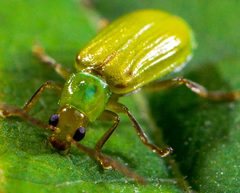
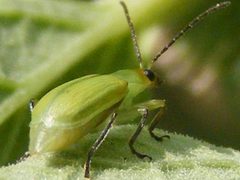
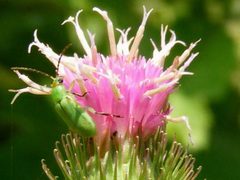
, the , is a chrysomelid native to North America and a major pest of corn (Zea mays). Larvae feed on corn roots, causing significant economic damage, while feed on corn silks, pollen, and leaves. Unlike the western corn rootworm, D. barberi has not developed resistance to Bt traits in Iowa as of 2019-2020 surveys. The exhibits extended in some , with remaining for multiple years before hatching. Research indicates its differs from D. virgifera, with shorter but more frequent flights and less sustained long-distance movement.
Pronunciation
How to pronounce Diabrotica barberi: /ˌdiːəˈbrɒtɪkə ˈbɑːrbəri/
These audio files are automatically generated. While they are not always 100% accurate, they are a good starting point.
Identification
Distinguished from the western corn rootworm (Diabrotica virgifera) by : D. barberi takes shorter flights but at higher frequency over a 23-hour period, while D. virgifera shows bimodal flight distribution with distinct short trivial flights and longer sustained flights. D. virgifera logs substantially more total flight time. D. barberi also differs from D. longicornis in reproductive and hybridization patterns—crosses between D. barberi females and D. longicornis males produce non-viable offspring, while the reciprocal cross yields viable hybrids.
Images
Habitat
Associated with agricultural fields planted to corn (Zea mays) and other cereals (Poaceae). and oviposition are strongly influenced by plant , particularly the timing of corn flowering. Simulation models indicate that planting dates, seasonal temperature patterns, and year-to-year variation in affect the synchronization of beetle with flowering corn.
Distribution
North America: Canada (Manitoba, New Brunswick, Nova Scotia, Ontario, Quebec) and United States (Alabama, Arkansas, Colorado, Connecticut, Delaware, Georgia, Illinois, Indiana, Iowa, Kansas, Kentucky, Maryland, Massachusetts, Michigan, Minnesota, Missouri, Nebraska, New Hampshire, New Jersey, New York, North Carolina, North Dakota, Ohio, Oklahoma, Pennsylvania, Rhode Island, South Carolina, South Dakota, Tennessee, Vermont, Virginia, West Virginia, Wisconsin).
Seasonality
timing varies and is sensitive to seasonal temperature patterns; activity peaks during early morning and early evening hours. Extended occurs in Nebraska , with remaining for more than one winter before hatching.
Diet
feed on corn (Zea mays) and, when corn is unavailable, goldenrod pollen. Larvae feed on corn root hairs, smaller roots, and primary roots.
Host Associations
- Zea mays - primary larvae feed on roots; feed on silks, pollen, and leaves
- Poaceae - other cereals used as
- Solidago - alternative food sourcegoldenrod pollen consumed when corn unavailable
Life Cycle
are laid in soil; some exhibit extended with multi-year dormancy. Larvae develop underground feeding on corn roots. occurs in soil. emerge and reproduce; female reproductive development and oviposition are temperature- and age-dependent. Pre-reproductive, reproductive, and post-reproductive stages have been characterized in laboratory studies.
Behavior
activity shows periodicity with peaks in early morning and early evening. Trivial flight performance does not vary with age. patterns are influenced by corn flowering , sex, and female reproductive maturity. Net from corn fields occurs on a season-long basis, with timing and magnitude of dispersal varying by field conditions.
Ecological Role
Herbivore and agricultural pest; are tightly coupled with corn . Acts as a model organism for studying insect-plant synchrony and the evolutionary of herbivores.
Human Relevance
Major economic pest of corn in North America. Survey data from Iowa (2019-2020) indicate it was the insect pest of greatest concern to corn farmers statewide, surpassing western corn rootworm in perceived importance in northeast and north-central Iowa. Management relies on crop , Bt corn (to which it has not yet developed resistance), soil-applied , and . Extended complicates management by allowing to persist across rotation cycles.
Similar Taxa
- Diabrotica virgiferaOverlapping range and shared plant (corn); distinguished by patterns, with D. virgifera showing bimodal flight distribution and greater sustained flight capacity
- Diabrotica longicornisClosely related with which hybridization has been proposed; distinguished by reproductive and hybrid viability patterns
More Details
Extended Diapause
Some Nebraska exhibit extended , with remaining viable in soil for multiple years. This trait allows populations to persist through crop cycles and complicates management strategies.
Hybridization Potential
Laboratory studies demonstrate asymmetric hybrid viability: crosses between D. longicornis females and D. barberi males produce fit offspring similar to parental , while the reciprocal cross yields poor viability and low survival. This suggests potential for in areas of sympatry.
Model Organism Status
D. barberi has been extensively studied using simulation models to understand , oviposition patterns, and insect-plant synchrony, making it one of the better-characterized agricultural pest systems.
Sources and further reading
- BugGuide
- Wikipedia
- GBIF taxonomy match
- iNaturalist taxon
- NCBI Taxonomy
- UC Davis Entomology/Nematology Fall Seminars Begin Wednesday, Sept. 21 | Bug Squad
- Jasmin Ramirez Bonilla: Targeting Cucumber Beetles on Melons | Bug Squad
- UC Davis Researcher and Colleagues Target 'Billion-Dollar Pest' | Bug Squad
- Farmer Feedback: Needs Assessment Reveals Growers' Views on Corn Insect Pests in Iowa
- For Western Corn Rootworm, Combo of Management Methods Critical to Slow Insecticide Resistance
- Bugs in orange and black: Three assassins - milkweed assassin bug, Zelus longipes; orange assassin bug, Pselliopus barberi; and wheel bug, Arilus cristatus — Bug of the Week
- Diabrotica barberi . [Distribution map].
- Fitness of Diabrotica barberi, Diabrotica longicornis, and Their Hybrids (Coleoptera: Chrysomelidae)
- Comparative flight behavior of Diabrotica virgifera virgifera and Diabrotica barberi in the laboratory
- Flight Orientation of Diabrotica virgifera virgifera and D. barberi (Coleoptera: Chrysomelidae) at Habitat Interfaces
- Reproductive Biology and Survival of Diabrotica barberi (Coleoptera: Chrysomelidae): Effect of Temperature, Food, and Seasonal Time of Emergence
- Impact of Host Plant Phenology on the Population Dynamics and Oviposition of Northern Corn Rootworms, Diabrotica barberi (Coleoptera: Chrysomelidae), in Field Corn
- Diabrotica barberi (Coleoptera: Chrysomelidae) Elevated to Species Rank Based on Behavior, Habitat Choice, Morphometrics, and Geographical Variation of Color
- A TEMPERATURE- AND AGE-DEPENDENT SIMULATION MODEL OF REPRODUCTION FOR THE NORTHERN CORN ROOTWORM, DIABROTICA BARBERI SMITH AND LAWRENCE (COLEOPTERA: CHRYSOMELIDAE)
- A SIMULATION MODEL OF NORTHERN CORN ROOTWORM, DIABROTICA BARBERI SMITH AND LAWRENCE (COLEOPTERA: CHRYSOMELIDAE), POPULATION DYNAMICS AND OVIPOSITION: SIGNIFICANCE OF HOST PLANT PHENOLOGY
- ANALYSIS OF A SIMULATION MODEL OF NORTHERN CORN ROOTWORM, DIABROTICA BARBERI SMITH AND LAWRENCE (COLEOPTERA: CHRYSOMELIDAE), DYNAMICS IN FIELD CORN, WITH IMPLICATIONS FOR POPULATION MANAGEMENT
- Frequency and Distribution of Extended Diapause in Nebraska Populations of <I>Diabrotica barberi</I> (Coleoptera: Chrysomelidae)