
Diabrotica undecimpunctata howardi
Barber, 1947
Eastern Spotted Cucumber Beetle, Southern Corn Rootworm
Diabrotica undecimpunctata howardi, the eastern of the spotted cucumber beetle, is a agricultural pest native to North America. It is distinguished from the western subspecies (D. u. undecimpunctata) by geographic range, occurring east of the Rocky Mountains. The completes one to three annually depending on latitude, with in mild climates and spreading northward seasonally. Both larval and adult stages cause economically significant damage to multiple crops.
Pronunciation
How to pronounce Diabrotica undecimpunctata howardi: //daɪ.əˈbrɒtɪkə ˌʌndɪˌsɛmˈpʌŋk.teɪtə haʊˈwɑːrdi//
These audio files are automatically generated. While they are not always 100% accurate, they are a good starting point.
Identification
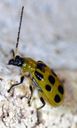
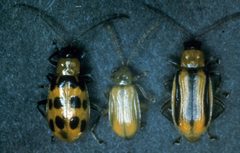
are distinguished from the western (Diabrotica undecimpunctata undecimpunctata) by geographic distribution rather than consistent morphological differences; the eastern subspecies ranges east of the Rocky Mountains to southern Nevada, southeastern California, and west to Alberta, Canada. Adults of the D. undecimpunctata have twelve black spots on a yellowish-green body, though spot patterns can vary. The species is often confused with the striped cucumber beetle (Acalymma vittatum), which has longitudinal stripes rather than spots.
Images
Habitat
Agricultural fields, particularly those containing cucurbits, corn, sorghum, beans, peanuts, and sweet potatoes. overwinter in protected areas in mild climates and disperse to fields during the growing season.
Distribution
Eastern North America: east of the Rocky Mountains, west to southern Nevada and southeastern California in the United States, and as far west as Alberta in Canada. spread seasonally northward during the growing season.
Seasonality
are active from spring through late summer, with peaking in late summer. One to three occur per year depending on region: one generation in northern areas, up to three in warmer regions. Adults overwinter in mild climates.
Diet
Larvae feed primarily on roots, stem bases, and sometimes fruit rinds in contact with soil. feed on leaves, flower petals, pollen, and fruit. Documented include corn (Zea mays), peanuts (Arachis hypogaea), squash (Cucurbita pepo), cucumber, melon, sorghum, beans, and sweet potato. Larval growth is significantly greater on corn and peanuts than on squash varieties.
Host Associations
- Zea mays - (larval and feeding)larvae feed on roots, on leaves and pollen; major economic
- Arachis hypogaea - (larval feeding)larvae cause pod scarring and penetration; primary pest in Virginia-Carolina region
- Cucurbita pepo - (larval and feeding)larval growth slower on squash compared to corn and peanuts
- Cucumis sativus - ( feeding) Erwinia tracheiphila causing bacterial wilt in eastern U.S.
- Erwinia tracheiphila - bacterial wilt transmitted to cucurbits in eastern U.S.
- Pantoea ananatis - transmitted to corn causing late-season decline ; endosymbiotic and transovarial association established
Life Cycle
Females lay in soil at the base of plants. Larvae hatch and feed on roots and stem bases, then pupate in soil. emerge and disperse by to various host plants. Development rate varies with temperature; gravid females have been observed as early as January in North Carolina when elevates body temperature sufficiently for development. Number of per year ranges from one in the north to three in warmer regions.
Behavior
are strong fliers and readily disperse between fields during the growing season. Both sexes exhibit behavioral by basking in direct sunlight on clear fall and winter days when air temperature is below 13°C, elevating body temperature up to 13.3°C above ambient. This thermoregulation enables , feeding, mating, and preovipositional development at temperatures otherwise too low for activity. On cloudy days, body temperature correlates more closely with substrate and ground temperature.
Ecological Role
Agricultural pest with significant economic impact through direct feeding damage and vectoring. As a of Erwinia tracheiphila and Pantoea ananatis, it facilitates transmission of bacterial to crop plants. The serves as prey for various vertebrate including toads (Bufo americanus, B. fowleri), deer mice (Peromyscus maniculatus), and bobwhite quail (Colinus virginianus), though cucurbitacin ingestion does not appear to confer chemical protection from .
Human Relevance
Major agricultural pest causing economic damage to cucurbits, corn, peanuts, and sweet potatoes. In the eastern U.S., feeding on cucurbits bacterial wilt (Erwinia tracheiphila), which renders plants unmarketable. In snap beans, adult feeding damages pods and interferes with pod set. Larval feeding is the primary damage agent in corn, peanuts, and sweet potato, destroying growing points in corn seedlings and causing direct damage to marketable sweet potato roots. Management relies primarily on preventative applications, with chlorpyrifos historically used until its 2022 registration revocation; isocycloseram shows promise as an alternative.
Similar Taxa
- Diabrotica undecimpunctata undecimpunctataWestern distinguished by geographic range (west of Great Basin) rather than reliable morphological characters; both subspecies overlap in southern Nevada and southeastern California
- Acalymma vittatumStriped cucumber beetle has longitudinal black stripes on rather than spots; both occur on cucurbit crops and bacterial wilt in eastern U.S.
- Diabrotica virgifera virgiferaWestern corn rootworm is similar in size and but has distinct coloration and is also a of Pantoea ananatis; co-occurs in corn fields
More Details
Thermoregulation and Overwintering
Behavioral through basking may explain observations of gravid females in January in North Carolina when air temperatures are too low for normal development. Substrate temperature is the best predictor of body temperature regardless of basking (R² = 0.94 for basking individuals, R² = 0.85 for non-basking).
Cucurbitacin Relationship
Despite the 's strong sensory attraction to cucurbitacins, these compounds do not provide protection from vertebrate . Larval growth is actually reduced at higher cucurbitacin concentrations (0.6 mg g⁻¹), suggesting a complex rather than strictly beneficial relationship with these plant secondary compounds.
Disease Vector Biology
Pantoea ananatis establishes an endosymbiotic and transovarial association with D. u. howardi, with the recovered from , , and first-instar larvae. This mechanism contributes to persistence and spread of late-season decline in corn.
Sources and further reading
- BugGuide
- GBIF taxonomy match
- iNaturalist taxon
- NCBI Taxonomy
- Spotted Cucumber Beetle: New Guide Profiles Crop Damage, Management for Polyphagous North American Pest
- Cutting Through the Complexity of Managing Early-Season Crop Pests
- Bug Eric: Fork-tailed Bush Katydid
- Cucurbitacins and predation of the spotted cucumber beetle, Diabrotica undecimpunctata howardi
- Thermoregulation by Diabrotica undecimpunctata howardi and potential effects on overwintering biology
- Western Corn Rootworm (Diabrotica virgifera virgifera LeConte) and Southern Corn Rootworm (Diabrotica undecimpunctata howardi Barber) Identified as Vectors of Late-Season Decline Disease-Causing Pantoea ananatis
- Sublethal Effects of vATPase-A and Snf7 dsRNAs on Biology of Southern Corn Rootworm, Diabrotica undecimpunctata howardi Barber
- Effects of host plant and cucurbitacin on growth of larval Diabrotica undecimpunctata howardi
- A novel insecticide, isocycloseram, shows promise as an alternative to chlorpyrifos against a direct pest of peanut, Diabrotica undecimpunctata howardi (Coleoptera: Chrysomelidae)