
Diabrotica undecimpunctata
Mannerheim, 1843
spotted cucumber beetle, southern corn rootworm, western cucumber beetle, western spotted cucumber beetle
Species Guides
2- Diabrotica undecimpunctata howardi(Eastern Spotted Cucumber Beetle)
- Diabrotica undecimpunctata undecimpunctata(Western Spotted Cucumber Beetle)
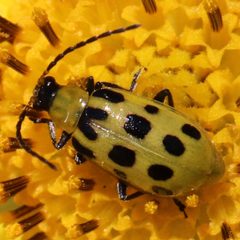
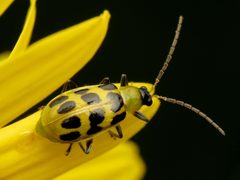
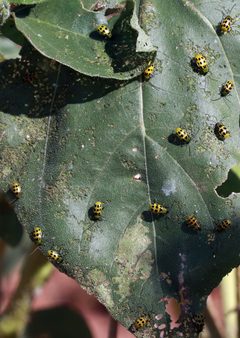
Diabrotica undecimpunctata is a leaf beetle native to North America and a major agricultural pest. are greenish-yellow with twelve black spots on the . The exhibits broad polyphagy, feeding on over 200 plant species across approximately 50 . Three are recognized, with D. u. howardi (eastern) and D. u. undecimpunctata (western) being the most significant agriculturally. The species bacterial wilt (Erwinia tracheiphila) and Pantoea ananatis, contributing to spread in cucurbits and corn.
Pronunciation
How to pronounce Diabrotica undecimpunctata: /di.aˈbɾɔ.ti.ka ʊn.dɛˌkɪm.pʌŋkˈta.ta/
These audio files are automatically generated. While they are not always 100% accurate, they are a good starting point.
Identification
Distinguished from the striped cucumber beetle (Acalymma vittatum) by spotted rather than striped elytral pattern. Differs from the banded cucumber beetle (Diabrotica balteata) by having discrete spots rather than broad bands. Superficially similar to some Meloidae and Cantharidae but has twelve distinct spots and more compact body shape. identification requires geographic location: D. u. howardi occurs east of the Rocky Mountains, D. u. undecimpunctata west of the Great Basin.
Images
Habitat
Agricultural fields, particularly those containing cucurbits, corn, beans, and other crops; also found in non-crop including sites in protected areas. overwinter in mild climates in field margins, woodlots, and other sheltered locations. Moist soil preferred for deposition.
Distribution
Native to North America. Found throughout southern Canada (British Columbia to Quebec), the continental United States, and the central highlands of Mexico. D. u. howardi ranges east of the Rocky Mountains to southern Nevada, southeastern California, and Alberta. D. u. undecimpunctata occurs west of the Great Basin in California, Oregon, Washington, Idaho, and Baja California Norte. Also present in Central America (Guatemala, El Salvador, Nicaragua) and Bermuda.
Seasonality
active from spring through fall. Overwinter as adults in mild climates. Number of per year ranges from one in northern areas to three in warmer regions. peaks in late summer. Adults disperse northward seasonally from sites.
Diet
feeder consuming over 200 plant across approximately 50 plant . Strong preference for cucurbits (Cucurbitaceae). feed on leaves, flowers, stems, pollen, and fruit. Larvae feed on roots, stem bases, and sometimes fruit rinds in contact with soil. Documented include corn, soybeans, cotton, beans, peanuts, sweet potato, squash, cucumbers, melons, apples, cherries, clover, lettuce, and potatoes.
Host Associations
- Cucurbitaceae - Primary Strong preference for cucurbits; feed on foliage and fruit, larvae on roots
- Zea mays - Larvae cause primary damage to roots; feed on leaves
- Glycine max - feed on foliage
- Arachis hypogaea - Larvae damage roots and pods; feed on vegetation
- Ipomoea batatas - Larvae feed on marketable roots causing direct damage
- Erwinia tracheiphila - Transmits bacterial wilt in cucurbits, particularly in eastern U.S.
- Pantoea ananatis - Late-Season Decline in corn; acquired and transmitted through feeding wounds and deposition
Life Cycle
Complete . Females lay 150–400 in soil near plants (up to 1,200 recorded). Eggs hatch in 6–9 days under favorable conditions, or up to 30 days in cooler temperatures. Larval stage lasts 2–3 weeks; larvae are yellowish and wormlike, feeding on roots. occurs in soil for 6–10 days; pupae measure 6.25 mm by 3.5 mm with robust terminal abdominal spines. follows. Adult lifespan approximately 60 days in summer, up to 200 days in winter.
Behavior
are strong fliers and disperse readily between fields during the growing season. Thermoregulatory observed: adults bask in direct sunlight to elevate body temperature above ambient when air temperature falls below 13°C, enabling continued activity, , feeding, and mating at otherwise suboptimal temperatures. Males engage in 'antennal stroking' during courtship, using to stroke female's antennae, , and legs. Females may mate with up to 15 males before accepting a reproductive partner.
Ecological Role
Agricultural pest causing economic damage through direct feeding and transmission. Larval root feeding destroys growing points in seedlings and reduces yield in mature plants. feeding damages reproductive structures and foliage. As a disease , facilitates spread of bacterial in agroecosystems. Serves as prey for various including carabid beetles, wolf spiders, birds, mammals, and amphibians; preyed upon by spiders, ground beetles, ants, and crickets.
Human Relevance
Major agricultural pest in North America. Economic damage to cucurbits, corn, beans, peanuts, and sweet potato. of bacterial wilt (Erwinia tracheiphila), which can destroy entire cucurbit crops. Management relies heavily on chemical control, though concerns about neurotoxicity and nontarget effects have reduced available . Cross-attraction to vittatalactone ( of striped cucumber beetle) offers potential for monitoring and attract-and-kill strategies. through conservation shows promise but is understudied.
Similar Taxa
- Acalymma vittatumStriped cucumber beetle; distinguished by three black stripes on rather than twelve spots; more specialized on cucurbits
- Diabrotica balteataBanded cucumber beetle; has greenish with broad black bands rather than discrete spots; more tropical distribution
- Diabrotica virgiferaWestern corn rootworm; similar larval damage in corn but lack distinct spotted pattern; more specialized on corn
Sources and further reading
- BugGuide
- Wikipedia
- GBIF taxonomy match
- iNaturalist taxon
- NCBI Taxonomy
- Jasmin Ramirez Bonilla: Targeting Cucumber Beetles on Melons | Bug Squad
- Spotted Cucumber Beetle: New Guide Profiles Crop Damage, Management for Polyphagous North American Pest
- Bug Eric: November 2024
- ID Challenge #8 | Beetles In The Bush
- Bug Eric: Fork-tailed Bush Katydid
- ID Challenge #8 | Beetles In The Bush
- Diabrotica undecimpunctata . [Distribution map].
- Western Corn Rootworm (Diabrotica virgifera virgifera LeConte) and Southern Corn Rootworm (Diabrotica undecimpunctata howardi Barber) Identified as Vectors of Late-Season Decline Disease-Causing Pantoea ananatis
- Cucurbitacins and predation of the spotted cucumber beetle, Diabrotica undecimpunctata howardi
- Thermoregulation by Diabrotica undecimpunctata howardi and potential effects on overwintering biology