
Diabrotica balteata
LeConte, 1865
banded cucumber beetle, belted cucumber beetle
Diabrotica balteata is a small leaf beetle in the Chrysomelidae, commonly known as the banded cucumber . It is a agricultural pest native to tropical and subtropical regions of the Americas, with its range extending from the southern United States through Central America to northern South America. The lacks and cannot tolerate freezing temperatures, limiting its northern distribution. Both larvae and cause crop damage: larvae feed on roots and tubers, while adults feed on leaves, flowers, and fruits.

Pronunciation
How to pronounce Diabrotica balteata: /diˈabɾotika balˈteata/
These audio files are automatically generated. While they are not always 100% accurate, they are a good starting point.
Identification
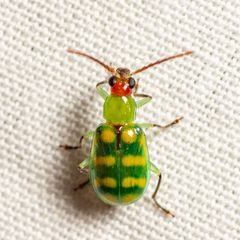
Distinguished from the spotted cucumber beetle (Diabrotica undecimpunctata) by its transverse banding pattern rather than spots. The bean leaf beetle (Cerotoma trifurcata) is similar in size and shape but has four black rectangular spots on yellowish-green wing covers and a triangular black spot at the - junction, lacking the transverse bands of D. balteata. The western striped cucumber beetle (Acalymma trivittatum) has three longitudinal stripes rather than transverse bands.
Images
Appearance
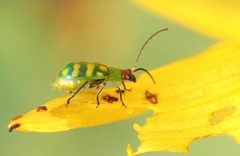
are 5–6 mm long with a red , black , and yellow marked with three transverse bands in shades of green or blue-green, plus a narrower longitudinal green line down the center. The banding pattern is variable and may be nearly absent in some individuals. Elytral coloration is influenced by plant diet. Larvae are initially white, approximately 2.3 mm long, and may turn yellow with feeding; later instars reach nearly 9 mm.
Habitat
Agricultural fields and associated non-crop in tropical and subtropical regions. Year-round activity occurs where temperatures remain between 10–30°C. longevity is optimal at 17–24°C. Abundance increases with late spring and summer rainfall.
Distribution
Native to tropical Americas; occurs from the southern United States (Arizona, California, Texas, and eastward to North Carolina and Florida) south through Mexico, Central America (Belize, Rica, El Salvador, Guatemala, Honduras, Nicaragua, Panama), and the Caribbean (Cuba) to northern South America (Colombia, Venezuela). Northern range expansion is limited by freezing intolerance.
Seasonality
In Tamaulipas, Mexico, most commonly observed May through July, a period of high . activity increases with wind speed. In suitable climates, six or seven per year are possible with no .
Diet
Highly . Larvae feed on roots and tubers of plants. feed on leaves, seedling cotyledons, fruits, flower parts, and corn silk. Primary hosts include Cucurbitaceae (cucumber, melon, squash, gourd, pumpkin), Leguminosae (common bean, lima bean, winged bean), sweet potato, and soybean. Secondary hosts include tomato, potato, cassava, rice, sorghum, wheat, maize, and crucifers.
Host Associations
- Cucumis sativus - primary cucumber
- Cucumis melo - primary melon
- Cucurbita spp. - primary squash, pumpkin, gourd
- Phaseolus vulgaris - primary common bean
- Phaseolus lunatus - primary lima bean
- Psophocarpus tetragonolobus - primary winged bean
- Ipomoea batatas - primary sweet potato
- Glycine max - primary soybean
- Solanum lycopersicum - secondary tomato
- Solanum tuberosum - secondary potato
- Manihot esculenta - secondary cassava
- Oryza sativa - secondary rice
- Sorghum bicolor - secondary sorghum
- Triticum aestivum - secondary wheat
- Zea mays - secondary maize/corn
- Brassica oleracea - secondary cabbage and crucifers
Life Cycle
Complete with , three larval instars, pupa, and . Eggs are oval, yellow, approximately 0.5 mm long, laid in clusters of up to 100 in soil cracks. Eggs hatch in 5–9 days. Larval development lasts 11–17 days. occurs in soil and lasts 4–6 days. Adults mate at approximately 6 days of age; females begin oviposition about 16 days later, laying clusters every few days for 2–8 weeks, producing up to 15 clusters and maximum 850 eggs. Adult lifespan averages 26 days. No occurs in any stage.
Behavior
are strong fliers with activity increasing during late spring and summer. activity increases with wind speed. Females oviposit in soil cracks near plants. Temperatures below 0°C are lethal to all stages; 0–4°C primarily harms larvae and pupae.
Ecological Role
Agricultural pest that reduces plant growth and fruit production through direct feeding damage. Larval root feeding and defoliation stress plants, making them susceptible to secondary . Acts as a for multiple plant including cowpea mosaic virus, cowpea severe mosaic virus, cowpea chlorotic mottle virus, bean mosaic virus, bean mild mosaic virus, quail pea mosaic virus, squash mosaic virus, melon necrotic spot virus, and bacterial wilt (Erwinia tracheiphila). Preyed upon by ants, particularly on in tropical regions. to including the tachinid fly Celatoria compressa and including Heterorhabditis spp. and Steinernema carpocapsae.
Human Relevance
Significant agricultural pest causing economic damage to diverse crops. Larval feeding riddles sweet potato tubers with holes and craters, reducing marketability. Root damage reduces plant growth and fruit production. feeding on seedlings can cause stand loss. capacity for numerous plant viruses and bacterial wilt increases crop losses beyond direct feeding damage. Management relies on , particularly targeting soil-dwelling larvae, with agents under study including . Crop and cultivars (e.g., romaine lettuce 'Valmaine') offer partial control.
Similar Taxa
- Diabrotica undecimpunctataSimilar size and general appearance, but D. undecimpunctata has spotted rather than banded elytral pattern; also known as spotted cucumber beetle or southern corn rootworm
- Cerotoma trifurcataSimilar size and shape, but has four black rectangular spots and triangular thoracic marking rather than transverse bands; known as bean leaf beetle
- Acalymma vittatumSimilar associations and , but has three longitudinal stripes rather than transverse bands; western striped cucumber beetle is a cucurbit rather than
More Details
Temperature limitations
No occurs in any life stage, preventing survival in regions with freezing temperatures. This physiological constraint explains the ' limited distribution to warmer regions of the Americas and its inability to establish in temperate zones without continuous warm-season activity.
Color plasticity
Elytral coloration varies with plant diet, with banding intensity ranging from distinct to nearly absent. This phenotypic plasticity may complicate field identification based on color pattern alone.
Sources and further reading
- BugGuide
- Wikipedia
- GBIF taxonomy match
- iNaturalist taxon
- NCBI Taxonomy
- Soybean Insects: Early-to-Late Season Pests (Emergence to R7) - AgriLife Extension Entomology
- UC Davis Entomology/Nematology Fall Seminars Begin Wednesday, Sept. 21 | Bug Squad
- Jasmin Ramirez Bonilla: Targeting Cucumber Beetles on Melons | Bug Squad
- Insect Pests of Seeds and Roots - AgriLife Extension Entomology
- Spotted Cucumber Beetle: New Guide Profiles Crop Damage, Management for Polyphagous North American Pest
- For Western Corn Rootworm, Combo of Management Methods Critical to Slow Insecticide Resistance
- Diabrotica balteata . [Distribution map].
- Biology of the Banded Cucumber Beetle, Diabrotica balteata, in Louisiana
- HOST PLANT SPECTRUM AND TEMPERATURE LIMITATIONS OF DIABROTICA BALTEATA
- Climate Change Effects on Agricultural Pests: Aphids, Diabrotica Balteata, and Asian Corn Borer in Plant-Pest Interactions and Pest Dynamics in the Context of Achieving SDGs