
Cerotoma trifurcata
(Forster, 1771)
Bean Leaf Beetle
Cerotoma trifurcata, commonly known as the bean leaf beetle, is a chrysomelid native to North America and a significant agricultural pest of soybean and other leguminous crops. overwinter in sheltered woodland edges and fence rows, migrating to soybean fields in spring to feed and reproduce. The has been documented as a of Bean Pod Mottle Virus (Comoviridae), transmitting the between plants during feeding. Its includes soil-dwelling larval stages that feed on root nodules, potentially affecting nitrogen fixation in plants.
Pronunciation
How to pronounce Cerotoma trifurcata: //sɛˈroʊtəˌmə traɪˈfɜrkətə//
These audio files are automatically generated. While they are not always 100% accurate, they are a good starting point.
Identification
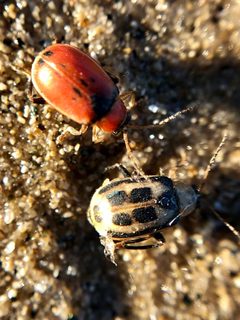
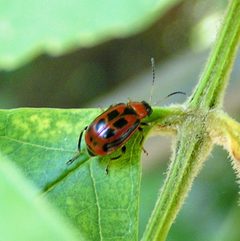
Distinguished from the banded cucumber beetle (Diabrotica balteata) by the arrangement of markings: bean leaf beetle has four spots or no pattern, while banded cucumber beetle has four transverse bands. The triangular spot at the elytral base is diagnostic for Cerotoma trifurcata. Separated from lady beetles (Coccinellidae) by body shape—bean leaf beetles are more elongate-oval with the visible from above, whereas lady beetles are strongly convex with heads tucked under pronota. Color variation within the can complicate identification; spotless forms occur.
Images
Habitat
Agricultural fields planted with soybean and other legumes; occupy woodlots, fence rows, and other sheltered sites with leaf litter and herbaceous debris. Favors areas with loose, well-drained soil suitable for larval development.
Distribution
Eastern and central North America, from Canada (Manitoba, Ontario, Québec) through the eastern and midwestern United States. Particularly abundant in the Mississippi River Valley and southern soybean-growing regions. Documented in Arkansas, Louisiana, Mississippi, Tennessee, Illinois, Iowa, and Minnesota.
Seasonality
emerge from sites when soil temperatures reach 10-15°C, typically April-May in northern regions, earlier in the south. Peak adult activity in soybean fields occurs during vegetative growth stages. Summer adults emerge mid-July to August. Adults enter reproductive in September-October and migrate to overwintering sites. Partial second generations may occur in favorable southern conditions.
Diet
feed on foliage, stems, and pods of leguminous plants, with soybean (Glycine max) as the primary . Larvae feed on roots and root nodules of the same hosts, potentially reducing nitrogen fixation capacity. Documented hosts include soybean, snap bean, and other Phaseolus .
Host Associations
- Glycine max - primary Soybean; feed on leaves and pods, larvae on roots and nodules
- Phaseolus vulgaris - Common bean; and larvae utilize this
- Bean Pod Mottle Virus - Transmitting between soybean plants during feeding
Life Cycle
overwinter in within woodlots and fence rows. Spring triggered by temperature thresholds. Females deposit singly or in small clusters in soil near plant stems. Larvae pass through three instars over 3-4 weeks, feeding on roots and nodules. occurs in soil and lasts 1-2 weeks. Summer- adults emerge mid-summer, feed, and in autumn migrate to sites to enter reproductive diapause. Partial second generations documented in southern regions with extended growing seasons.
Behavior
exhibit migratory between refugia and agricultural fields, moving in spring to colonize emerging soybeans and returning to sheltered sites in autumn. Overwintering form in protected locations with abundant plant debris. Adults are active feeders during daylight hours. capability enables between fields and patches.
Ecological Role
Herbivorous pest of soybean with documented impacts on yield through defoliation, pod damage, and root feeding by larvae. Larval feeding on nitrogen-fixing nodules may indirectly affect plant nutrition. Serves as for fungi including bassiana, which has been observed causing -dependent mortality in . Acts as biological for Bean Pod Mottle Virus, contributing to plant in agricultural systems.
Human Relevance
Major economic pest of soybean in North America, with management requiring applications including neonicotinoid . Research demonstrates economic benefits of preventive control in high-pest-pressure regions, particularly the southern United States. Virus transmission capability adds indirect damage beyond direct feeding injury. Subject of research focusing on scouting thresholds, varieties, and options.
Similar Taxa
- Diabrotica balteataSimilar size and associations; distinguished by transverse yellow bands on rather than spots, and lack of triangular basal spot
- Eriopis connexaBoth have spotted coloration and occur on soybean; distinguished by -level characters—E. connexa is a lady beetle (Coccinellidae) with strongly convex body, hidden , and predatory habit rather than herbivory
More Details
Pathogen Vector Biology
C. trifurcata is the primary of Bean Pod Mottle Virus in North American soybean production. The acquires the virus through feeding on infected plants and transmits it to healthy plants via salivary secretions during subsequent feeding. This vector relationship creates economic damage beyond direct herbivory and influences management decisions regarding timing.
Entomopathogenic Fungus Interactions
Field studies in Louisiana documented bassiana as a significant mortality factor for , with rates reaching 20% in field and 65% in laboratory-held beetles during years with large overwintering . This -dependent mortality suggests natural potential that varies with population size.
Insecticide Resistance and Management
Neonicotinoid (imidacloprid, thiamethoxam) are widely used for early-season control. Meta-analysis of 170 field trials across four southern states demonstrated consistent yield benefits from treated seed in high-pest-pressure regions, contradicting earlier EPA assessments that questioned economic returns. Yield improvements averaged 2 bushels per acre, with greater benefits in Louisiana and Mississippi compared to northern states.
Sources and further reading
- BugGuide
- GBIF taxonomy match
- iNaturalist taxon
- NCBI Taxonomy
- Soybean Insects: Early-to-Late Season Pests (Emergence to R7) - AgriLife Extension Entomology
- Treating Southern Soybeans with Neonicotinoids Yields Economic Benefits After All
- ID Challenge #16 | Beetles In The Bush
- Cerotoma-trifurcata - Entomology Today
- Ecology and management of the bean leaf beetle Cerotoma trifurcata
- Life Cycle of the Bean Leaf Beetle, Cerotoma trifurcata (Coleoptera: Chrysomelidae), in Southern Minnesota
- Ecology of the bean leaf beetle Cerotoma trifurcata (Forster): improving preventive and curative insect management
- The literature of arthropods associated with soybeans : III, a bibliography of the bean leaf beetles, Cerotoma trifurcata (Forster) and C. ruficornis (Olivier) (Coleoptera: Chrysomelidae)
- Spatial and Temporal Distribution Patterns of the Bean Leaf Beetle, Cerotoma trifurcata (Forster) 1 , on Soybeans in Illinois 2
- No-Choice Preference of Cerotoma trifurcata (Coleoptera: Chrysomelidae) to Potential Host Plants of Bean Pod Mottle Virus (Comoviridae) in Iowa
- Distribution of Bean Pod Mottle Virus in Arkansas Soybean as Related to the Bean Leaf Beetle, Cerotoma trifurcata , (Coleoptera: Chrysomelidae) Population 1
- Impact of Beauveria bassiana (Balsamo) Vuillemin on survival of overwintering Bean Leaf Beetles, Cerotoma trifurcata (Forster), (Coleoptera, Chrysomelidae)
- No-Choice Preference of <I>Cerotoma trifurcata</I> (Coleoptera: Chrysomelidae) to Potential Host Plants of Bean Pod Mottle Virus (<I>Comoviridae</I>) in Iowa