
Cerotoma
Chevrolat, 1836
bean leaf beetles
Species Guides
3- Cerotoma atrofasciata(Bean Leaf Beetle)
- Cerotoma ruficornis(bean leaf beetle)
- Cerotoma trifurcata(Bean Leaf Beetle)
Cerotoma is a of leaf beetles (Chrysomelidae) containing approximately seven described distributed across North America and the Neotropics. The genus is best known for Cerotoma trifurcata, commonly called the bean leaf beetle, a significant agricultural pest of soybean and common bean. feed on foliage and pods, while larvae feed on roots and root nodules. The genus exhibits strong associations with leguminous plants.
Pronunciation
How to pronounce Cerotoma: /sɛˈroʊtəˌmə/
These audio files are automatically generated. While they are not always 100% accurate, they are a good starting point.
Identification
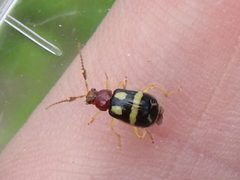
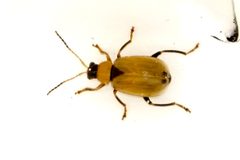
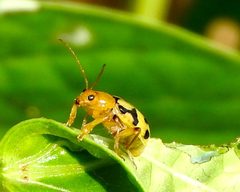
Cerotoma are small to medium leaf beetles, generally 5–7 mm in length, with an oval to slightly elongated body shape. typically display variable coloration, often yellowish-green to reddish with dark markings. Cerotoma trifurcata, the most studied species, commonly shows four black rectangular spots on the and a distinctive triangular black spot at the junction of the and . are thread-like and of moderate length. The can be distinguished from similar chrysomelids like Diabrotica (cucumber beetles) by body proportions and specific spot patterns, though species-level identification requires examination of genitalia or detailed color pattern analysis.
Images
Habitat
Agricultural systems and natural areas supporting leguminous plants. Found in soybean fields, bean crops, and adjacent vegetation. overwinter in leaf litter, field margins, and protected sites.
Distribution
North America and the Neotropics. Records include the United States (particularly southern and midwestern states including Minnesota, Illinois, Louisiana, Mississippi, Arkansas, Tennessee), with southern Minnesota representing a documented northern limit for C. trifurcata . Neotropical distribution includes Central and South America.
Seasonality
emerge in spring when temperatures warm, typically coinciding with of plants. laying occurs in spring and early summer. New adults emerge in mid-summer, with potential for second in southern ranges. Adults seek overwintering sites in fall.
Diet
Larvae feed on roots and root nodules of leguminous plants. feed on foliage, creating round holes in leaves, and may feed on pods. Documented include Glycine max (soybean) and Phaseolus spp. (common bean).
Host Associations
- Glycine max - primary soybean
- Phaseolus spp. - primary common bean
- leguminous crops - general association
Life Cycle
emerge in spring and feed on young plants. Females lay in soil near host plant bases. Eggs hatch in approximately one week. Larvae pass through three instars, feeding on roots and nodules. occurs in soil. New adults emerge in mid-summer; second possible in favorable conditions. Adults migrate to overwintering sites in fall.
Behavior
are active during daylight hours. Strong capability allows between fields. involves in protected sites with leaf litter. Adults demonstrate preference for legume and may move en masse into fields from overwintering sites.
Ecological Role
Agricultural pest of legume crops. Larval root feeding damages nitrogen-fixing nodules, potentially reducing plant nitrogen availability. defoliation can reduce photosynthetic capacity and pod feeding directly impacts yield. Serves as early-season pest in soybean production systems.
Human Relevance
Significant economic pest of soybean and snap bean production. Bean leaf beetle (C. trifurcata) is a primary target of applications, including neonicotinoid . Feeding damage can reduce yield; guide management decisions. The has been demonstrated to show economic benefit from preventive insecticide treatments in high pest pressure regions of the southern United States.
Similar Taxa
- Diabrotica balteataSimilar size, shape, and in soybean fields; distinguished by green or yellowish-green with four lighter crosswise bands rather than black spots, and different proportions
- Diabrotica undecimpunctata howardiOverlapping agricultural and legume feeding; spotted cucumber beetle has different spot arrangement and more elongated body form
Sources and further reading
- BugGuide
- Wikipedia
- GBIF taxonomy match
- iNaturalist taxon
- NCBI Taxonomy
- Catalogue of Life
- Soybean Insects: Early-to-Late Season Pests (Emergence to R7) - AgriLife Extension Entomology
- Cerotoma-trifurcata - Entomology Today
- Treating Southern Soybeans with Neonicotinoids Yields Economic Benefits After All
- ID Challenge #16 | Beetles In The Bush
- Ecology and management of the bean leaf beetle Cerotoma trifurcata
- Ecology of the bean leaf beetle Cerotoma trifurcata (Forster): improving preventive and curative insect management
- Life Cycle of the Bean Leaf Beetle, Cerotoma trifurcata (Coleoptera: Chrysomelidae), in Southern Minnesota
- The literature of arthropods associated with soybeans : III, a bibliography of the bean leaf beetles, Cerotoma trifurcata (Forster) and C. ruficornis (Olivier) (Coleoptera: Chrysomelidae)
- Biology of Cerotoma arcuatus (Coleoptera: Chrysomelidae) and Field Validation of a Laboratory Model for Temperature Requirements
- Spatial and Temporal Distribution Patterns of the Bean Leaf Beetle, Cerotoma trifurcata (Forster) 1 , on Soybeans in Illinois 2