
Acalymma trivittatum
(Mannerheim, 1843)
Western Striped Cucumber Beetle
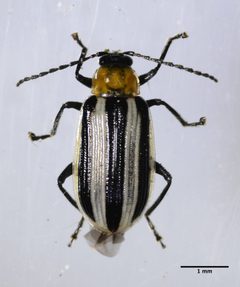
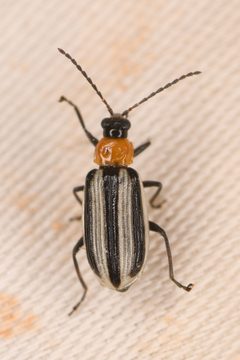
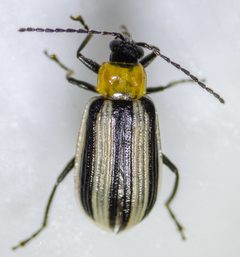
Acalymma trivittatum, the western striped cucumber , is a leaf beetle native to western North America. It is a key agricultural pest of cucurbit crops including melons, cucumbers, squash, and pumpkins. The is closely related to the eastern striped cucumber beetle (Acalymma vittatum), with which it shares similar and damage potential. Both and larvae cause significant economic injury through direct feeding damage and transmission of bacterial wilt Erwinia tracheiphila.
Pronunciation
How to pronounce Acalymma trivittatum: //əˈkælɪmə tɹɪvɪˈteɪtəm//
These audio files are automatically generated. While they are not always 100% accurate, they are a good starting point.
Identification
Distinguished from its sister Acalymma vittatum by geographic range: A. trivittatum occurs west of the Rocky Mountains while A. vittatum occurs to the east. Both species have yellow with three longitudinal black stripes. The species is also similar in appearance to the western spotted cucumber beetle (Diabrotica undecimpunctata undecimpunctata), but the latter has black spots rather than stripes on yellow elytra.
Images
Habitat
Associated with cultivated and wild cucurbit plants. Non-crop and include vegetation near agricultural fields, though specific plants in these habitats are not well documented.
Distribution
Western North America, primarily west of the Rocky Mountains. Ranges from southern Canada through the western United States to most of Mexico. Also present in Central America.
Seasonality
are active during the growing season. Number of per year ranges from one in northern latitudes to three in southern, warmer regions. Adults disperse from sites to cucurbit crops in spring.
Diet
feeder on plants in the Cucurbitaceae. feed on cotyledons, leaves, stems, flowers, and fruit. Larvae feed on roots and may damage fruit rinds in contact with soil.
Host Associations
- Cucurbitaceae - primary pest; includes melons (Cucumis melo), cucumbers, squash, gourds, and pumpkins
Life Cycle
Females lay at the base of plants below the soil surface. A single female may lay up to 1,500 eggs over her lifetime. Larvae hatch and feed on roots, then pupate in soil. emerge from and may disperse by to new host plants. Complete development from egg to adult occurs within the growing season; number of varies with latitude.
Behavior
are strong fliers and rapidly locate and aggregate on preferred cucurbit . Both sexes are attracted to the vittatalactone, which is produced by males of the related A. vittatum and appears to function cross-species. Adults disperse from field to field during the growing season.
Human Relevance
Major agricultural pest of cucurbit crops. Economic damage includes seedling mortality, stunted growth, reduced fruit set, fruit scarring and rot, and transmission of bacterial wilt (Erwinia tracheiphila), which can destroy susceptible crops. Management relies heavily on , though resistance development and non-target effects on create challenges. , , and -based monitoring show promise for integrated management.
Similar Taxa
- Acalymma vittatumSister with nearly identical appearance and ; distinguished primarily by geographic range east of the Rocky Mountains
- Diabrotica undecimpunctata undecimpunctataWestern spotted cucumber beetle; similar size and coloration but with black spots rather than stripes on ; broader range and generally considered a milder pest of cucurbits
More Details
Pheromone research
The synthetic vittatalactone, derived from male A. vittatum, attracts both A. trivittatum and D. undecimpunctata, offering potential for improved monitoring and targeted management.
Research needs
Critical knowledge gaps include specific non-crop plants used for , short-distance dynamics after harvest, and optimized scouting protocols for this .
Sources and further reading
- BugGuide
- Wikipedia
- GBIF taxonomy match
- iNaturalist taxon
- NCBI Taxonomy
- Jasmin Ramirez Bonilla: Targeting Cucumber Beetles on Melons | Bug Squad
- Chemical Ecologist to Speak at UC Davis on 'The Smells of Dinner, Death, and Danger' | Bug Squad
- Striped Cucumber Beetles: A New Guide Reviews Management Options for Vexing Cucurbit Pests
- Integrated Pest Management Pays for Midwestern Watermelon Growers
- Bug Eric: City Nature Challenge 2023 Recap
- Spotted Cucumber Beetle: New Guide Profiles Crop Damage, Management for Polyphagous North American Pest