
Neogalerucella calmariensis
(Linnaeus, 1767)
black-margined loosestrife beetle, purple loosestrife beetle
A small leaf beetle in the Chrysomelidae, native to Europe and Asia, that has been introduced to North America as a agent for purple loosestrife (Lythrum salicaria). and larvae feed on leaves and meristems of their plant, causing significant damage that reduces plant vigor and seed production. The is one of several Neogalerucella beetles used in loosestrife biocontrol programs.
Pronunciation
How to pronounce Neogalerucella calmariensis: //ˌniː.oʊ.ɡæləˈruːsɛlə ˌkælməˈriːɛn.sɪs//
These audio files are automatically generated. While they are not always 100% accurate, they are a good starting point.
Identification
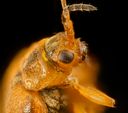
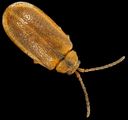
Distinguished from other Neogalerucella by the combination of black elytral margins and bronze-green coloration. N. calmariensis has narrower black margins than N. pusilla, which has broader, more extensive black markings. N. calmariensis also prefers drier upland compared to N. pusilla, which is associated with wetter sites. Microscopic examination of male genitalia may be required for definitive identification.
Images
Appearance
are small, oval leaf beetles approximately 4–6 mm in length. The body is bronze-green to coppery with distinct black margins along the . are thread-like and moderately long. Larvae are pale yellowish to greenish, soft-bodied, and slug-like in form, with dark fecal shields carried on their backs.
Habitat
Associated with purple loosestrife (Lythrum salicaria) stands in wetlands, riparian zones, and disturbed moist areas. In its native range, occurs in meadows, riverbanks, and marsh edges where the plant grows. In North America, found wherever loosestrife has established, from wetlands to roadside ditches.
Distribution
Native to Europe and temperate Asia. Introduced and established in North America, including Canada (Alberta, Ontario, Quebec, Maritime provinces) and the northern United States, for of purple loosestrife.
Seasonality
emerge from sites in late spring (May–June in temperate regions), with peak activity in summer. Larval development occurs through summer. New adults appear in late summer, overwinter in leaf litter or soil, and resume activity the following spring.
Diet
Specialized feeder on purple loosestrife (Lythrum salicaria). chew small round holes in leaves and feed on meristem tissue. Larvae skeletonize leaves and feed on growing tips. Has been observed to occasionally feed on related Lythraceae in captive conditions, but field remain tightly associated with L. salicaria.
Host Associations
- Lythrum salicaria - primary Required for development and ; the sole in natural
Life Cycle
Holometabolous with one per year in temperate regions. are laid in rows on leaves and stems of plants. Larvae pass through three instars, feeding gregariously when young and dispersing as they mature. occurs in soil at the base of host plants. overwinter and emerge to feed and reproduce the following spring.
Behavior
are active fliers and readily disperse to new patches. Both adults and larvae feed openly on foliage, often conspicuously positioned on upper leaf surfaces. Larvae carry fecal material as a defensive shield. Adults may drop from plants when disturbed ().
Ecological Role
As a herbivore, regulates purple loosestrife in native range and suppresses loosestrife in introduced range. Reduces plant , flowering, and seed set. Serves as prey for including birds, spiders, and predatory insects. Part of a guild of loosestrife biocontrol agents that collectively reduce weed .
Human Relevance
Widely used in North American programs against purple loosestrife since the 1990s. Released by government agencies and conservation organizations to restore wetland degraded by loosestrife invasion. Not considered a pest; no economic or agricultural impacts. Subject of extensive research on weed biocont efficacy and non-target risk.
Similar Taxa
- Neogalerucella pusillaOverlaps in range and use; distinguished by broader black elytral markings and preference for wetter microhabitats
- Neogalerucella grisescensAnother loosestrife-feeding with more uniformly grayish coloration and different geographic distribution
- Galerucella spp.Related leaf beetles in same ; differ in associations and usually lack the distinct black marginal pattern
More Details
Biological control history
First released in North America in 1992 after extensive -specificity testing. Now established across the northern tier of the United States and southern Canada. Often released in combination with N. pusilla and the root-feeding weevil Hylobius transversovittatus for integrated loosestrife management.
Population dynamics
can reach high densities and cause severe defoliation of loosestrife stands. Effectiveness varies by site; populations often lag behind loosestrife expansion, leading to patchy control. Climate and site hydrology influence establishment success.