
Hylobius transversovittatus
(Goeze, 1777)
Purple Loosestrife Root Borer
A root-boring weevil native to Europe, Asia, northwest Africa, and parts of Australia. and larvae feed exclusively on purple loosestrife (Lythrum salicaria). Introduced to North America in 1992 as a agent to manage of its plant in wetlands.
Pronunciation
How to pronounce Hylobius transversovittatus: /hɪˈloʊbiəs trænsˌvɜːrsoʊvɪˈteɪtəs/
These audio files are automatically generated. While they are not always 100% accurate, they are a good starting point.
Identification
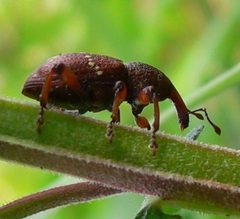
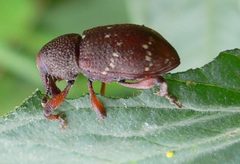
Distinguished from other Hylobius by the two irregular transverse lines of white hair tufts on the . The combination of dark brown coloration, narrow and , curved , and association with purple loosestrife provides additional diagnostic characters. Larvae are recognized by their creamy color, dark brown head capsules, and crescent shape when extracted from roots.
Images
Appearance
weevils are dark brown, approximately 13 mm long and 6 mm wide, with two irregular transverse lines of tufts of white hair. The and are narrow, with a curved trunk-like . are elbowed; legs are reddish. are white or pale yellow, oval. Larvae are creamy-colored with dark brown heads, crescent-shaped.
Habitat
Wetlands and riparian areas where purple loosestrife grows; occur in soil or leaf litter. Larval development occurs within root tissues of plants, with development potentially interrupted by flooding.
Distribution
Native to Europe, Asia, northwest Africa, and parts of Australia. Introduced to the United States and Canada beginning in 1992, with established in the northeastern United States, southeastern Canada, and the American Midwest.
Seasonality
emerge from sites in spring. Most active from June to August. Adults may emerge from chambers between July and October. Can overwinter in any life stage: , larvae, pupae, or adults.
Diet
feed on leaves of purple loosestrife (Lythrum salicaria), creating ragged edges. Larvae feed initially on root hairs, then tunnel into roots and feed on woody rootstock tissue.
Host Associations
- Lythrum salicaria - obligatePrimary ; purple loosestrife. feed on foliage, larvae bore into roots.
- Lythrum alatum - incidentalWinged loosestrife; limited attack observed only under artificial test conditions, not preferred when purple loosestrife available.
- Decodon verticillatus - incidentalSwamp loosestrife; limited attack observed only under artificial test conditions, not preferred when purple loosestrife available.
Life Cycle
Females deposit approximately 200 singly over 2-3 months near roots or occasionally on stems. Eggs hatch in about two weeks. Larvae undergo two over 1-2 years, feeding on root tissues. occurs in chambers formed in upper root regions, followed by a final molt to pupa. emerge by chewing through root tissue. All life stages can overwinter.
Behavior
are mostly . Females oviposit singly. Larvae tunnel through root tissue, with development resuming after flood interruption. Adults may live for several years.
Ecological Role
herbivore of purple loosestrife. In native range, contributes to of plant. In North America, deployed as agent to reduce purple loosestrife abundance, improve native wetland plant , and restore biodiversity. Larval root damage weakens host plants, reduces seed production, and increases susceptibility to environmental stress.
Human Relevance
Used in programs since 1992 to manage purple loosestrife in North American wetlands. Field releases approved following specificity testing and environmental assessment. Established have achieved 28% root rates at release sites within six years, with larval documented up to 400 meters downstream.
Similar Taxa
- Other Hylobius speciesShare general weevil but lack the distinctive transverse white hair tuft patterns and specific association with purple loosestrife.
- Galerucella spp. (leaf beetles)Also used for purple loosestrife biocontrol but differ in feeding on foliage rather than roots; and larvae are leaf-feeders, not root-borers.
More Details
Biological Control Efficacy
feeding causes minimal damage; larval root-boring is the primary control mechanism. Multiple larvae in a single rootstock substantially weaken plants. Six years post-introduction, 28% of roots at release sites were infested, with downstream larval confirmed.
Host Specificity Testing
Pre-release testing on approximately 50 North American native plants demonstrated high specificity. Attack on two native Lythraceae occurred only under artificial conditions; purple loosestrife was strongly preferred when available.
Sources and further reading
- BugGuide
- Wikipedia
- GBIF taxonomy match
- iNaturalist taxon
- NCBI Taxonomy
- Catalogue of Life
- Host specificity tests of Hylobius transversovittatus goeze (Coleoptera: Curculionidae), a potential biological control agent of purple loosestrife, Lythrum salicaria L. (Lythraceae)
- Host Specificity and Environmental Impact of the WeevilHylobius transversovittatus, a Biological Control Agent of Purple Loosestrife (Lythrum salicaria)