
Galerucella nymphaeae
(Linnaeus, 1758)
water-lily beetle, water lily leaf beetle
Galerucella nymphaeae is a skeletonizing leaf beetle in the Chrysomelidae. and larvae feed on aquatic and semi-aquatic plants, primarily in the families Nymphaeaceae and Polygonaceae. The exhibits a distinctive reproductive strategy where adults mate in summer but delay oviposition until spring after . show genetically based in , size, and reproductive traits associated with host plant use, suggesting incipient host race formation.
Pronunciation
How to pronounce Galerucella nymphaeae: //ɡæləˈruː.sɛlə ˌnɪmˈfiː.iː//
These audio files are automatically generated. While they are not always 100% accurate, they are a good starting point.
Identification
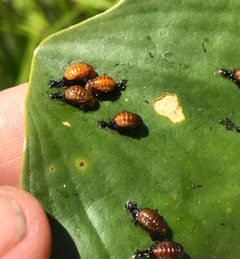
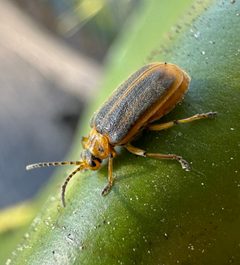
from Nymphaeaceae (Nuphar, Nymphaea) are larger, darker in color, and possess disproportionately larger than those from Polygonaceae hosts (Polygonum, Rumex). First instar larvae from Nymphaeaceae hosts have capsules 17–28% larger than those from Polygonaceae hosts. Adults possess pointed setae on the first two tarsomeres and spatula-shaped setae on the third tarsomere, which function in underwater attachment.
Images
Habitat
Distribution
Holarctic distribution, present in North America and Europe. Documented from Belgium, The Netherlands, Germany, Finland, and North America.
Seasonality
emerge in mid-summer, feed and mate, then enter reproductive for winter. Oviposition occurs in spring following diapause termination. Most females in the summer enter reproductive diapause without ovipositing; a small proportion of early-emerging females oviposit before entering diapause.
Diet
Herbivorous. and larvae feed on leaves of plants. Feeding preference is strongly biased toward natal host plant , with 88–98% of consumption on the natal host.
Host Associations
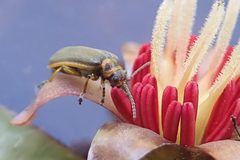
- Nuphar lutea - primary Yellow water lily; and larvae feed on floating leaves
- Nymphaea alba - primary White water lily; and larvae feed on floating leaves
- Nymphaea spp. - primary Water lily
- Polygonum amphibium - secondary Water knotweed; semi-aquatic
- Rumex hydrolapathum - secondary Water dock; semi-aquatic
- Lythrum spp. - recorded Loosestrife; noted in some
Life Cycle
(one per year). Larvae pass through three instars feeding on leaves. Mature larvae drop from host plants to soil to pupate. New emerge in summer. The consists primarily of first-generation adults with a small number from a potential second generation.
Behavior
Possesses a reversible underwater attachment system using tarsal air bubbles trapped beneath hairy attachment structures, enabling adherence to submerged surfaces for 2–3 minutes (up to >5 minutes in some individuals). When pressed underwater, opens to reveal abdominal air bubble and waggles legs before detaching. On inclined submerged surfaces, running beetles immediately ascend while stationary beetles begin ascending within ~35 seconds. When sprayed with water to simulate rain, stops moving and withstands the "shower." Females assess and larval load when making oviposition decisions. plants serve as mating sites, promoting positive assortative mating.
Ecological Role
Herbivore on aquatic macrophytes. Grazing activity influences water lily leaf condition. Potential agent given -specific feeding patterns.
Human Relevance
Closely related to European Galerucella introduced to North America for of purple loosestrife (Lythrum salicaria). Studied as a model for developing rearing paradigms for chrysomelids. Underwater attachment mechanism has biomimetic applications for reversible underwater adhesion technologies.
Similar Taxa
- Galerucella sagittariae in the G. nymphaeae ; does not hybridize in nature despite easy laboratory hybridization. Distinguished by association (Comarum palustre, Rubus chamaemorus vs. Nuphar lutea), though are morphologically similar. Complete avoidance of Nuphar by G. sagittariae.
- Galerucella pusillaRelated used for of purple loosestrife; G. nymphaeae was considered as a potential agent before specificity concerns.
Sources and further reading
- BugGuide
- Wikipedia
- GBIF taxonomy match
- iNaturalist taxon
- NCBI Taxonomy
- Underwater Attachment of the Water-Lily Leaf Beetle Galerucella nymphaeae (Coleoptera, Chrysomelidae)
- Host preference and larval performance suggest host race formation in Galerucella nymphaeae
- Life history of Galerucella nymphaeae and implications of reproductive diapause for rearing univoltine chrysomelids
- Attachment ofGalerucella nymphaeae(Coleoptera, Chrysomelidae)to surfaces with different surface energy
- Small-scale distributional dynamics of the yellow water-lily and its herbivore Galerucella nymphaeae (Coleoptera: Chrysomelidae)
- Differences in morphology and reproductive traits of Galerucella nymphaeae from four host plant species
- Egg and larval load assessment and its influence on oviposition behaviour of the leaf beetle Galerucella nymphaeae
- A cytological study of the changes occurring in the oenocytes of Galerucella nymphaeae Linn. during the larval and pupal periods of development
- GENETICALLY BASED POLYMORPHISMS IN MORPHOLOGY AND LIFE HISTORY ASSOCIATED WITH PUTATIVE HOST RACES OF THE WATER LILY LEAF BEETLE, GALERUCELLA NYMPHAEAE
- Species and habitat races in the chrysomelid Galerucella nymphaeae species complex in northern Europe
- GENETICALLY BASED POLYMORPHISMS IN MORPHOLOGY AND LIFE HISTORY ASSOCIATED WITH PUTATIVE HOST RACES OF THE WATER LILY LEAF BEETLE, GALERUCELLA NYMPHAEAE
- The genome sequence of a leaf beetle, Galerucella nymphaeae (Linnaeus, 1758).