
Psylliodes affinis
(Paykull, 1799)
Potato Flea Beetle
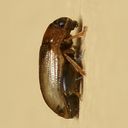
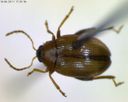
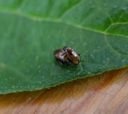
Psylliodes affinis, commonly known as the potato flea beetle, is a flea beetle in the Chrysomelidae. It is distributed across Europe, Northern Asia (excluding China), and North America. As a member of the Psylliodes, it shares the characteristic jumping ability that gives flea beetles their .
Pronunciation
How to pronounce Psylliodes affinis: /ˌsɪ.laɪˈoʊ.diːz əˈfaɪ.nɪs/
These audio files are automatically generated. While they are not always 100% accurate, they are a good starting point.
Identification
Psylliodes affinis can be distinguished from other flea beetles by its association with potato and related solanaceous crops. Members of the Psylliodes are characterized by their enlarged hind adapted for jumping, a trait that separates them from other chrysomelid beetles. Specific morphological features distinguishing P. affinis from such as P. chrysocephala (cabbage-stem flea beetle) require examination of subtle characters including punctation patterns and body proportions.
Images
Distribution
Europe and Northern Asia (excluding China); North America. The has been recorded as present in Belgium.
Host Associations
- Solanum tuberosum - feeds on 'potato flea beetle' indicates association with potato, though specific feeding records are not detailed in available sources
Behavior
Like other flea beetles, P. affinis possesses enlarged hind legs that enable a characteristic jumping escape response when disturbed. This is the origin of the 'flea beetle.'
Human Relevance
The 'potato flea beetle' suggests agricultural significance as a potential pest of potato crops, though specific economic impact data is not available in the provided sources.
Similar Taxa
- Psylliodes chrysocephalaAlso a Psylliodes with jumping ability, but associated with brassica crops (cabbage-stem flea beetle) rather than potato
More Details
Nomenclature
Originally described as Galeruca affinis by Paykull in 1799, later transferred to Psylliodes. The specific epithet 'affinis' (Latin for 'related' or 'similar') likely refers to its resemblance to other in the genus.
Sources and further reading
- BugGuide
- Wikipedia
- GBIF taxonomy match
- iNaturalist taxon
- NCBI Taxonomy
- Meet 'Mantis Master Keeper' Andrew Pfeifer | Bug Squad
- Saving the Rusty-Patched Bumble Bee | Bug Squad
- Take 2 on tropical tiger moths: Spotted oleander caterpillar moth, Empyreuma affinis — Bug of the Week
- Mason bees in peril when parasitic wasps arrive – Leucospid wasp, Leucospis affinis — Bug of the Week
- A Tick that Feeds on Birds May Increase the Range of Lyme Disease
- Learning the Insect Lingo While Working Abroad