
Psylliodes chrysocephala
(Linnaeus, 1758)
cabbage-stem flea beetle, cabbage stem flea beetle
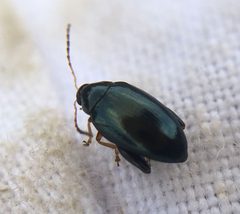
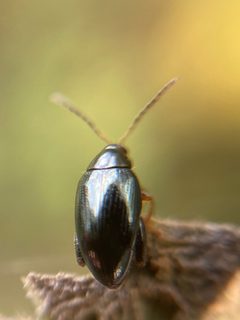
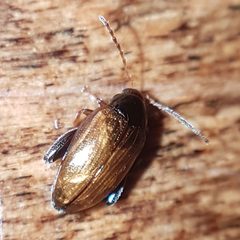
Psylliodes chrysocephala, the cabbage-stem flea beetle, is a small flea beetle native to the Western Palaearctic and introduced to Canada. It is a major agricultural pest of winter oilseed rape (Brassica napus) in northern Europe, with feeding on leaves and larvae mining within petioles and stems. The exhibits an obligatory summer period to survive heat and desiccation stress, with complex physiological and genetic mechanisms regulating this dormancy. Management has become increasingly difficult due to neonicotinoid bans and rising resistance.
Pronunciation
How to pronounce Psylliodes chrysocephala: /psɪˈlaɪoʊdiːz ˌkraɪsoʊˈsɛfələ/
These audio files are automatically generated. While they are not always 100% accurate, they are a good starting point.
Identification
Distinguished from by three key characters: absence of angles on the pronotum, equally coarse punctation on and , and first front tarsal segment equal in length to third. The orange-red hind with darkened apices and metallic blue coloration are helpful field characters, though coloration is variable.
Images
Habitat
Agricultural and semi-natural containing Brassicaceae plants; strongly associated with cultivated and wild members of the mustard . Found in winter oilseed rape fields, on cabbages, cauliflowers, turnip rape, watercress, radish, mustards, and nasturtium. aestivate during summer in sheltered locations to avoid heat and desiccation.
Distribution
Native to Western Palaearctic including Macaronesia, Cape Verde, and North Africa; introduced to Canada. In England, historically most abundant in Buckinghamshire, Cambridgeshire, Huntingdonshire, and Northamptonshire with localized occurrences in 13 other counties.
Seasonality
active from late summer through spring; mate in late August with oviposition from late September through mid-April. Larvae develop through winter and spring, pupating in early summer. New adults emerge from May. Obligatory summer period from approximately June to August.
Diet
feed on leaves of Brassicaceae; larvae mine within petioles and stems of plants. Feeding stimulated by glucosinolates and sugars, though glucosinolates are not prerequisite for feeding.
Host Associations
- Brassica napus - primary winter oilseed rape, major crop pest
- Brassica nigra - black mustard
- Brassica oleracea - cabbages, cauliflowers
- Brassica rapa - turnip rape
- Nasturtium officinale - watercress
- Raphanus sativus - radish
- Sinapis alba - white mustard; shows larval
- Sinapis arvensis - wild mustard
- Tropaeolum majus - common nasturtium
Life Cycle
laid in soil beneath plant at 1-5 cm depth, in small clusters; single female may lay up to 1000 eggs. Eggs hatch after approximately 60 days (240 above 3.2°C). Larvae feed internally in stems and petioles for several weeks, completing development in about 4 weeks with 20-fold size increase. Fully developed larvae emerge and pupate in soil. New appear from May, may enter period after harvest of mature rape plants, then mate in late summer with some adults .
Behavior
possess enlarged hind enabling -like jumping. Exhibits obligatory summer as adults to survive heat and desiccation stress, involving dramatic metabolic suppression, reserve reduction, and lipid reserve increase. Females attracted to volatile organic compounds from mechanically damaged oilseed rape plants; males show no such response, indicating in olfactory sensitivity. Antennal contact chemosensilla respond to cruciferous including glucosinolates. Mating involves active antennal movement by males at beginning and end of copulation.
Ecological Role
Significant agricultural pest causing yield losses; larvae do not appear to substantially reduce yields despite being present in plants. Natural enemies present but effects quantified. cycles with peaks at approximately seven-year intervals reported in central Europe.
Human Relevance
Major pest of winter oilseed rape in northern Europe; most important establishment pest of rape in UK with potential yield losses up to 20% reported historically, though recent data suggests lower actual losses. Management complicated by neonicotinoid bans and resistance development. Subject of research into interference-based control methods and strategies.
Similar Taxa
- Psylliodes luridipennisLundy Cabbage Flea Beetle, to Lundy Island; distinguished by distribution and plant specificity
- Other Psylliodes speciesDifferentiated by pronotal angles, punctation , and front tarsal segment proportions
More Details
Physiological research
Subject of extensive research on transporters (Tret-1 and Tret-2) regulating energy metabolism during ; microRNA shown to regulate obligatory aestivation with 25% of miRNAs differentially abundant during dormancy
Pest management challenges
strategies limited by lack of cultivars, time-consuming monitoring methods, absence of threshold models based on plant physiological , and lack of registered non-synthetic alternatives
Host plant resistance
Larval appears absent in Brassica napus possibly due to domestication bottlenecks, but present in Sinapis alba, offering potential for resistance breeding
Sources and further reading
- BugGuide
- Wikipedia
- iNaturalist taxon
- Learning the Insect Lingo While Working Abroad
- Democracy, Evidence, Neonics, Oilseed Rape and Bees - Buglife Blog - Buglife
- Secret Pesticides Documents Revealed - Buglife Blog - Buglife
- The Drugs (Neonicotinoids) Don’t Work 5 - Buglife Blog - Buglife
- The Drugs (Neonicotinoids) Don’t Work 3 - Buglife Blog - Buglife
- In Search of Britain’s Endemics - Buglife Blog - Buglife
- Antennal contact chemosensilla in Psylliodes chrysocephala responding to cruciferous allelochemicals
- Antennal glands in Psylliodes chrysocephala , and their possible role in reproductive behaviour
- Reciprocal roles of two trehalose transporters in aestivating cabbage stem flea beetles ( Psylliodes chrysocephala )
- Physiological and transcriptional changes associated with obligate aestivation in the cabbage stem flea beetle (Psylliodes chrysocephala)
- Data analysis of flea beetle (Psylliodes chrysocephala L.): comparing three (3) distribution families of Generalized Linear Model
- The microRNA pathway regulates obligatory aestivation in the cabbage stem flea beetle Psylliodes chrysocephala
- Larval antibiosis to cabbage stem flea beetle ( Psylliodes chrysocephala ) is absent within oilseed rape ( Brassica napus )
- Observations on the cabbage stem flea beetle, Psylliodes chrysocephala, on winter oil‐seed rape in Cambridgeshire
- Understanding crop colonization of oilseed rape crops by the cabbage stem flea beetle (Psylliodes chrysocephala L. (Coleoptera: Chrysomelidae))
- The distribution and importance of cabbage stem flea beetle ( Psylliodes chrysocephala (L.)) on winter oilseed rape in England
- Performance of cabbage stem flea beetle larvae (Psylliodes chrysocephala) in brassicaceous plants and the effect of glucosinolate profiles
- The influence of glucosinolates and sugars on feeding by the cabbage stem flea beetle, Psylliodes chrysocephala
- Attraction of cabbage stem flea beetle ( Psylliodes chrysocephala ) to host plant odors
- Integrated pest management strategies for cabbage stem flea beetle (Psylliodes chrysocephala) in oilseed rape
- Larval antibiosis to cabbage stem flea beetle ( Psylliodes chrysocephala ) is absent within oilseed rape ( Brassica napus )