
Epitrix cucumeris
(Harris, 1851)
potato flea beetle
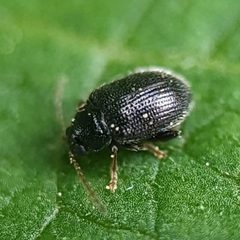
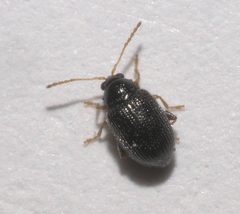
is a small flea beetle native to North America and a major agricultural pest of potatoes. measure 1.5–2 mm and feed on foliage, while larvae may damage tubers. The has been introduced to Europe, including Portugal, Spain, and the Azores. Identification requires detailed examination due to similarity to .
Pronunciation
How to pronounce Epitrix cucumeris: /ɛˈpɪtrɪks kuˈkuːmɛrɪs/
These audio files are automatically generated. While they are not always 100% accurate, they are a good starting point.
Identification
Requires detailed morphological examination to separate from ; the small size (1.5–2 mm), oval convex body, and association with Solanaceae are suggestive but not diagnostic.
Images
Habitat
Agricultural fields, particularly potato areas; also found in association with other Solanaceae . Overwinters in soil and plant debris.
Distribution
Native to North America, occurring widely across Canada (Alberta, British Columbia, Manitoba, New Brunswick, Newfoundland, Northwest Territories, Nova Scotia, Nunavut, Ontario, Prince Edward Island, Quebec, Saskatchewan, Yukon), USA (Arkansas, California, Colorado, Connecticut, Delaware, Florida, Illinois, Indiana, Iowa, Kansas, Kentucky, Maine, Maryland, Massachusetts, Michigan, Minnesota, Missouri, Montana, Nebraska, New Hampshire, New Jersey, New York, North Carolina, North Dakota, Ohio, Oregon, Pennsylvania, Rhode Island, South Carolina, South Dakota, Tennessee, Vermont, Virginia, Washington, West Virginia, Wisconsin, Wyoming), and Mexico. Introduced to Europe: Portugal (mainland, Azores, Madeira), Spain. Also present in Central America and Caribbean (Dominican Republic, Guadeloupe, Jamaica, Puerto Rico) and South America (Bolivia, Colombia, Ecuador, Venezuela).
Seasonality
overwinter and become active in spring when temperatures rise; multiple per year.
Diet
feed on foliage of Solanaceae, primarily potato (Solanum tuberosum); larvae feed on roots and may damage tubers.
Host Associations
- Solanum tuberosum - primary major agricultural pest; damage foliage, larvae may damage tubers
- Solanaceae - additional feed on many other Solanaceae
Life Cycle
Overwinters as in soil and plant debris. Adults emerge in spring and become active. are deposited in soil near base of plants. Larvae develop in soil, feeding on roots and tubers. occurs in soil. Multiple per year.
Behavior
exhibit characteristic -like jumping when disturbed. Spring triggered by rising temperatures. Adults are not highly aggregated on plants based on spatial distribution studies.
Ecological Role
Agricultural pest causing economic damage to potato crops through foliar feeding by and tuber damage by larvae.
Human Relevance
Major pest of potato in North America; subject to control efforts and resistance studies (including documented resistance). Economic impact through reduced yield and quality of potato crops.
Similar Taxa
- Other Epitrix speciesMorphologically similar; E. cucumeris difficult to distinguish without detailed examination
- Other flea beetles (Chrysomelidae: Alticini)Shared jumping and general body form, but associations and geographic range may differ
More Details
Pest Management
Spatial distribution studies indicate that 10 per plot provide adequate (0.25 level) when more than 2.8 per plant are present in spring and more than 7.2 adults per plant in summer.
Taxonomic Note
First described by Harris in 1851; the epithet 'cucumeris' is misleading as the primary is potato, not cucumber.
Sources and further reading
- BugGuide
- Wikipedia
- GBIF taxonomy match
- iNaturalist taxon
- NCBI Taxonomy
- Epitrix cucumeris . [Distribution map].
- Feeding Behavior and DDT Resistance of Epitrix cucumeris (Harris)
- The Life History and Control of the Potato Flea beetle, Epitrix Cucumeris Harris, on the Eastern Shore of Virginia
- THE SPATIAL DISTRIBUTION OF SPRING AND SUMMER POPULATIONS OF ADULT POTATO FLEA BEETLES, EPITRIX CUCUMERIS (HARRIS) (COLEOPTERA: CHRYSOMELIDAE), ON SMALL PLOTS OF POTATOES