
Epitrix
Foudras, 1859
Hairy Flea Beetles
Species Guides
10- Epitrix brevis
- Epitrix cucumeris(potato flea beetle)
- Epitrix fasciata(banded epitrix)
- Epitrix fuscula(eggplant flea beetle)
- Epitrix hirtipennis(tobacco flea beetle)
- Epitrix humeralis
- Epitrix lobata
- Epitrix pubescens
- Epitrix subcrinita(Western Potato Flea Beetle)
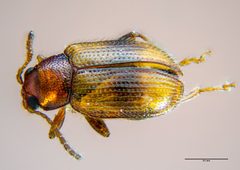
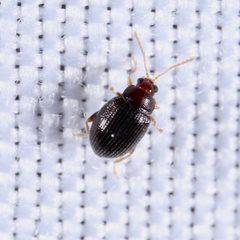
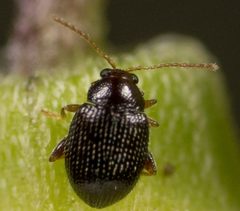
Epitrix is a of flea beetles (Chrysomelidae: Alticini) containing 162 described with worldwide distribution across all continents except Australia and Antarctica. Many species are significant agricultural pests, particularly of Solanaceae crops including potato, tomato, eggplant, and tobacco. Several species have been inadvertently introduced between continents, establishing in new regions and becoming subjects of concern.
Pronunciation
How to pronounce Epitrix: /ˈɛ.pɪ.trɪks/
These audio files are automatically generated. While they are not always 100% accurate, they are a good starting point.
Identification
Distinguished from similar flea beetle by combination of morphological features including spermathecae and structures; specific identification of Holarctic requires examination of male genitalia. Visual sex determination possible in some species based on abdominal sternite .
Images
Habitat
Agricultural areas and natural vegetation supporting plants in Solanaceae ; associated with potato fields, tobacco plantations, and other cultivated solanaceous crops.
Distribution
Worldwide distribution excluding Australia and Antarctica; native to North America, Europe, and other regions with multiple introduced to new continents through human activity including Pacific islands, Atlantic islands, and between North America and Europe.
Diet
Feeding restricted to Solanaceae ; documented include potato (Solanum tuberosum), tomato (Solanum lycopersicum), eggplant (Solanum melongena), tobacco (Nicotiana tabacum), and other solanaceous plants.
Life Cycle
Complete with , three larval instars, prepupal, and pupal stages. In Epitrix hirtipennis at 27°C: egg development approximately 4 days, larval stage 13 days, 3 days, pupa 5 days; total development from oviposition to approximately 24 days. Preoviposition period approximately 13 days. Adult longevity approximately 70 days with continuous oviposition until shortly before death.
Behavior
are flea beetles capable of jumping; females lay at rate of approximately 3.1 per day with mean total of 138.6 eggs per female.
Ecological Role
Herbivore and agricultural pest; some function as when introduced to new regions.
Human Relevance
Major agricultural pest causing damage to potato and other Solanaceae crops; subject to plant regulations and control efforts; several have developed resistance including resistance in Epitrix cucumeris.
Similar Taxa
- Other Alticini generaMay be confused morphologically; distinguished by genitalia characteristics and associations
More Details
Invasion History
Multiple have established outside native ranges through inadvertent human transport: Epitrix hirtipennis from North America to Europe (including Hungary), Epitrix cucumeris and E. tuberis between North America and Europe, and various species to Atlantic and Pacific islands.
Sources and further reading
- BugGuide
- Wikipedia
- GBIF taxonomy match
- iNaturalist taxon
- NCBI Taxonomy
- Biology and control of the tuber flea beetle, Epitrix tuberis Gentner, in Nebraska
- Epitrix fasciata . [Distribution map].
- Epitrix tuberis . [Distribution map].
- First record of Epitrix hirtipennis in Hungary (Coleoptera: Chrysomelidae)
- Epitrix cucumeris . [Distribution map].
- Epitrix hirtipennis . [Distribution map].
- World checklist of flea-beetles of the genus Epitrix (Coleoptera: Chrysomelidae: Galerucinae: Alticini)
- Distribution of Two Species of Epitrix (Coleoptera) in Washington
- Feeding Behavior and DDT Resistance of Epitrix cucumeris (Harris)
- LIFE HISTORY STUDIES OF THE TOBACCO FLEA BEETLE, EPITRIX HIRTIPENNIS (MELSHEIMER) (COLEOPTERA: CHRYSOMELIDAE)
- Key to Holarctic species of Epitrix flea beetles (Coleoptera: Chrysomelidae: Galerucinae: Alticini) with review of their distribution, host plants and history of invasions