
Epitrix tuberis
Gentner, 1944
tuber flea beetle
Epitrix tuberis is a small flea beetle native to western North America, first described by Gentner in 1944. It is the most damaging of five Epitrix species associated with potato in North America. The species completes two annually and has been expanding its range into Central and South America in association with potato industry development. and larvae both feed on Solanaceous plants, with larvae causing economically significant damage to potato tubers.
Pronunciation
How to pronounce Epitrix tuberis: /ɛˈpɪtrɪks tuːˈbɛrɪs/
These audio files are automatically generated. While they are not always 100% accurate, they are a good starting point.
Identification
Extremely difficult to distinguish from based on external alone. All five North American Epitrix associated with potatoes are morphologically similar. Accurate identification requires examination of male and female genitalia and overall habitus by trained . Molecular identification via of the c oxidase subunit I (COI) gene is available; reference sequences deposited in EPPO-Q-bank and BOLD databases.
Images
Appearance
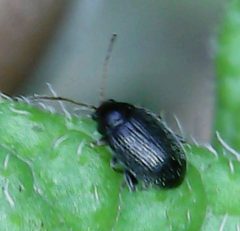
Small flea beetle, 1.5–2.0 mm in length. Body dull black to reddish-black with short white hairs across . brown to yellow. Legs reddish with lighter . Hind expanded, adapted for jumping. Morphologically similar to other Epitrix ; definitive identification requires examination of genitalia.
Habitat
Agricultural and semi-agricultural environments associated with Solanaceous crop production. Overwinters in soil near harvested potato fields. Found in foliage of plants below 30 cm in height. Activity reduced on windy days.
Distribution
Native to western North America. Documented from Canada (Alberta, British Columbia, Saskatchewan) and USA (California, Colorado, Nebraska, New Mexico, Oregon, South Dakota, Washington, Wyoming). Expanding range into Central and South America; recorded from Rica and Ecuador. In British Columbia interior, area extends from International Border north to Malakwa, west through Adams Lake to Barriere, Criss Creek, Pavilion, south to Lillooet, Lytton, Merritt, Princeton, and Hedley.
Seasonality
emerge from sites to feed and mate. Pre-oviposition period lasts 5–8 days. Two per year under favorable conditions: first generation develops in early-planted potatoes, second generation in late-planted potatoes. Overwintered adults typically die in July, overlapping with of new generation between July and early September. Little to no activity before midday.
Diet
feed on leaves of plants, creating holes approximately 1.0–1.5 mm wide. Larvae feed on roots and tubers, excavating small brown tunnels. Primary host is potato (Solanum tuberosum). Alternative hosts include eggplant (Solanum melongena), tomato (Solanum lycopersicum), tobacco (Nicotiana tabacum), Chinese lantern, and ground cherry.
Host Associations
- Solanum tuberosum - primary Main ; most economically significant
- Solanum melongena - alternative Utilized when potato unavailable
- Solanum lycopersicum - alternative Lesser extent than potato
- Nicotiana tabacum - alternative Lesser extent than potato
- Physalis - alternative Chinese lantern, ground cherry
Life Cycle
Complete with two annually. overwinter in soil near harvested potato fields. After 5–8 day pre-oviposition period, females enter soil near potato stems and deposit . Eggs incubate 3–4 days before hatching. Larval stage lasts 2–4 weeks, feeding on roots and tubers. Fully grown larvae construct chambers in soil and metamorphose into adults. Second generation develops in late-planted potatoes.
Behavior
Primarily disperses by jumping using expanded hind ; capable of but prefers jumping. Flight occurs over long distances when seeking plants, but inhibited by wind speeds exceeding 3 m/s. Little to no flight before midday. When approached on foliage, jump to escape. Inactive on windy days. Overwinters along field edges where Solanaceous weeds provide cover.
Ecological Role
Herbivore specializing on Solanaceae. influenced by crop practices; higher densities occur in non-rotated fields. survival dependent on availability of field-edge with Solanaceous weeds.
Human Relevance
Major agricultural pest of potatoes in North America, considered the most damaging of five Epitrix affecting this crop. Larval tunneling in tubers causes commercial downgrading despite superficial damage not affecting edibility. Economic losses documented since early 20th century; $250,000 loss in Colorado in 1904. Threshold for intervention: one per ten plants. Management includes minimum 3-year crop , monitoring via sweep-net for plants over 30 cm, hand inspection for shorter plants, and removal of Solanaceous weeds. International phytosanitary concern due to potential spread via rooted plants or soil containing /pupae.
Similar Taxa
- Epitrix cucumerisFormerly confused with E. tuberis due to morphological similarity; both potato pests requiring genitalial examination for separation
- Epitrix hirtipennisTobacco flea beetle; one of four other North American Epitrix associated with potatoes, externally indistinguishable from E. tuberis
- Epitrix similarisLacks ; morphologically similar affecting potatoes
- Epitrix subcrinitaWestern potato flea beetle; morphologically similar , all five require identification
More Details
Molecular identification resources
Reference sequences for COI available in EPPO-Q-bank and BOLD databases to aid identification of metamorphic stages
Taxonomic history
first described by Gentner in 1944; previously misidentified as E. cucumeris due to morphological similarities
Sources and further reading
- BugGuide
- Wikipedia
- GBIF taxonomy match
- iNaturalist taxon
- NCBI Taxonomy
- Epitrix tuberis . [Distribution map].
- Biology and control of the tuber flea beetle, Epitrix tuberis Gentner, in Nebraska
- Notes on the Biology of the Tuber Flea Beetle, Epitrix tuberis Gentner (Coleoptera: Chrysomelidae), in the Interior of British Columbia