
Chaetocnema
Stephens, 1831
flea beetles
Species Guides
25- Chaetocnema acuminata
- Chaetocnema aequabilis
- Chaetocnema arizonica
- Chaetocnema bicolor
- Chaetocnema borealis
- Chaetocnema brunnescens(Buttonwood Flea Beetle)
- Chaetocnema concinna(brassy flea beetle)
- Chaetocnema confinis(sweetpotato flea beetle)
- Chaetocnema densa
Chaetocnema is a large of flea beetles in the Chrysomelidae, comprising approximately 470 described worldwide. Members are small, jumping leaf beetles that feed on plant foliage. Several species are economically significant agricultural pests, including the corn flea beetle (C. pulicaria), which Stewart's wilt in corn, and C. confinis, which attacks sweet potatoes. The genus exhibits broad geographic distribution across multiple continents with diverse plant associations.
Pronunciation
How to pronounce Chaetocnema: //ˌkiːtəˈknɛmə//
These audio files are automatically generated. While they are not always 100% accurate, they are a good starting point.
Identification
Distinguished from other flea beetle by combination of small size, body shape, and genitalic characters. Chaetocnema quadricollis can be identified by its association with Hibiscus and its extremely small size (males ~1 mm, females ~1.6 mm). C. pulicaria is recognized as a tiny black causing scratch-like feeding marks on corn leaves. Chaetocnema is distinguished from the similar genus Crepidodera by subtle morphological differences in body form and genitalia; some species were historically confused between these genera.
Images
Appearance
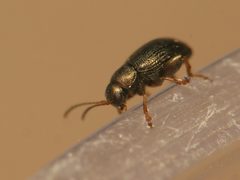
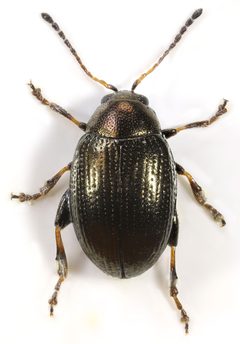
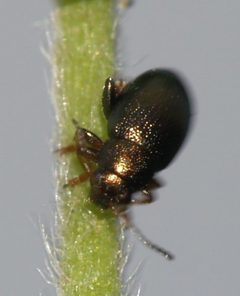
Small leaf beetles, typically 1–3 mm in length. Body form compact and somewhat rounded. Hind enlarged, adapted for jumping—a characteristic of flea beetles (Alticinae). Coloration variable, commonly black, brown, or metallic. Some display distinct patterns or coloration useful for identification. relatively short. often punctate or .
Habitat
Diverse including agricultural fields, wetlands, prairies, woodlands, and sand prairies. Specific show distinct habitat preferences: C. quadricollis occurs in lowland wetlands on Hibiscus lasiocarpus; C. pulicaria is associated with corn-growing regions; C. confinis is across varied agricultural and natural settings.
Distribution
Worldwide distribution with approximately 470 described . Documented from North America (including USA and Canada), Central and South America, Europe, Africa (including South Africa, Democratic Republic of Congo), Asia (India, Japan, China, Southeast Asia), and Oceania (Pacific islands). Specific species have more restricted ranges: C. quadricollis described from Florida but occurs across eastern North America; C. concinna introduced to Maritime Provinces of Canada in late 1980s; C. basalis distributed across South and Southeast Asia.
Seasonality
activity varies by and region. C. quadricollis observed in mid-July in Missouri wetlands. C. pulicaria active during corn-growing season with influenced by winter temperature thresholds affecting survival. Some species associated with later-season plant .
Diet
Herbivorous, feeding on plant foliage. typically feed on leaves, creating characteristic feeding damage. Larval feeding habits vary; some have root-feeding larvae while others feed on foliage or stems. Specific associations include: C. quadricollis on Hibiscus species (rose mallow); C. pulicaria on corn (Zea mays); C. confinis on sweet potato (Ipomoea batatas) and on other plants; C. basalis on rice, wheat, millet, and mustard; C. concinna on sugar beet and diverse plants.
Host Associations
- Hibiscus lasiocarpus - food plantC. quadricollis
- Zea mays - food plantC. pulicaria
- Ipomoea batatas - food plantC. confinis
- Oryza sativa - food plantC. basalis
- Triticum - food plantC. basalis
- Beta vulgaris - food plantC. concinna
Life Cycle
Complete with , larva, pupa, and stages. Specific developmental details vary by . stage varies; C. pulicaria overwinters as adults, with survival dependent on winter temperature thresholds. Larval development occurs in soil or on plants depending on species.
Behavior
are active jumpers, using enlarged hind legs to escape disturbance. C. quadricollis adults feed gregariously on upper leaf surfaces, causing leaves to shrivel and turn brown with severe damage. Some show mate-guarding . Adults may be sampled by sweeping vegetation or beating branches. Attraction to light traps has been documented for some species.
Ecological Role
Herbivores that can significantly impact plant through defoliation. Some serve as of plant : C. pulicaria vectors Pantoea stewartii, the bacterium causing Stewart's wilt in corn. As primary consumers, they transfer energy from plants to higher through by birds, spiders, and other insects.
Human Relevance
Several are significant agricultural pests. C. pulicaria is the most important economic species in North America, causing direct feeding damage to corn and vectoring Stewart's wilt ; climate change models predict northward range expansion into the Corn Belt. C. concinna is the most important pest of sugar beet in Europe. C. basalis attacks rice, wheat, and millet in Asia. C. confinis is a pest of sweet potato. C. quadricollis occasionally reaches pest status on rose mallow. Some species may be beneficial through weed suppression. Control methods have historically included Bordeaux mixture or arsenate of lead.
Similar Taxa
- CrepidoderaSimilar small size and appearance; historically confused with Chaetocnema, with some transferred between upon revision
- AlticaAnother of flea beetles with similar jumping and herbivorous habits; generally larger and more brightly colored
- PhyllotretaFlea beetle with similar and agricultural pest status; distinguished by different body proportions and associations
More Details
Taxonomic History
The has undergone extensive revision, with White (1996) providing a major revision for North America. Some have been synonymized, such as C. decipiens being synonymized under C. quadricollis.
Climate Change Implications
Predictive models incorporating climate change scenarios indicate northward range expansion of C. pulicaria, potentially increasing Stewart's wilt risk in northern corn-growing regions previously considered low-risk.
Collection Notes
are often collected by sweeping vegetation; due to small size, high magnification (8X or greater) may be needed for photography and examination.
Sources and further reading
- BugGuide
- Wikipedia
- GBIF taxonomy match
- iNaturalist taxon
- NCBI Taxonomy
- Catalogue of Life
- Life at 8X—hibiscus flea beetle | Beetles In The Bush
- Climate Data Predicts Northward Range Expansion of Corn Pest
- Ascalaphidae | Beetles In The Bush
- August | 2022 | Beetles In The Bush
- Chaetocnema basalis . [Distribution map].
- Chaetocnema confinis . [Distribution Map].
- Chaetocnema basalis . [Distribution map].
- New Turfgrass Host Associations and Regional Detections for the Flea Beetle Chaetocnema minuta Melsheimer (Coleoptera: Chrysomelidae) in the Southwestern United States
- Introduced leaf beetles of the Maritime Provinces, 9: Chaetocnema concinna (Marsham, 1802) (Coleoptera: Chrysomelidae)
- Two new species of Chaetocnema Stephens from South Africa (Coleoptera: Chrysomelidae, Galerucinae, Alticini)
- The Chaetocnema longicornis species-group: systematics and geographic distribution (Coleoptera: Chrysomelidae, Alticinae)