
Chaetocnema quadricollis
Schwarz, 1878
hibiscus flea beetle
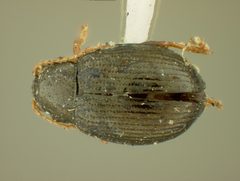
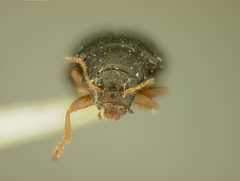
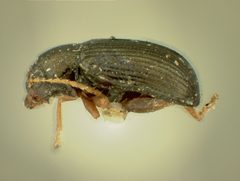
Chaetocnema quadricollis is a minute flea beetle in the Galerucinae, tribe Alticini. Originally described from Florida in 1878, it occurs across North America and has been documented from numerous localities in Missouri. The is strongly associated with Hibiscus species, particularly Hibiscus lasiocarpus (rose mallow), on which feed gregariously on foliage. It was previously recorded under the synonym C. decipiens in Missouri state records.
Pronunciation
How to pronounce Chaetocnema quadricollis: /ˌkiːtəˈsniːmə ˌkwɑːdrɪˈkɒlɪs/
These audio files are automatically generated. While they are not always 100% accurate, they are a good starting point.
Identification
Identified as Chaetocnema by small size and flea beetle jumping ; confirmed as C. quadricollis primarily by plant association with Hibiscus . Distinguished from similar such as Crepidodera by subtle morphological features requiring microscopic examination. The species was synonymized under C. quadricollis by White (1996), having previously been recorded as C. decipiens in Missouri.
Images
Habitat
Associated with wetland and riparian where plant Hibiscus lasiocarpus (rose mallow) grows. Observed in lowland wetlands, sloughs, and wet bottomland forests. In Missouri, found at Otter Slough Conservation Area in Mudsnake Marsh and at Route 66 State Park along the Meramec River.
Distribution
North America. Documented from Florida (type locality), Saskatchewan, and numerous localities in Missouri including St. Louis County and southeastern Missouri. GBIF records indicate presence across North America.
Seasonality
Active in mid-summer through mid-August in Missouri. Observed in mid-July and mid-August, with activity apparently declining during late summer "doldrums" period.
Diet
feed gregariously on foliage of Hibiscus , particularly Hibiscus lasiocarpus (rose mallow). Feeding occurs primarily on upper leaf surfaces, causing leaves to shrivel and turn brown when damage is severe. Adults have also been observed feeding on sap at broken leaf petioles.
Host Associations
- Hibiscus lasiocarpus - food sourcePrimary ; rose mallow
- Hibiscus moscheutos - food sourceHistorical record from New Jersey literature
Behavior
exhibit characteristic flea beetle jumping when disturbed. Feed gregariously in groups on plant foliage. Pairs sometimes found in close physical contact, though whether this represents active mating or mate guarding has not been confirmed. can reach high densities, with "good numbers" observed at some localities.
Ecological Role
Herbivore on native Hibiscus in wetland . Historical literature notes occasional pest status on cultivated rosemallow, with control recommendations published as early as 1919.
Human Relevance
Minor occasional pest of ornamental Hibiscus (rosemallow) in . Historical control recommendations included Bordeaux mixture and arsenate of lead. Of interest to entomologists as one of the smallest flea beetles in North America and for its specialized association.
Similar Taxa
- Crepidodera spp.Similar small size and general appearance; C. quadricollis was originally described as having "exactly the same aspect of a small Crepidodera"
- Other Chaetocnema speciesNine other recorded from Missouri; distinguished primarily by associations and subtle morphological features
More Details
Taxonomic history
Originally described as Chaetocnema quadricollis by Schwarz in 1878 from Florida. Recorded from Missouri under the name C. decipiens by Riley & Enns (1979, 1982). Synonymized under C. quadricollis by White (1996) in his revision of the in North America.
Historical pest status
Weiss & Dickerson (1919) documented the as a pest of swamp rose-mallow (Hibiscus moscheutos) in New Jersey, recommending chemical control measures.
Photographic challenges
The extreme small size of this presents significant photographic challenges. At 8x magnification with full flash, images suffer from diffraction-related softness even at f/14 aperture, requiring trade-offs between depth of field and sharpness.