
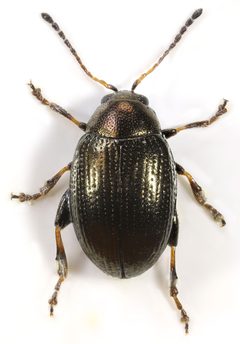
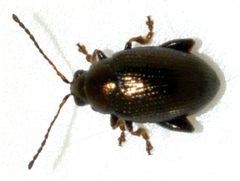
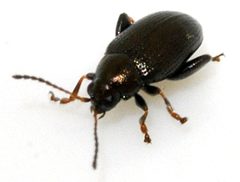
Chaetocnema concinna
(Marsham, 1802)
brassy flea beetle, hop flea beetle, beet flea beetle, brassy-toothed flea beetle
Chaetocnema concinna is a small flea beetle native to Europe and northern Asia that has been introduced to North America, first documented in Canada in the late 1980s. In Europe, it is the most important pest of sugar beet, though its economic impact in North America remains unquantified. The exhibits broad plant associations and can function as either a pest or beneficial organism depending on context.
Pronunciation
How to pronounce Chaetocnema concinna: //kiːˈtɒknəmə kənˈsɪnə//
These audio files are automatically generated. While they are not always 100% accurate, they are a good starting point.
Identification
A small flea beetle in the tribe Alticini, distinguished by the enlarged hind characteristic of flea beetles that enable jumping. Specific diagnostic features for C. concinna require examination of genitalia and fine morphological details; consultation of White's 1996 revision of North American Chaetocnema is recommended for definitive identification.
Images
Habitat
Agricultural areas, particularly those supporting sugar beet and other crop plants; also associated with weedy including Amaranthus .
Distribution
Native to Europe and Northern Asia (excluding China). Introduced to North America: established in Maritime Provinces of Canada (widely distributed in Nova Scotia and Prince Edward Island, two localities in New Brunswick) and Maine, USA. First recorded in Canada in the late 1980s.
Diet
Phytophagous; feeds on sugar beet (Beta vulgaris), rapeseed, and Amaranthus including A. retroflexus.
Host Associations
- Beta vulgaris - primary sugar beet; most important pest in Europe
- Brassica napus - rapeseed
- Amaranthus retroflexus - redroot pigweed; also other Amaranthus spp.
Behavior
are capable of jumping using enlarged hind legs, typical of flea beetles. Feeding can cause characteristic damage to plant foliage.
Ecological Role
Agricultural pest of sugar beet in Europe; potential agent for weedy Amaranthus in some contexts.
Human Relevance
Major economic pest of sugar beet in Europe. Introduced to North America where its economic impact has not yet been demonstrated. Status as pest or beneficial insect varies by context and plant.
Similar Taxa
- Chaetocnema pulicariaAnother small flea beetle in same ; C. pulicaria is the corn flea beetle, distinguished by association with Zea mays and role as of Stewart's wilt. C. concinna is distinguished by association with sugar beet and Amaranthus.
- Chaetocnema quadricollisSimilar size and ; C. quadricollis is associated with Hibiscus (rosemallow), providing a plant distinction from C. concinna.
More Details
Introduction History
Introduced to Maritime Provinces of Canada in the late 1980s based on voucher specimen records. First formally reported from Canada in 1990 (The Canadian Entomologist 122: 647-647).
Nomenclatural Note
Originally described as Chrysomela concinna Marsham, 1802; transferred to Chaetocnema by subsequent revision.
Sources and further reading
- BugGuide
- Wikipedia
- GBIF taxonomy match
- iNaturalist taxon
- NCBI Taxonomy
- Life at 8X—hibiscus flea beetle | Beetles In The Bush
- Climate Data Predicts Northward Range Expansion of Corn Pest
- Citizen Science Delivers "Unprecedented View" of Monarch Butterfly Parasitoids
- North American turtles establish succcessful populations in Germany, possibly threathening ecosystems | Blog
- Bug of the Week
- Introduced leaf beetles of the Maritime Provinces, 9: Chaetocnema concinna (Marsham, 1802) (Coleoptera: Chrysomelidae)
- CHAETOCNEMA CONCINNA(MARSHAM, 1802), A EUROPEAN FLEA BEETLE INTRODUCED IN NORTH AMERICA (COLEOPTERA: CHRYSOMELIDAE: ALTICINAE)