
Amblycerus
Thunberg, 1815
pea and bean weevils, seed beetles
Species Guides
2- Amblycerus robiniae(Locust Seed Beetle)
- Amblycerus vitis(Arizona Grape Bruchid)
Amblycerus is the second most diverse of seed beetles in the Americas, containing over 60 described . These bruchid beetles are specialized seed , with larvae developing inside seeds of various plants. The genus exhibits complex evolutionary patterns of host plant association, having radiated from an ancestral association with Fabaceae into at least 12 other plant including Sterculiaceae, Boraginaceae, and Humiriaceae. Species-level identification requires examination of male genitalia and pygidial .
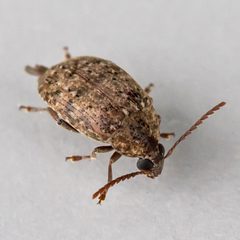
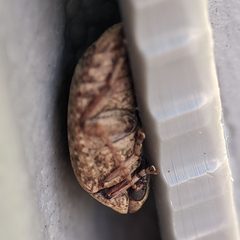
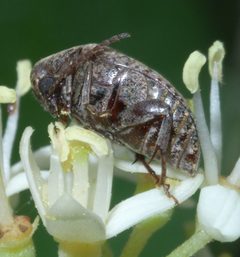
Pronunciation
How to pronounce Amblycerus: /æmˈblɪsərəs/
These audio files are automatically generated. While they are not always 100% accurate, they are a good starting point.
Identification
Identification to level requires examination of male genitalia and pygidial characters. The belongs to the tribe Amblycerini within Bruchinae. Species groups have been established based on morphological characters, though some group delimitations remain problematic and have undergone recent revision.
Images
Habitat
are determined by plant distribution; occur in environments ranging from extremely dry deciduous forest to semievergreen riparian moist forest.
Distribution
Primarily distributed in the Americas, with highest diversity in Brazil. distribution models for A. dispar indicate high suitability in central-west Argentina and Chile, with potential for southwestern USA.
Diet
Larvae are obligate seed , feeding internally on developing seeds. do not feed on seeds; feeding habits of adults are poorly documented.
Host Associations
- Fabaceae - ancestral original from which radiated
- Sterculiaceae - major recipient for shifts
- Boraginaceae - major recipient for shifts
- Humiriaceae - new record for bruchids (A. crassipunctatus)
- Rosaceae - novel record (A. dispar on Prunus dulcis)
- Capparaceae - new record for Bruchinae
- Salicaceae - new record for Bruchinae
- Guazuma ulmifolia - A. cistelinus
- Geoffroea decorticans - main A. dispar
- Prunus dulcis - A. dispar, stored almonds in Argentina
- Vitis - A. vitis, Arizona grape bruchid
Life Cycle
Complete with , larval, pupal, and stages. Larvae develop entirely within seeds, where they feed and pupate. Some overwinter as pupae, with adults emerging in spring.
Behavior
Females oviposit on or near developing seeds. Oviposition has been cited as a factor explaining shifts between plant . Larvae are endophytic seed .
Ecological Role
Seed ; rates on individual can range from 12% to 42% depending on conditions. Intra- and interhabitat variation in seed predation intensity is substantial. No of A. cistelinus were found in extensive sampling.
Human Relevance
A. dispar has been reported attacking stored almonds (Prunus dulcis) in Argentina, representing a potential economic concern for nut storage and production. Monitoring for early detection is recommended when native occur near cultivated areas. A. vitis is known as the Arizona grape bruchid.
Similar Taxa
- SpermophagusFormerly included some now transferred to Amblycerus; distinguished by morphological characters of the male genitalia and
- Other Bruchinae generaAmblycerus is distinguished by tribal assignment (Amblycerini) and characteristic morphological features of the dispar and spondiae groups
Sources and further reading
- BugGuide
- Wikipedia
- iNaturalist taxon
- NCBI Taxonomy
- Catalogue of Life
- Bug Eric: Blacklighting Already?
- Cladistics, bruchids and host plants: evolucionary interactions in Amblycerus (Coleoptera: Bruchidae)
- Ecology and Redescription of the Arizona Grape Bruchid, Amblycerus vitis (Coleoptera)
- Ecology ofAMBLYCERUS CRASSIPUNCTATUSRibeiro-Costa (Coleoptera: Bruchidae) in Seeds of Humiriaceae, a New Host Family for Bruchids, with an Ecological Comparision to Other Species ofAMBLYCERUS
- Intra‐ and Interhabitat Variations in Guazuma ulmifolia (Sterculiaceae) Seed Predation by Amblycerus Cistelinus (Bruchidae) in Costa Rica
- Catalog for the Brazilian Amblycerus Thunberg (Coleoptera: Chrysomelidae: Bruchinae) with taxonomic notes, host plants associations and distributional records
- Rearrangements in some species groups of Amblycerus Thunberg, 1815 (Coleoptera: Chrysomelidae: Bruchinae) including keys, description of a new species, new host plant and distributional records
- Unusual host selection inAmblycerus disparlarvae (Coleoptera: Chrysomelidae: Bruchinae) and its potential impact on stored almonds (Prunus dulcis)
- Circumscription of the sclerolobii group of Amblycerus Thunberg (Coleoptera, Chrysomelidae, Bruchinae) with descriptions of four new species and a revision of the species groups of the genus.