
Prionus integer
LeConte, 1851
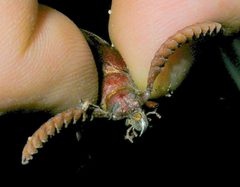
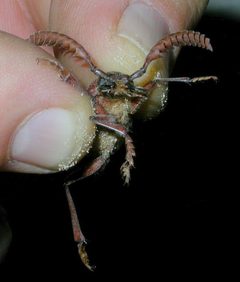
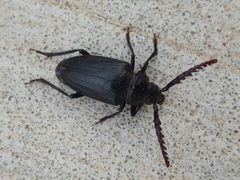
Prionus integer is a longhorned beetle (Cerambycidae) in the subgenus Homaesthesis, to the United States and found in shortgrass prairie of the Great Plains. exhibit unusual burrowing , with both sexes creating shallow soil burrows. Males are strongly attracted to prionic acid lures, and adult activity appears triggered by rainfall events. The was described by LeConte in 1851 and remains poorly known compared to economically important .
Pronunciation
How to pronounce Prionus integer: /ˈpraɪ.ə.nəs ˈɪn.tə.dʒər/
These audio files are automatically generated. While they are not always 100% accurate, they are a good starting point.
Identification
Distinguished from other Prionus by combination of: occurrence in shortgrass prairie (not oak woodland), simple in females versus in males, and lack of the highly segmented antennae (30+ segments) characteristic of P. fissicornis in subgenus Antennalia. Males attracted to prionic acid lures shared with other Homaesthesis species. Burrowing in —creating shallow soil burrows—is apparently unique among documented Prionus species and serves as a behavioral indicator.
Images
Habitat
Shortgrass prairie in semi-arid regions. Specifically documented from dry grasslands with sandy/loam soils in southeastern Colorado. found along roadsides where vegetation is lusher due to rain shedding by the road. Burrows occur in soil exposures, often at the base of small bunch grasses. Absent from oak woodland or pinyon-juniper where related like P. heroicus occur.
Distribution
to the United States. Documented from shortgrass prairie of southeastern Colorado (Bent County, north of Las Animas) and potentially other Great Plains localities with similar . GBIF records indicate presence in US. Precise range boundaries unknown due to limited collecting effort and recent discovery of effective survey methods.
Seasonality
active in June. appears triggered by rainfall events; documented emergence following heavy afternoon/evening rain with peak activity at dusk. Morning searches have found inactive individuals in burrows. Seasonal activity likely corresponds to summer rainy period in semi-arid grasslands.
Diet
Larvae have been associated with roots of sagebrush (Artemisia tridentata) and yellow rabbitbrush (Chrysothamnus viscidiflorus). Two records document larvae damaging newly planted beans and cutting underground stems of potato plants in southern Idaho, apparently in fields recently cleared from native rangeland. do not feed; mouthparts not adapted for feeding.
Host Associations
- Artemisia tridentata - larval food plantbig sagebrush; roots consumed by larvae
- Chrysothamnus viscidiflorus - larval food plantyellow rabbitbrush; roots consumed by larvae
- Phaseolus vulgaris - larval food plantbeans; larvae damaged newly planted fields in Idaho where native vegetation had been cleared
- Solanum tuberosum - larval food plantpotato; larvae cut underground stems in Idaho fields
Life Cycle
Complete with subterranean larval stage. Larvae feed on roots of plants. occurs in soil. emerge following rainfall events, with mass emergences documented. Adults are short-lived and do not feed. Females excavate shallow burrows in soil, possibly for emission or mating rendezvous; function of burrowing remains unclear. Oviposition presumably occurs into soil at base of plants, though direct observation of -laying not confirmed.
Behavior
of both sexes create shallow soil burrows approximately two inches deep, with fresh diggings visible at the surface. Burrows are often located at the base of bunch grasses. Females have been observed sitting within burrows with rhythmic abdominal movements, possibly associated with emission. Males are strongly attracted to prionic acid lures and fly upwind to locate females. Mass emergences occur following rainfall, with hundreds of individuals appearing within hours. Mating occurs on the surface; males attempt to mate with females near burrow entrances. Adults are -capable but often crawl actively on ground and vegetation.
Ecological Role
Larvae function as root herbivores in shortgrass prairie , potentially contributing to nutrient cycling and plant dynamics. Larval feeding on woody shrub roots (sagebrush, rabbitbrush) suggests role in semi-arid shrubland/grassland . Mass events provide concentrated food resource for . Specific predators undocumented, but likely preyed upon by birds, mammals, and other insects.
Human Relevance
Minor agricultural pest in Idaho, where larvae have damaged bean and potato plantings in fields converted from native rangeland. Not considered a significant economic pest compared to P. laticollis (eastern orchards) and P. californicus (western orchards). Of interest to entomologists and collectors due to recent development of effective -based survey methods using prionic acid lures.
Similar Taxa
- Prionus fissicornisAlso occurs in Great Plains shortgrass prairie and attracted to prionic acid lures. Distinguished by highly segmented (30+ segments) in subgenus Antennalia versus P. integer in subgenus Homaesthesis; P. fissicornis do not create burrows.
- Prionus heroicusLarge with similar robust build, but occurs in oak/pine/juniper woodland of southwestern US, not shortgrass prairie; males also attracted to prionic acid but species distinguished by habitat and distribution.
- Prionus emarginatusAnother Homaesthesis from Great Plains grasslands; specific distinguishing features not detailed in available sources but likely separable by subtle morphological differences and or parapatric distribution.
More Details
Discovery of burrowing behavior
burrowing in P. integer was discovered unexpectedly during a 2014 collecting trip and appears to be previously unreported in the . The function of these burrows remains unclear—they are larger than necessary for simple oviposition, and females have been observed performing rhythmic movements while sitting in them. This behavior may represent emission from a protected location, or possibly a mating rendezvous site.
Pheromone lure efficacy
Prionic acid lures, originally developed for orchard pest P. laticollis and P. californicus, have proven highly effective for detecting non-economic Homaesthesis species including P. integer. This demonstrates the potential for -based survey methods to improve knowledge of poorly collected cerambycid species.
Rain-triggered emergence
Mass emergences following rainfall events suggest an to semi-arid environments where moisture cues synchronize adult activity and reproductive opportunities. This pattern has been observed in both P. integer and P. fissicornis.
Sources and further reading
- BugGuide
- Wikipedia
- GBIF taxonomy match
- iNaturalist taxon
- Catalogue of Life
- How to catch “bucket loads” of Prionus fissicornis! | Beetles In The Bush
- My first experience with Prionus lure | Beetles In The Bush
- 2014 Great Plains Collecting Trip iReport | Beetles In The Bush
- November | 2014 | Beetles In The Bush