
Prionus heroicus
Semenov, 1908
Heroic prionus
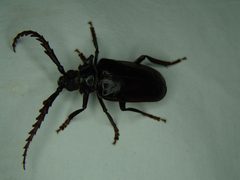
Prionus heroicus is one of the largest long-horned beetles in North America, with males reaching substantial size. The occurs in oak and pine-juniper woodlands of the southwestern United States and adjacent Mexico, with larvae developing underground as root-feeders. are active during both day and night and are attracted to prionic acid lures, though males typically cannot locate the precise source and instead circle or search nearby. The species exhibits a defensive posture when disturbed, raising its body off the ground.
Pronunciation
How to pronounce Prionus heroicus: //ˈpraɪ.ə.nəs hɛˈroʊ.ɪ.kəs//
These audio files are automatically generated. While they are not always 100% accurate, they are a good starting point.
Identification
Distinguished from the similar and closely related P. californicus by its blackish (rather than reddish) coloration and broader pronotum that is distinctly wider than the base of the . The pronotum of P. californicus is narrower than the elytral base. Males of P. heroicus have 12 antennal segments with moderate flabellation, less dramatically expanded than in P. californicus. From P. integer and P. fissicornis, P. heroicus is much larger and associated with woodland rather than grassland . The is active during midday hours, unlike P. integer and P. fissicornis which are primarily .
Images
Habitat
Oak woodlands, pine-juniper woodlands, and canyonland with scrubby oaks. Associated with Gambel oak (Quercus gambelii) and other oak . Found in mountainous areas and canyon systems with suitable trees. Occurs in areas with sufficient soil depth for larval development.
Distribution
Southwestern United States and adjacent Mexico. Documented from Arizona (mountainous areas, especially southeastern but also Prescott and Payson regions), New Mexico (Mills Canyon in Harding County, northeastern New Mexico), Colorado (Moffat County in extreme northwest), Texas (Big Bend National Park), and Oklahoma (Black Mesa area in extreme northwestern panhandle). The Oklahoma record represents a significant eastern range extension and new state record. Historical record from Payne County, Oklahoma remains dubious.
Seasonality
active from June through summer months. Peak activity observed in June. Adults fly during both day and night, with midday activity documented unlike many .
Diet
Larvae feed on roots of living oaks and possibly other woody plants. Specific larval not fully documented, but association with oak woodlands strongly suggests oak roots as primary hosts. do not feed or feeding habits unknown.
Host Associations
- Quercus gambelii - larval Gambel oak; primary association in many areas
- Quercus - larval Oaks generally; specific may vary by locality
- Pinus - possible larval Pine-juniper woodlands also inhabited
Life Cycle
Larvae subterranean, feeding on tree roots for several years. Larval development period estimated at 2-3 years or more based on related . occurs underground. emerge and are active during summer. Females have been found in leaf litter at bases of living oaks and stumps, presumably for oviposition.
Behavior
Males attracted to prionic acid lures from considerable distances, but exhibit unusual searching : they fly to the vicinity of lures then either circle broadly in the air or land and run rapidly on the ground searching, seemingly unable to locate the precise source. Some males approach traps in without landing, then suddenly fly away. This suggests prionic acid functions for long-distance detection but additional components may be needed for precise location. When disturbed, may assume a defensive posture with the body raised off the ground, maintained for several seconds before lowering. In the field, adults immediately attempt to flee when handled and take flight if allowed.
Ecological Role
Root-feeding larvae may influence tree health and soil processes. Large size makes conspicuous elements of woodland insect . The serves as a model for studying communication and associations in prionine beetles.
Human Relevance
Occasionally attracted to lights or lures in campgrounds and residential areas near suitable . Large size makes it an impressive find for naturalists and collectors. Not an agricultural pest. Prionic acid lures developed for related pest (P. laticollis, P. californicus) have proven effective for detecting and studying this and other non-economic Prionus species, aiding taxonomic and ecological research.
Similar Taxa
- Prionus californicusSimilar large size and general appearance; distinguished by reddish coloration, narrower pronotum, and more dramatically male . P. heroicus is blackish with broader pronotum.
- Prionus integerGrassland-associated ; much smaller, found in shortgrass prairie with different associations and activity pattern.
- Prionus fissicornisGrassland with highly segmented (up to 30 segments) in males; much smaller and associated with herbaceous rather than oaks.
More Details
Pheromone response behavior
Unlike P. integer and P. fissicornis, which readily enter prionic acid-baited traps, P. heroicus males consistently fail to locate trap entrances despite strong attraction to the vicinity. This behavioral difference may reflect different communication systems among .
Range expansion documentation
The 2014 discovery at Black Mesa, Oklahoma confirmed the in the state and represented a significant eastern range extension. The previously reported Payne County, Oklahoma record (Alexander 1958, as P. tetricus) had been considered dubious due to the eastern flora of that region; the Black Mesa record from western oak woodland is more credible.
Taxonomic history
Originally described by Semenov in 1908. Has been treated under the synonym P. tetricus in some literature, though this name is now considered invalid.