
Prionus emarginatus
Say, 1824
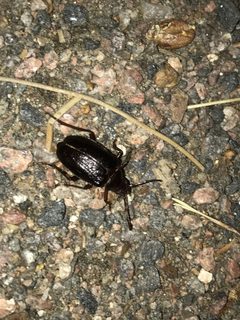
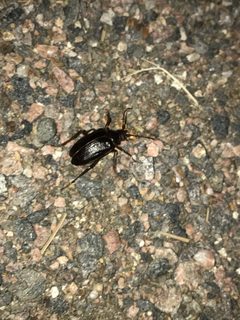
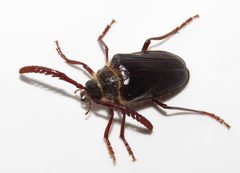
Prionus emarginatus is a of long-horned beetle in the Cerambycidae, found in North America. It belongs to the subgenus Homaesthesis, one of eight species in this poorly known group primarily distributed in the Great Plains and Rocky Mountains. are large, blackish beetles with broad pronota. Males are attracted to prionic acid lures, suggesting females emit this compound as a . The species is , with males active at night and attracted to ultraviolet and mercury-vapor lights.
Pronunciation
How to pronounce Prionus emarginatus: /ˈpriː.ə.nəs ɛˌmɑr.dʒɪˈneɪ.təs/
These audio files are automatically generated. While they are not always 100% accurate, they are a good starting point.
Identification
Prionus emarginatus is a large, robust long-horned beetle with blackish coloration and a broad pronotum. Males have serrate and are attracted to prionic acid lures. The can be distinguished from other Prionus species by its placement in the subgenus Homaesthesis, though specific diagnostic features for field identification are not well documented in available sources.
Images
Habitat
Shortgrass prairie and pinyon/juniper/oak woodland in the Great Plains and Rocky Mountain regions.
Distribution
North America, specifically the Great Plains and Rocky Mountains. Documented from northeastern New Mexico (Harding County), with records suggesting occurrence in shortgrass prairie and woodland transition zones.
Seasonality
active during summer months. One documented observation from July 2023 in northeastern New Mexico.
Diet
Larvae are subterranean and feed on roots; specific plants unknown but presumed to include herbaceous plants or woody vegetation based on related in the .
Life Cycle
Complete with subterranean larval stage feeding on roots. emerge in summer. Specific developmental details unknown.
Behavior
Males are strongly attracted to prionic acid lures, indicating female-produced . activity pattern; males come to ultraviolet and mercury-vapor lights at night.
Ecological Role
Larvae function as root-feeders in soil . may serve as prey for and contribute to nutrient cycling through larval feeding activities.
Human Relevance
Of interest to entomologists and coleopterists studying Prionus diversity and . No documented economic importance.
Similar Taxa
- Prionus integerBoth belong to subgenus Homaesthesis and occur in Great Plains shortgrass prairie; P. integer is active at dusk while P. emarginatus is
- Prionus fissicornisBoth occur in northeastern New Mexico shortgrass prairie; P. fissicornis belongs to subgenus Antennalia with highly segmented (30+ segments)
- Prionus heroicusLarge blackish Prionus with broad pronotum; P. heroicus occurs in oak/juniper woodland and is larger with more extensive distribution
- Prionus californicusLarge black Prionus attracted to prionic acid; P. californicus occurs in western North America and is active at dusk rather than night