
Prionus debilis
Casey, 1891
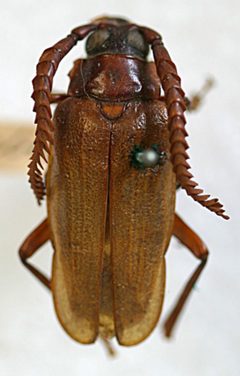
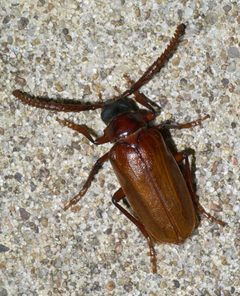
Prionus debilis is a long-horned beetle in the Cerambycidae, occurring in the tallgrass prairies of the eastern Great Plains. Males possess hypersegmented, adapted for detecting female . The was first documented to be attracted to prionic acid lures in 2015, representing a significant finding for the . It is considered uncommonly collected and appears to have a relatively restricted distribution compared to other Prionus species.

Pronunciation
How to pronounce Prionus debilis: //ˈpɹaɪənəs ˈdɛbɪlɪs//
These audio files are automatically generated. While they are not always 100% accurate, they are a good starting point.
Identification
Distinguished from other Prionus by its occurrence in tallgrass prairie rather than sand dune or pine forest habitats preferred by related species. Males can be separated from sympatric Prionus by the specific antennal , though precise diagnostic features require examination. The species is smaller and less robust than P. imbricornis, with which it may co-occur.
Images
Appearance
Large-bodied long-horned beetle. Males have highly modified with numerous segments and (comb-like) branches that maximize surface area for chemical reception. The overall body form is typical of the Prionus, with a robust, somewhat cylindrical shape.
Habitat
Tallgrass prairie remnants, specifically in areas with bunch grasses such as bluestems (Andropogon spp.). Associated with native prairie vegetation rather than forested or dune .
Distribution
Eastern Great Plains of North America, documented from south-central Kansas and southwestern Missouri. Historical records suggest occurrence near Yates Center, Kansas, with activity peaking around early July.
Seasonality
active in early to mid-summer, with peak activity around the first week of July in Kansas. activity pattern with males attracted to lights and lures after dusk.
Host Associations
- Quercus - possible larval Lingafelter (2007) suggestion; considered doubtful by field observers
- Castanea - possible larval Lingafelter (2007) suggestion; considered doubtful
- Vitis - possible larval Lingafelter (2007) suggestion; considered doubtful
- Pyrus - possible larval Lingafelter (2007) suggestion; considered doubtful
- Zea mays - possible larval Lingafelter (2007) suggestion; considered doubtful
- Andropogon - probable larval Inferred from association; bunch grasses in tallgrass prairie
Life Cycle
Larval habits remain unknown. are and do not fly to lights, instead crawling on the ground near light sources. and larval development details undocumented.
Behavior
Males are attracted to prionic acid, a principal component for the , making them susceptible to lure-baited pitfall traps. Males have been observed crawling on the ground near ultraviolet lights without actually flying to them. Unlike many other Prionus , males do not appear to fly actively during attraction events.
Ecological Role
As a member of the Prioninae, likely functions as a root-feeding larva in prairie , potentially contributing to nutrient cycling and soil aeration. role in ecosystem processes undocumented.
Human Relevance
Of interest to coleopterists and ecological researchers studying prairie insect . The 2015 demonstration of prionic acid attraction provided a new method for studying this poorly known . No documented economic or agricultural significance.
Similar Taxa
- Prionus imbricornisOverlaps in distribution; distinguished by larger size, more robust build, and different preference (deciduous forests vs. tallgrass prairie)
- Prionus integerSympatric in Great Plains; distinguished by occurrence in sand dune and different
- Prionus pocularisSimilar size and form; distinguished by association with pine forests rather than prairie, and later seasonal activity
- Orthosoma brunneumRelated prionine that co-occurs at lights; not attracted to prionic acid and lacks hypersegmented, male
More Details
Pheromone attraction discovery
In July 2015, males were first demonstrated to be attracted to prionic acid lures, with 21 males captured in a single trap. This likely represents the first documented use of synthetic for this .
Taxonomic note
Listed as a synonym in some sources (Catalogue of Life) but accepted in others (GBIF, NCBI). The has been placed in subgenus Neopolyarthron by some authors.