
Prionus pocularis
Dalman, 1817
Tooth-necked Longhorn Beetle
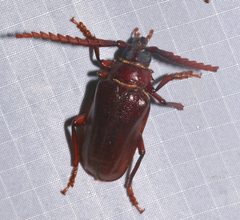
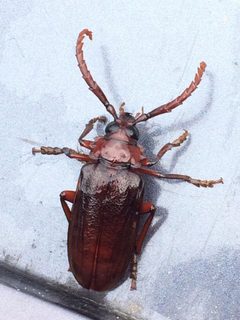
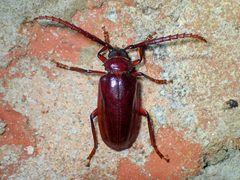
Prionus pocularis is a large longhorn beetle in the Prioninae, distributed across southeastern North America with its northwestern range limit in the Ozark Highlands of Missouri. The is strongly associated with shortleaf pine forests, where larvae develop in decaying pine wood. are and have been documented responding to prionic acid lures, a trait shared with other Prionus species.
Pronunciation
How to pronounce Prionus pocularis: /ˈpraɪ.ə.nəs ˈpɒk.jʊˌlɛ.rɪs/
These audio files are automatically generated. While they are not always 100% accurate, they are a good starting point.
Identification
Prionus pocularis can be distinguished from other eastern North American Prionus by its association with pine rather than the sand dunes or tallgrass prairies favored by . Males possess the characteristic hyper-segmented, typical of the , adapted for detecting female . The species reaches its northwestern distributional limit in Missouri, where it overlaps with the more common P. imbricornis; the two can occur together at blacklights and traps, though P. pocularis appears far less frequently.
Images
Habitat
Deciduous and mixed pine-hardwood forests, specifically associated with shortleaf pine (Pinus echinata) in the Ozark Highlands. In Missouri, occurs in pine-dominated forests of the White River Hills region and at Pinewoods Lake in the Mark Twain National Forest.
Distribution
Southeastern United States, ranging from the Atlantic coastal plain westward to eastern Texas, Oklahoma, and the Ozark Highlands of southern Missouri. Documented in Missouri from Carter County (Pinewoods Lake) and Barry County (White River Hills region). Canadian records from Ontario and Québec.
Seasonality
activity in Missouri occurs from late July through August, based on collection records from 2015. This timing is later than the mid-summer peak of P. debilis in tallgrass prairies.
Host Associations
- Pinus echinata - larval shortleaf pine; larvae develop in decadent pines
Behavior
are and have been observed responding to prionic acid-baited pitfall traps and ultraviolet lights. Males exhibit the hyper-segmented, characteristic of the , adapted for detecting . In Missouri, males have been found in prionic acid traps placed in pine forest , though attraction appears weaker and less consistent than in some .
Human Relevance
Targeted by coleopterists using prionic acid lures for survey and collection. The ' occurrence in Missouri shortleaf pine forests represents a range limit of interest for biogeographic studies.
Similar Taxa
- Prionus imbricornisOverlaps in Missouri pine forests and is attracted to the same prionic acid lures; P. imbricornis is far more common and widespread in the region
- Prionus debilisShares prionic acid attraction and , but occurs in tallgrass prairie rather than pine forests and peaks earlier in summer
- Orthosoma brunneumRelated brown prionid in Prioninae, often found at the same blacklights; lacks hyper-segmented and is not attracted to prionic acid
More Details
Pheromone response
The 2015 field season provided the first documented demonstration of P. pocularis attraction to prionic acid lures in Missouri, though success was limited compared to other Prionus —only single males were captured on two occasions despite repeated trapping efforts.
Historical context
Prior to 2015, the was known in Missouri from only two males collected at blacklight at Pinewoods Lake in the 1980s, making it one of the state's less frequently encountered cerambycids.