
Nothopleurus madericus
(Skiles, 1978)
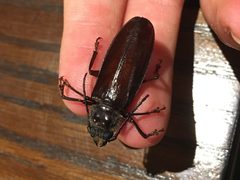
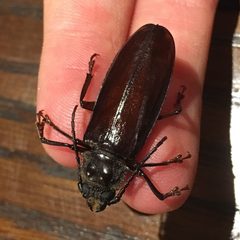
Nothopleurus madericus is a large prionine longhorn beetle described by Skiles in 1978. It belongs to a characterized by robust, wood-boring beetles. The name references Madera Canyon in the Santa Rita Mountains of Arizona, a known locality for this rare . Field observations indicate may be or , with at least one individual observed in an hole on oak during evening hours.
Pronunciation
How to pronounce Nothopleurus madericus: /noˈθo.plɛu.ruːs məˈdɛrɪkəs/
These audio files are automatically generated. While they are not always 100% accurate, they are a good starting point.
Identification
As a member of Prioninae, Nothopleurus madericus likely exhibits the 's characteristic large size, robust , and that may be serrate or slightly clubbed in females. The Nothopleurus is distinguished within Macrotomini by specific features of the pronotum and , though precise diagnostic characters for N. madericus require examination of . The is notably larger than most sympatric cerambycids; field observers have described it as a "large prionid."
Images
Habitat
Based on the type locality and field observations, Nothopleurus madericus occurs in oak-juniper woodland and pine-oak forest of the Sky Island mountain ranges in southeastern Arizona. One individual was observed in an hole on Quercus emoryi (Emory oak). The has been found at moderate elevations in the Santa Rita Mountains.
Distribution
Documented from southeastern Arizona, specifically the Santa Rita Mountains (Madera Canyon area). The epithet and field records suggest this is the core range. Catalogue of Life and GBIF list broader distributions to Central America and North America, though specific country records beyond the United States require verification.
Seasonality
activity has been observed in late July. A field observer noted encountering an adult at dusk during storm conditions, when longhorn beetles typically become active.
Host Associations
- Quercus emoryi - probable larval observed in hole on trunk
Behavior
One field account describes an partially emerging from a trunk hole, showing only and , and withdrawing when disturbed. This suggests or adult activity and potential sensitivity to disturbance. Adults may be attracted to light, as is common in Prioninae.
Ecological Role
As a wood-boring cerambycid, larvae likely contribute to decomposition of dead oak wood and nutrient cycling in montane forest . The appears to be rare and locally distributed, suggesting specialized ecological requirements.
Human Relevance
Primarily of interest to coleopterists and natural historians. The is considered rare and desirable among collectors. Its type locality in a well-known collecting area (Madera Canyon) makes it a target species for enthusiasts visiting southeastern Arizona.
Similar Taxa
- Derobrachus hovoreiAlso a large prionine in the same region, but distinguished by different pronotal structure and association with palo verde rather than oak
- Polyphylla spp.Large scarabs that come to lights in same , but readily distinguished by and different body form
More Details
Conservation status
No formal conservation status assigned. Extremely limited observations (5 iNaturalist records, few published accounts) suggest it may be naturally rare, cryptic, or have narrow requirements. The honors Madera Canyon, a renowned biodiversity hotspot in the Santa Rita Mountains.
Taxonomic notes
Described by Skiles in 1978, making it a relatively recently described . The Nothopleurus contains few species and is in need of modern revision.