
Macrotomini
Tribe Guides
1Macrotomini is a tribe of longhorn beetles within the Prioninae. Members are generally large, robust beetles with prominent . The tribe is distributed across multiple continents with greatest diversity in tropical and subtropical regions. Many are associated with woody vegetation and are of interest to collectors due to their size and distinctive .
Pronunciation
How to pronounce Macrotomini: /ˌmækroʊˈtoʊmɪnaɪ/
These audio files are automatically generated. While they are not always 100% accurate, they are a good starting point.
Identification
Distinguished from other Prioninae tribes by combination of: large body size with robust build; mandibular structure (prominent, often sexually dimorphic); relatively short compared to body length; and specific antennal (serrate or weakly pectinate in many ). Differs from closely related tribes such as Prionini by shape and antennal proportions. Genus-level identification requires examination of mandible , antennal segment ratios, and pronotal structure.
Images
Appearance
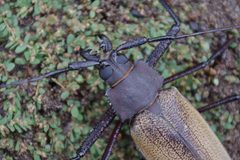
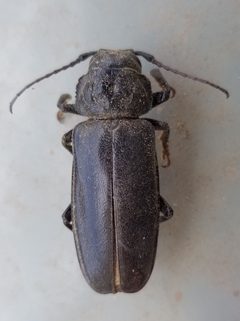
Large-bodied beetles, typically 20–60 mm in length. Robust, somewhat flattened or cylindrical body form. Prominent, often enlarged , especially in males. usually shorter than body length, sometimes serrate or pectinate. may be smooth, punctate, or ridged. Coloration commonly black, brown, or reddish-brown, sometimes with contrasting patterns.
Habitat
Associated with forested and woodland environments. Larval development occurs in dead or dying wood of hardwood trees and shrubs. often found on or near trees, particularly where bark is damaged or wood is decaying. Some inhabit savanna or open woodland with scattered trees.
Distribution
Widespread in tropical and subtropical regions. Present in the Afrotropical, Oriental, Australasian, and . Absent or poorly represented in temperate regions of the Northern Hemisphere. Greatest in Africa, Southeast Asia, and South America.
Seasonality
activity generally coincides with warm seasons in respective regions. In tropical areas, activity may occur year-round with peaks during rainy seasons. Temperate zone active primarily in late spring through summer. Many species are attracted to lights at night.
Diet
Larvae feed on dead or decaying wood of angiosperm trees, acting as primary decomposers. Some have been recorded from coniferous wood. may feed on sap, bark, or not at all; specific adult feeding habits are poorly documented for most species.
Host Associations
- Angiosperm trees (various) - larval Dead or dying wood of hardwood
Life Cycle
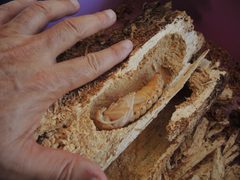
Complete with prolonged larval stage. laid in cracks or under bark of wood. Larvae tunnel through wood, creating galleries; development may take 1–3 years depending on and conditions. occurs in wood chambers. emerge through exit holes.
Behavior
are primarily and attracted to artificial light sources. Males use enlarged in combat with rival males. Both sexes may stridulate by rubbing body parts together, producing audible sounds. capability varies; some are strong fliers while others are relatively sedentary.
Ecological Role
Contribute to wood decomposition and nutrient cycling in forest . Larval tunneling creates for other and facilitates fungal of dead wood. Serve as prey for birds, mammals, and other insects.
Human Relevance
Some larger are collected for the insect trade due to their impressive size and . Occasional pests of timber, though rarely causing significant economic damage. Presence in dead wood can indicate forest health and decay processes.
Similar Taxa
- PrioniniAlso large Prioninae with prominent , but differ in antennal proportions (often longer relative to body) and mandibular structure
- MallodoniniOverlapping distribution and ; distinguished by details of and pronotal shape
More Details
Taxonomic Note
Macrotomini has undergone significant revision; some formerly placed here have been moved to other tribes. Current composition focuses on genera with shared mandibular and antennal characteristics.
Conservation
Vulnerable to loss from deforestation, particularly in tropical regions where diversity is highest. Dependence on dead wood makes sensitive to forest management practices that remove coarse woody debris.