
Centrodera spurca
(LeConte, 1857)
yellow Douglas-fir borer
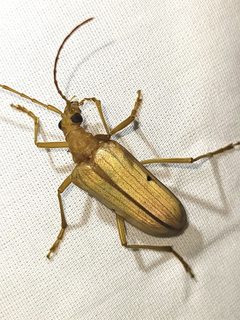
Centrodera spurca, commonly known as the yellow Douglas-fir borer, is a of flower longhorn beetle in the Cerambycidae. It is native to North America, with records from western Canada (British Columbia, Alberta) and the western United States. The species has been documented in coniferous forest , particularly in association with Douglas-fir (Pseudotsuga menziesii). A notable disjunct occurs in the Sacramento Mountains of New Mexico, separated from the main Pacific Coast distribution.
Pronunciation
How to pronounce Centrodera spurca: /sɛnˈtroʊdɛrə ˈspɜrkə/
These audio files are automatically generated. While they are not always 100% accurate, they are a good starting point.
Identification
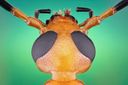
The is described as a "large, blonde lepturine" cerambycid. As a member of the Lepturinae (flower longhorns), it likely exhibits the slender body form and elongated typical of this group. The yellow or blonde coloration distinguishes it from darker and similar species in the Rhagiini tribe. Positive identification requires examination of specific morphological characters including antennal structure, pronotal shape, and elytral .
Images
Habitat
Coniferous forests, particularly montane and alpine coniferous woodlands. Associated with Douglas-fir (Pseudotsuga menziesii) and other coniferous . The New Mexico occurs in high-elevation (approximately 9000 ft) alpine coniferous forest with Gambel oak (Quercus gambelii) margins.
Distribution
North America. Primary distribution in western North America: British Columbia and Alberta in Canada; Pacific Coast states of the United States. A disjunct occurs in the Sacramento Mountains of Otero County, New Mexico, representing an eastern outlier from the main range.
Seasonality
have been collected in late June in the New Mexico . Activity likely coincides with warmer months, with specific timing varying by elevation and latitude.
Host Associations
- Pseudotsuga menziesii - larval Douglas-fir; implied by and association
- Quercus gambelii - associationGambel oak; captured in traps hanging in this in New Mexico
Behavior
are attracted to sweet red wine in jug traps, suggesting feeding on fermenting plant exudates or sap flows. This is consistent with the "flower longhorn" of the Lepturinae .
Similar Taxa
- Stenocorus copeiSimilar size and (captured in same trap type in New Mexico), but S. copei is smaller and darker, belonging to a different within Lepturinae
- Other Centrodera species may overlap in distribution; C. spurca distinguished by yellow/blonde coloration versus typically darker coloration in related
More Details
Disjunct New Mexico Population
The was documented in the Sacramento Mountains of New Mexico in 2024, representing a significant range extension from the main Pacific Coast distribution. This was discovered in sweet red wine-baited jug traps placed in Gambel oak along the margin of alpine coniferous forest at approximately 9000 ft elevation near Cloudcroft, Otero County. The collector noted this as an interesting disjunction from the main population in the Pacific Coast states.
Collection Method
Documented capture using sweet red wine (SRW) in jug traps, with ethanol-enhanced variants (SRW/EtOH) also effective. Traps remained attractive for extended periods (over one month) in high-elevation, cooler conditions where bait evaporation was reduced.