
Typocerus lugubris
(Say, 1824)
Mournful Long-horned Beetle
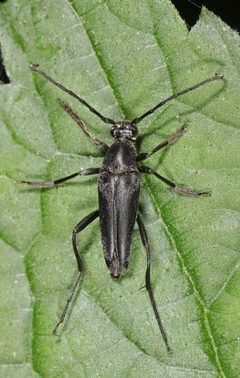
Typocerus lugubris is a of flower longhorn beetle in the Cerambycidae, Lepturinae. It is distinguished from other Typocerus species by its entirely black coloration without yellow markings. are active during June and July and have been observed visiting flowers, including Hydrangea arborescens and Saururus cernuus, where they feed on pollen. The species occurs in eastern North America, with records from Missouri and surrounding regions.
Pronunciation
How to pronounce Typocerus lugubris: /taɪˈpoʊsərəs luˈɡjuːbrɪs/
These audio files are automatically generated. While they are not always 100% accurate, they are a good starting point.
Identification
The all-black coloration makes this distinctive within the Typocerus. Two other mostly black Missouri species, T. lunulatus and T. zebra, always bear yellow blotches in the basal area of the or exhibit yellow transverse bands respectively. T. confluens can vary to nearly black but is more robust, has erect hairs on the pronotum, and lacks poriferous areas on antennomere 6. Remaining Typocerus species are chestnut colored with distinct transverse yellow banding.
Images
Appearance
are entirely black without any yellow markings on the . Body has the narrow-necked, broad-shouldered appearance characteristic of the Lepturinae. Elytra are strongly tapering. Prothorax is strongly basally depressed. Antennal segments are apically produced with distinct poriferous areas.
Habitat
Found in association with flowers in woodland and glade . Documented from Trail of Tears State Park in mesic forest with wild hydrangea, and from glade/woodland interfaces.
Distribution
Eastern North America. Documented from Missouri (Trail of Tears State Park, Valley View Glades, Victoria Glades), with broader distribution across eastern United States and Canada (Ontario).
Seasonality
active June through July. Peak activity coincides with flowering period of plants.
Diet
feed on pollen from flowers. Documented visiting Hydrangea arborescens and Saururus cernuus.
Host Associations
- Hydrangea arborescens - flower observed feeding on flowers
- Saururus cernuus - flower Mating and pollen feeding observed
Behavior
are and attracted to flowers. Mating has been observed on Saururus cernuus, with females consuming pollen from the plant.
Ecological Role
function as while feeding on pollen. Larval unknown, but larvae of related Lepturinae typically develop in decaying wood.
Similar Taxa
- Typocerus velutinusMost similar ; distinguished by distinct, well-delimited transverse yellow elytral bands versus all-black coloration of T. lugubris
- Typocerus lunulatusMostly black but always bears yellow blotches in basal area of
- Typocerus zebraMostly black but exhibits yellow transverse bands
- Typocerus confluensCan be nearly black but more robust, with erect pronotal hairs and lacking poriferous areas on antennomere 6
More Details
Larval biology
Larval and development remain unknown, as is typical for many Lepturinae .
Taxonomic history
Originally described as Leptura lugubris by Say in 1824.