
Typocerus lunulatus
(Swederus, 1787)
Species Guides
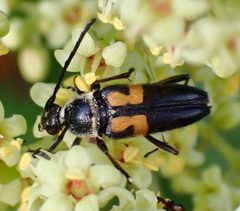
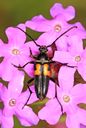
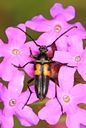
1Typocerus lunulatus is a flower longhorn beetle in the Cerambycidae, Lepturinae. are and visit flowers for feeding. The occurs in North America with two recognized : the nominate form and T. l. texanus (Texas stallingia ). It is one of several mostly black Typocerus species that can be distinguished from by specific elytral markings.
Pronunciation
How to pronounce Typocerus lunulatus: /tɪˈpoʊsərəs luːˈnjuːlətəs/
These audio files are automatically generated. While they are not always 100% accurate, they are a good starting point.
Identification
Mostly black with yellow blotches in the basal area of the , distinguishing it from T. lugubris (all black), T. zebra (yellow transverse bands), and T. velutinus/T. deceptus (chestnut brown with transverse yellow banding). The yellow blotches are located basally rather than forming complete transverse bands. The is slightly more robust than T. velutinus.
Images
Habitat
are found on flowers in forested and woodland . Specific larval plants are unknown, though related in the are associated with various hardwood trees.
Distribution
North America. The T. l. texanus occurs in Texas.
Seasonality
are active during June and July, with activity peaking in early summer.
Diet
feed on pollen and nectar of flowers. Larval diet is unknown but presumed to be wood-boring in hardwood trees as is typical for the .
Host Associations
- Hydrangea arborescens - flower observed feeding on flowers
Life Cycle
Complete with , larva, pupa, and stages. Larvae are wood-borers, though specific trees have not been documented. Adults are and active in summer.
Behavior
flower-visiting . are active fliers and can be found feeding on flowers alongside other Lepturinae .
Ecological Role
function as while feeding on flowers. Larvae contribute to wood decomposition as borers in dead or dying hardwood trees.
Human Relevance
No significant economic or medical importance. Of interest to entomologists and naturalists studying flower longhorn beetles.
Similar Taxa
- Typocerus lugubrisAll black coloration without yellow markings; T. lunulatus has yellow basal blotches
- Typocerus zebraHas yellow transverse bands across rather than basal blotches
- Typocerus velutinusChestnut brown with distinct transverse yellow bands; more slender body
- Typocerus deceptusChestnut brown with weak, often interrupted transverse yellow bands; slightly more robust with more elytral apices
More Details
Subspecies
Two are recognized: Typocerus lunulatus lunulatus (Swederus, 1787), the nominate form, and Typocerus lunulatus texanus Linsley & Chemsak, 1976, known as the Texas stallingia .