
Typocerus zebra
(Olivier, 1800)
Zebra Longhorn Beetle, Zebra Longhorn
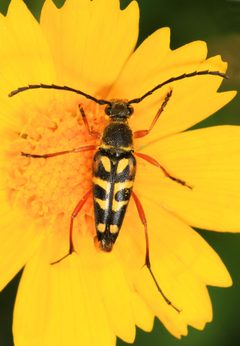
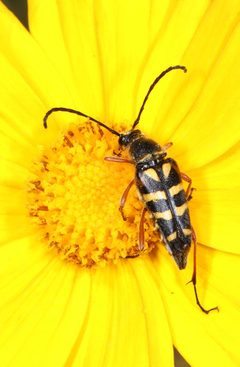
Typocerus zebra, commonly known as the zebra longhorn or zebra longhorn , is a of flower longhorn beetle in the Cerambycidae. are and frequently observed on flowers, where they feed on pollen and nectar. The species is distributed across North America and is particularly associated with open where its flowers grow. Like other members of the Lepturinae, it exhibits elongated and a slender body form adapted for floral visitation.
Pronunciation
How to pronounce Typocerus zebra: /tɪˈpoʊsɛrəs ˈziːbrə/
These audio files are automatically generated. While they are not always 100% accurate, they are a good starting point.
Identification
Typocerus zebra is distinguished by its striking black and white transverse banding pattern on the , which gives rise to its . The body is relatively slender and elongated, typical of the Lepturinae . are long, often approaching or exceeding body length. The may be confused with other Typocerus species, particularly T. velutinus and T. deceptus, though T. zebra typically shows more distinct and regular transverse banding. Close examination of elytral pattern and pronotal may be necessary for definitive identification.
Images
Distribution
North America, with records from Canada and the United States. Specific range details within North America are not well documented in available sources.
Diet
feed on pollen and nectar of flowers. Specific floral documented include Coreopsis lanceolata and other native wildflowers in prairie and open woodland .
Behavior
are and active during daylight hours. They are frequently found on flowers, where they feed and presumably mate. The is capable of and may move readily between flowering plants.
Ecological Role
As a flower-visiting , T. zebra likely contributes to pollination of its plants, though the extent of its effectiveness as a has not been quantified.
Similar Taxa
- Typocerus velutinusSimilar size, shape, and coloration; both are flower longhorns with yellowish or pale markings. T. velutinus has more distinct and well-delimited transverse yellow bands on compared to T. zebra.
- Typocerus deceptusDeceptively similar appearance, though T. deceptus is generally more robust with weaker, often interrupted transverse bands and interrupted basal pronotal band.
- Other Typocerus speciesMembers of this share the general lepturine body plan and often exhibit banded or patterned , requiring careful examination for -level identification.
Sources and further reading
- BugGuide
- Wikipedia
- GBIF taxonomy match
- iNaturalist taxon
- NCBI Taxonomy
- Catalogue of Life
- September | 2022 | Beetles In The Bush
- Cimbicidae | Beetles In The Bush
- 2019 Arkansas/Oklahoma Insect Collecting Trip iReport | Beetles In The Bush
- Typocerus deceptus in Missouri | Beetles In The Bush
- Archive — Bug of the Week