
Typocerus velutinus
(Olivier, 1795)
Banded Longhorn, Banded Longhorn Beetle
Species Guides
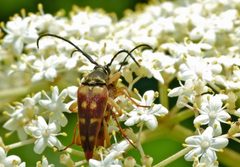
1Typocerus velutinus is a common and widespread flower longhorn beetle ( Lepturinae) found across eastern North America. are and feed on flowers, while larvae develop in decaying wood of hardwood trees. The is frequently encountered on wild hydrangea (Hydrangea arborescens) and other flowering plants during summer months. It serves as a and is an important component of forest . Two are recognized: T. v. velutinus and T. v. nobilis.
Pronunciation
How to pronounce Typocerus velutinus: //taɪˈpoʊsərəs vɛljuˈtaɪnəs//
These audio files are automatically generated. While they are not always 100% accurate, they are a good starting point.
Identification
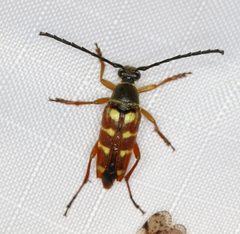
Distinguished from the similar Typocerus deceptus by: (1) continuous, unbroken yellow pubescent band on basal margin of pronotum (interrupted at middle in T. deceptus); (2) distinct, well-delimited transverse yellow elytral bands (weaker and often interrupted at middle in T. deceptus); (3) less robust, more slender body form; (4) weakly emarginated lateral elytral margins near apices (strongly emarginated in T. deceptus, giving more tapered appearance). Distinguished from other Typocerus by banding pattern and pronotal characteristics.
Images
Appearance
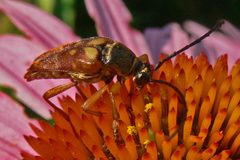
Medium-sized longhorn beetle with distinct transverse yellow bands across dark . Body covered with dense, velvety . Pronotum bears a continuous, unbroken band of dense yellow pubescence along its basal margin. Elytral bands are well-delimited and distinct, not interrupted at the middle. are long but do not exceed body length in females; slightly longer in males. Body form is slender rather than robust. Lateral margins of elytra are only weakly emarginated near the apices, giving a less tapered appearance than similar .
Habitat
Deciduous forests and woodland edges with flowering vegetation. frequent flowers in open areas and forest margins. Larval is decaying wood of standing or fallen hardwood trees. Associated with mesic forest conditions in eastern North America.
Distribution
Eastern North America, from Canada through the United States. Documented from Vermont, Missouri, Indiana, and Illinois. Widespread and common throughout its range compared to .
Seasonality
active during summer months, with peak activity in July. activity pattern coinciding with flower availability.
Diet
feed on pollen and nectar of flowers, including wild hydrangea (Hydrangea arborescens). Larvae develop within decaying wood, feeding on fungal-decayed hardwood tissue.
Host Associations
- Hydrangea arborescens - flower Wild hydrangea; observed feeding on flowers
- Betula - larval Birch; larvae develop in decaying wood
- Rhus - larval Sumac; larvae develop in decaying wood
Life Cycle
Complete . Larvae develop within decaying wood of hardwood trees, where they feed on fungal-decayed tissue. occurs within the wood. emerge in summer and are active on flowers. Specific duration of developmental stages not documented.
Behavior
. are active during daylight hours and are attracted to a variety of flowers for feeding. -capable and readily move between flowers. Adults frequently found in company of other flower longhorn beetles. Adults are active and somewhat flighty, making field photography challenging.
Ecological Role
function as while feeding on flowers. Larvae contribute to wood decomposition and nutrient cycling in forest . Serves as prey for birds and other . between is facilitated by connectivity, indicating sensitivity to landscape fragmentation.
Human Relevance
Subject of landscape genetics research examining effects of connectivity on structure. Occasionally encountered by gardeners and naturalists. Not considered a pest; larvae do not attack living wood. Useful as a study organism for understanding movement in fragmented landscapes.
Similar Taxa
- Typocerus deceptusExtremely similar appearance; distinguished by interrupted pronotal pubescent band, weaker and interrupted elytral bands, more robust body, and strongly emarginated elytral apices. T. velutinus is far more common and widespread.
More Details
Landscape genetics research
genetic structure of T. velutinus has been studied using microsatellite markers across a fragmentation gradient in Indiana. Surface metrics of connectivity explained genetic dissimilarities 30 times better than isolation-by-distance models, demonstrating that this ' is strongly influenced by landscape structure.
Subspecies
Two recognized: T. v. velutinus (Olivier, 1795) and T. v. nobilis (Newman, 1841). The nominate subspecies is more widespread; T. v. nobilis has more restricted distribution.