
Brachyleptura vagans
(Olivier, 1795)
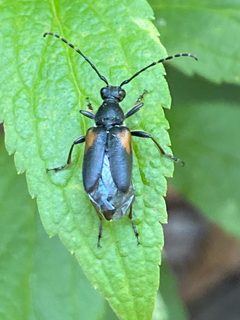
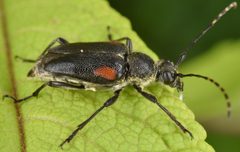
Brachyleptura vagans is a of longhorn beetle (Cerambycidae) first described by Guillaume-Antoine Olivier in 1795. It belongs to the Lepturinae, commonly known as flower longhorns, and is native to North America. The species is distinguished by its black with small red patches behind the humeri and white-annulated .
Pronunciation
How to pronounce Brachyleptura vagans: /bræ.kɨ.lɛpˈtʊr.ə ˈveɪ.ɡænz/
These audio files are automatically generated. While they are not always 100% accurate, they are a good starting point.
Identification
Distinguished from the similar Brachyleptura rubrica by having that are wholly black except for small red patches behind the humeri, whereas B. rubrica has more extensively red coloration on the elytra. Both share the characteristic white-annulated . Distinguished from other Lepturinae by the abbreviated (shortened) elytra typical of the Brachyleptura, though this trait is less pronounced in B. vagans than in some .
Images
Appearance
Elongate with posteriorly tapering and narrow pronotum giving a broad-shouldered appearance. Elytra are predominantly black with small (usually) red patches behind the humeri (shoulders). have white annulations (rings). Conical and that do not surround the base of the antennae. (forward-slanting) . The related Brachyleptura rubrica has more extensively red elytra.
Habitat
Associated with shortleaf pine (Pinus echinata) forests in the Ozark Highlands. Larvae develop in dead hardwood branches, with recorded including beech, birch, elm, hickory, maple, and Carpinus caroliniana (blue beech/musclewood). Wood condition appears more important than , with slightly decayed (punky) wood preferred over freshly dead material.
Distribution
Eastern North America. Documented from the United States including Missouri (Ozark Highlands), Vermont, and Virginia. Also recorded from Canada.
Seasonality
are active during the day () and visit flowers. Most commonly encountered in June based on collection records.
Host Associations
- Ceanothus americanus - food sourcepreferred flower
- Pinus echinata - associationshortleaf pine forests of Ozark Highlands
- Carpinus caroliniana - larval recorded from punky dead branch
Life Cycle
Larvae are wood-borers in dead hardwood branches. emerge from in dead wood and are active during daylight hours.
Behavior
flower visitor. have been observed mating on flowers. Like other Lepturinae, exhibits flower-visiting uncommon among Cerambycidae, which are typically .
Ecological Role
function as when visiting flowers. Larvae contribute to decomposition of dead hardwood branches.
Similar Taxa
- Brachyleptura rubricaSimilar form and white-annulated , but distinguished by more extensive red coloration on versus small red patches behind humeri in B. vagans. B. rubrica shows distinct preference for white, compound, flat-topped flowers such as Hydrangea arborescens, while B. vagans appears more associated with Ceanothus americanus.
- Strangalia famelica solitariaCommon Missouri flower longhorn with different elytral pattern and coloration
- Typocerus octonotatusCommon flower longhorn with different pattern of spots on
More Details
Nomenclature note
Catalogue of Life lists authorship as (Olivier, 1800), while GBIF and Wikipedia cite (Olivier, 1795). The earlier date is likely correct based on original description.
Collection history
Less commonly encountered than B. rubrica in Missouri; most collections from shortleaf pine forests of the Ozark Highlands rather than the more widespread distribution of B. rubrica.
Sources and further reading
- BugGuide
- Wikipedia
- GBIF taxonomy match
- iNaturalist taxon
- Catalogue of Life
- Monday Ménage – Brachyleptura rubrica | Beetles In The Bush
- Nocturnal hunters: Mexican redrump tarantula, Brachypelma vagans — Bug of the Week
- A friendly encounter with a very large tarantula: Red Rump Tarantula, Tliltocatl vagans — Bug of the Week
- Spider megacolony study breaks publicity records at Pensoft
- Zookeys | Blog - Part 2
- Pensoft blog - Part 7