
Brachyleptura rubrica
(Say, 1824)
Red-winged Longhorn Beetle
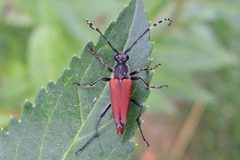
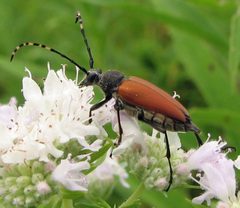
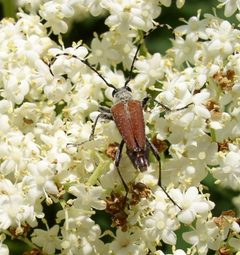
Brachyleptura rubrica is a longhorn beetle (Cerambycidae: Lepturinae) described by Thomas Say in 1824. It is a flower-visiting commonly found on white, compound, flat-topped inflorescences, particularly Hydrangea arborescens. The species is distinguished by its often abbreviated and white-annulated . Larvae develop in decaying hardwoods including beech, birch, elm, hickory, and maple.
Pronunciation
How to pronounce Brachyleptura rubrica: //ˌbrækɪˈlɛptjʊrə ruːˈbrɪkə//
These audio files are automatically generated. While they are not always 100% accurate, they are a good starting point.
Identification
Distinguished from other Lepturinae by the often abbreviated ( characteristic). Distinguished from the similar Brachyleptura vagans by having red elytra rather than black elytra with small red patches behind the humeri. Distinguished from Cerambycinae by conical and not surrounding antennal bases. Distinguished from Lamiinae by rather than flat .
Images
Appearance
Elongate with posteriorly tapering giving a broad-shouldered appearance. Elytra often abbreviated (shortened), though only scarcely so in this . with white annulations. Pronotum relatively narrow. Conical . not surrounding antennal bases. (forward-slanting) .
Habitat
Deciduous forests and woodland edges. centered on flowering plants with white, compound, flat-topped inflorescences. Larval habitat in slightly decayed (punky) dead branches of hardwood trees.
Distribution
Eastern North America. Recorded from United States and Canada (New Brunswick, Nova Scotia, Ontario, Québec). Specific US state records include Missouri, Virginia, and southeastern states.
Seasonality
active in June (based on Missouri observation). activity pattern. Likely active through summer months given flower-visiting .
Diet
feed on pollen and nectar of flowers, particularly Hydrangea arborescens, Ceanothus americanus, Cornus drummondii, Daucus carota, and Parthenium integrifolium. Larvae feed on decaying hardwood tissue.
Host Associations
- Hydrangea arborescens - food sourcePrimary flower ; flat-topped white inflorescences
- Ceanothus americanus - food sourceSecondary flower
- Cornus drummondii - food sourceSecondary flower
- Daucus carota - food sourceSecondary flower
- Parthenium integrifolium - food sourceSecondary flower
- Carpinus caroliniana - larval Documented rearing record from punky dead branch
- Spiraea - food sourceVarious ; per Wikipedia
- Fagus (beech) - larval Documented larval
- Betula (birch) - larval Documented larval
- Ulmus (elm) - larval Documented larval
- Carya (hickory) - larval Documented larval
- Acer (maple) - larval Documented larval
Life Cycle
Complete . Larvae develop in decaying hardwood branches. Single documented rearing record produced one from punky wood of Carpinus caroliniana. Adults emerge to visit flowers for feeding and mating.
Behavior
flower visitor. Mating pairs observed on flowers. feed on pollen and nectar while on flowers. Attracted to white, compound, flat-topped floral structures.
Ecological Role
of flowering plants. Larval decomposer of decaying hardwood wood, contributing to nutrient cycling in forest .
Human Relevance
Subject of entomological study and photography. Documented in faunal studies of Cerambycidae. No documented economic importance or pest status.
Similar Taxa
- Brachyleptura vagansSimilar form and white-annulated , but distinguished by black with small red patches behind humeri rather than predominantly red elytra. More commonly found in shortleaf pine forests of Ozark Highlands.
- Strangalia famelica solitariaCommon Missouri flower longhorn with similar flower-visiting , but more routinely encountered than B. rubrica and less specific in flower preferences.
- Strangalia luteicornisCommon Missouri flower longhorn with similar flower-visiting , more routinely encountered than B. rubrica.
- Strangalia sexnotataCommon Missouri flower longhorn with similar flower-visiting , more routinely encountered than B. rubrica.
- Typocerus octonotatusCommon Missouri flower longhorn with similar flower-visiting , more routinely encountered than B. rubrica.
- Typocerus velutinusCommon Missouri flower longhorn with similar flower-visiting , more routinely encountered than B. rubrica.
- Typocerus deceptusRare flower longhorn found on same Hydrangea arborescens flowers, but distinguished by different and rarity status.
More Details
Historical Documentation
First documented in Missouri faunal study by MacRae (1994). Described by Thomas Say in 1824, originally as Leptura rubrica.
Collection Notes
Not rare but not routinely encountered compared to other common flower longhorns. Excitement of first observation noted by collector in mid-1980s despite being relatively widespread.
Wood Condition Preference
Larval development appears to require slightly decayed (punky) wood rather than freshly dead branches; wood condition may be more important than specific tree for larval success.