
Brachyleptura circumdata
(Olivier, 1795)
Dark-shouldered Long-horned Beetle
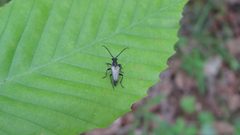
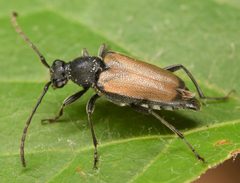
Brachyleptura circumdata is a small flower longhorn beetle in the Lepturinae, measuring 7–10 mm in length. First described by Olivier in 1795, it is smaller than and exhibits abbreviated characteristic of the . The is known to breed in coniferous trees as larvae and is most active during June and July. It belongs to a group of cerambycids that visit flowers as .
Pronunciation
How to pronounce Brachyleptura circumdata: /brɑː.kɪˈlɛp.tʊ.ra kər.kʊmˈdaː.ta/
These audio files are automatically generated. While they are not always 100% accurate, they are a good starting point.
Identification
Distinguished from other Brachyleptura by its smaller size (7–10 mm versus larger ). The abbreviated separate it from Lepturinae with full-length wing covers. Differs from Cerambycinae by conical and not surrounding antennal bases; differs from Lamiinae by (forward-slanting) rather than flat face. Among Missouri congeners, B. rubrica has red coloration and white-annulated ; B. vagans has wholly black elytra with small red humeral patches.
Images
Appearance
Small measuring 7–10 mm in length, notably smaller than other Brachyleptura . Exhibits abbreviated (shortened wing covers), a defining trait of the . As a member of Lepturinae, has posteriorly tapering elytra and a generally narrow pronotum creating a broad-shouldered appearance. Possesses conical and that do not surround the base of the . Antennae are long, as characteristic of Cerambycidae.
Habitat
Larval consists of coniferous forests, specifically breeding in spruce and possibly pine. habitat includes flowering vegetation; as a flower longhorn, visits flowers during activity periods. Specific adult flower records are not documented.
Distribution
North America, with confirmed records from Canada (New Brunswick) and the United States. The has a broad distribution across the continent, though specific state-level records beyond general North American presence are not well documented in available sources.
Seasonality
activity period is June–July. This represents the primary window for adult observation and collection.
Diet
Larvae feed upon spruce (Picea spp.) and possibly pine (Pinus spp.). feeding habits are not documented, though related flower longhorns visit flowers for nectar and pollen.
Host Associations
- Picea - larval food plantprimary
- Pinus - possible larval food plantinferred from 'possibly pine' in source; not confirmed
Life Cycle
Complete with documented larval stage feeding in coniferous wood. Larvae develop in spruce and possibly pine. occurs in June–July. Specific details regarding placement, , or larval instars are not documented.
Behavior
activity pattern. visit flowers, a characteristic of Lepturinae. Specific behavioral observations beyond seasonal activity and flower visitation are not documented.
Ecological Role
Larvae function as wood-borers in coniferous trees, contributing to decomposition of dead or dying wood. may contribute to pollination through flower visitation, though this role is not quantified.
Similar Taxa
- Brachyleptura rubricaLarger size, red coloration, white-annulated ; prefers white compound flat-topped flowers such as Hydrangea arborescens
- Brachyleptura vagansSimilar form and white-annulated , but wholly black with small red humeral patches; associated with shortleaf pine forests in Ozark Highlands
- Strangalia famelica solitariaMore commonly encountered flower longhorn in Missouri with different color pattern
- Typocerus octonotatusCommon flower longhorn with distinct spotted pattern
More Details
Taxonomic authorship discrepancy
Sources conflict on authorship date: Wikipedia cites Olivier 1795, while Catalogue of Life lists (Olivier, 1800). The 1795 date is more commonly cited in modern references.
Rarity of observation
Despite being the most widely distributed of its in North America, the species is infrequently encountered and poorly photographed. No online images were documented in some regional surveys as of 2019.